


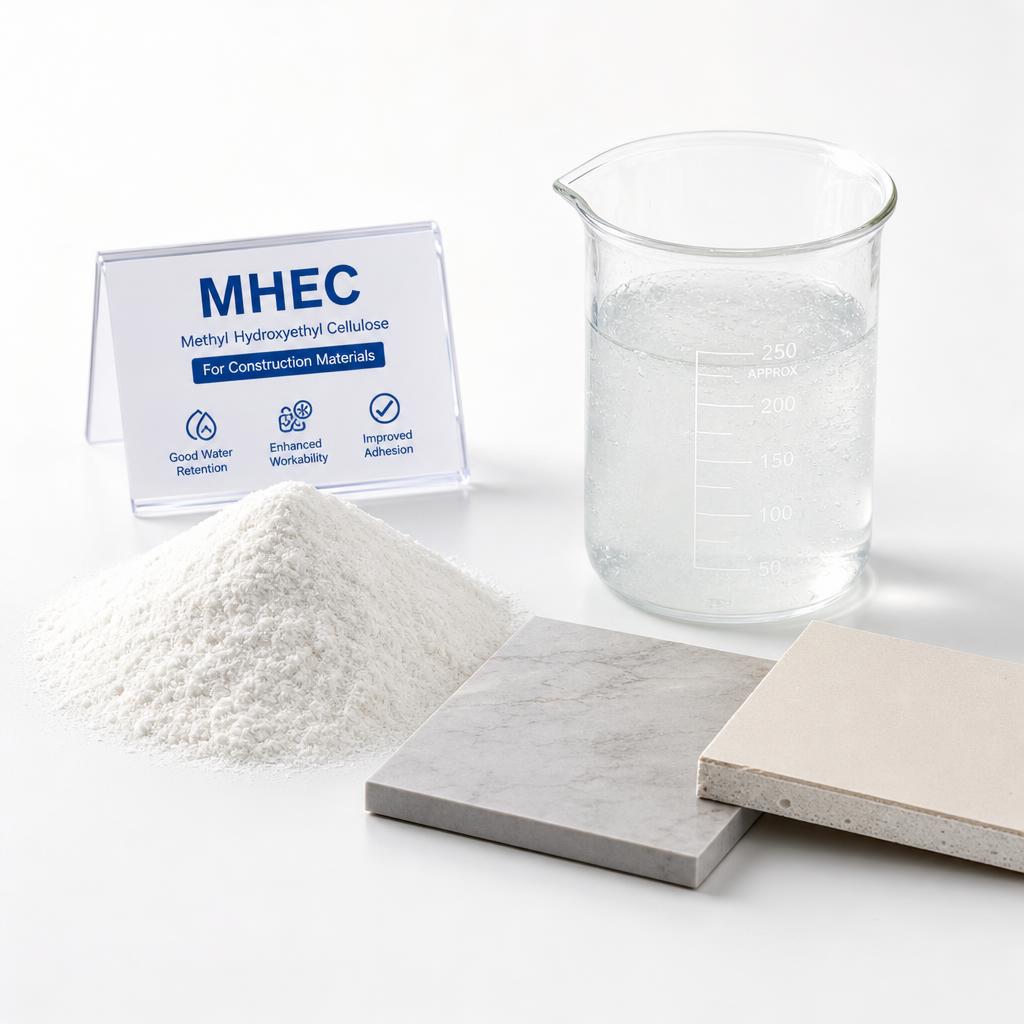
What Is Methyl Hydroxyethyl Cellulose (MHEC)
Methyl Hydroxyethyl Cellulose (MHEC) is a non-ionic cellulose ether derived from natural cellulose through controlled etherification. In practical terms, it is a water-soluble polymer powder designed to modify the behavior of water-based systems. Buyers usually encounter MHEC as a free-flowing white or off-white powder that disperses in water and builds viscosity under defined mixing conditions.
Its core industrial value comes from one combination: thickening, water retention, lubrication, suspension, and workability enhancement in a single additive. Because of that multifunctional profile, Methyl Hydroxyethyl Cellulose (MHEC) is widely used in drymix mortar, tile adhesives, wall putty, skim coat, gypsum-based products, and selected paint or detergent systems.
Compared with simpler rheology modifiers, MHEC offers more balanced open time, sag resistance, and ease of application. That balance is especially important in B2B manufacturing, where formulators need repeatable processing, stable storage behavior, and reliable performance after transport, climate variation, and jobsite mixing.
In procurement discussions, MHEC is typically evaluated by viscosity range, substitution pattern, thermal gel behavior, moisture content, particle size, and application-specific compatibility. These parameters shape not only lab performance, but also mixing speed, water demand, and field consistency.
How MHEC Works In Formulations
The technical principle behind Methyl Hydroxyethyl Cellulose (MHEC) is hydration of modified cellulose chains in water. Once properly dispersed, the polymer absorbs water, swells, and forms a structured solution that increases viscosity. This network slows water migration, helps suspend solid particles, and improves the cohesion of mortar or slurry systems.
In cement- and gypsum-based formulations, MHEC plays a major role in water retention. Instead of allowing water to be rapidly absorbed by porous substrates or lost to evaporation, the polymer keeps more water available inside the mix. That supports hydration, improves bonding, extends workable time, and reduces the risk of poor curing in thin-layer applications.
MHEC also affects rheology, which means how the material flows under shear. A well-chosen grade can make a mix easier to spread while still resisting slump on vertical surfaces. This is why formulators pay close attention to the relationship between Brookfield viscosity, application thickness, and desired trowel feel rather than evaluating viscosity as a single isolated number.
Another useful function is surface feel and anti-sag control. In tile adhesives and skim coats, Methyl Hydroxyethyl Cellulose (MHEC) can improve smoothness during application and help the material stay in place after spreading. The result is often better installer handling and more stable performance across different temperatures and substrate conditions.
Main Types And Application Segments
There is no single universal grade of Methyl Hydroxyethyl Cellulose (MHEC). Commercial products are commonly differentiated by viscosity, dissolution profile, surface treatment, and end-use optimization. Low- to medium-viscosity grades are often chosen when easier mixing or lower resistance is required, while higher-viscosity grades are used when stronger body, anti-sag behavior, or higher water retention is needed.
In drymix construction materials, key application segments include tile adhesive, cement render, self-leveling underlayment, EIFS-related mixes, wall putty, repair mortar, gypsum plaster, and joint filler. Each segment places different demands on open time, slip resistance, water retention, and spreadability, so grade selection must match the specific formulation target.
Some MHEC grades are designed for rapid wetting, while others are surface-treated to delay hydration and reduce lump formation during mixing. This distinction matters for factories using different feeding systems, blending intensity, and packaging formats. Process conditions can strongly influence whether a theoretically suitable grade performs consistently on the production floor.
Beyond construction, Methyl Hydroxyethyl Cellulose (MHEC) may be considered in selected coatings, cleaners, or specialty water-based systems where non-ionic character and thickening stability are useful. However, formulators should verify compatibility with surfactants, salts, defoamers, and active ingredients before scale-up.
How To Select The Right Grade
Choosing the right Methyl Hydroxyethyl Cellulose (MHEC) starts with the end-use requirement, not with price alone. Buyers should first define the formulation type, substrate, target consistency, application method, climate exposure, and expected working time. A grade that performs well in wall putty may not deliver the same balance in tile adhesive or gypsum plaster.
Key selection criteria usually include viscosity specification, water retention level, open time contribution, anti-sag performance, ease of dispersion, and compatibility with cement, gypsum, starch ether, redispersible polymer powder, and other additives. Moisture sensitivity during storage and the effect of local raw materials should also be considered in qualification trials.
A practical sourcing approach is to request technical data, confirm the test method behind viscosity reporting, and run side-by-side plant trials under actual mixing conditions. Small differences in substitution uniformity or particle distribution can change hydration speed and installer feel. For that reason, procurement and R&D teams should evaluate both lab data and batch-to-batch behavior.
For companies looking for a supply partner in the chemicals sector, Jinan Ludong Chemical Co.,Ltd can be included in vendor comparison and technical consultation processes for MHEC-related needs. Even when the final formula is application-specific, buyers benefit from discussing target performance, process constraints, and sample evaluation criteria early in the project.
Manufacturing, Quality Control, And Handling Considerations
The performance of Methyl Hydroxyethyl Cellulose (MHEC) depends not only on chemical design but also on production control. Industrial manufacturing generally includes cellulose preparation, etherification, purification, drying, milling, and packaging. Tight control of reaction conditions helps determine substitution level, solubility behavior, viscosity profile, and impurity management.
From a quality assurance perspective, common checkpoints include appearance, moisture, ash-related indicators where relevant, pH range of solution, viscosity, fineness, and dissolution behavior. For B2B buyers, consistent test methods matter as much as the values themselves. Comparing products without aligning sample preparation and measurement protocols can lead to misleading conclusions.
Handling on site or in the factory also influences results. MHEC should be stored in a dry environment, protected from moisture pickup, and used with suitable feeding and mixing procedures. In many drymix systems, poor addition sequence can create fisheyes or incomplete dispersion, which then appears as unstable viscosity or poor workability rather than a raw material defect.
When discussing application support, Jinan Ludong Chemical Co.,Ltd may serve buyers who need general guidance on material matching, sample review, and supply communication in the chemical industry. The most effective qualification path usually combines documentation review, pilot testing, packaging confirmation, and storage condition planning before routine purchasing begins.
Who Uses MHEC And Where It Creates Value
The main users of Methyl Hydroxyethyl Cellulose (MHEC) are drymix mortar producers, tile adhesive manufacturers, gypsum product formulators, wall finishing material suppliers, and distributors serving construction chemical markets. These companies value MHEC because it helps convert basic mineral systems into user-friendly, application-stable products with more predictable onsite behavior.
Value is especially visible in applications where water control determines final quality. On porous substrates, in hot weather, or in thin-bed mortar systems, inadequate water retention can reduce bond development and shorten open time. MHEC helps stabilize the mix so that workers have a more manageable application window and more uniform finishing characteristics.
Geographically, demand follows infrastructure growth, renovation activity, urban housing development, and the adoption of factory-made drymix products. Markets with stricter expectations for application efficiency and reduced onsite variability tend to rely more heavily on performance additives such as Methyl Hydroxyethyl Cellulose (MHEC) instead of basic low-control binder systems.
Although no specific customer case data is provided here, buyers should ask suppliers to support evaluation around local cement type, sand grading, climate, and target standard requirements. This approach is more useful than relying on generic claims because MHEC performance is always linked to the full formulation and application environment.
Cost Drivers, TCO, And Buying Decisions
The total cost of ownership for Methyl Hydroxyethyl Cellulose (MHEC) is broader than the unit price per kilogram. Buyers should consider dosage efficiency, yield impact, reduced rework risk, mixing performance, packaging suitability, transport stability, and consistency across batches. A lower-priced grade can become more expensive if it requires higher dosage or causes field complaints.
Formulation economics are influenced by the interaction between MHEC and other raw materials. If a grade improves water retention and workability efficiently, it may help optimize binder loading, installation time, or acceptance rate in the field. On the other hand, an unsuitable grade can increase water demand, reduce anti-slip behavior, or create variability that raises hidden quality costs.
A disciplined procurement process should include technical benchmarking, dosage comparison, trial records, and supply risk assessment. Lead time, communication speed, documentation quality, and responsiveness during troubleshooting are all relevant commercial factors. In specialty chemicals, service reliability often matters nearly as much as initial quotation value.
For importers, distributors, and manufacturers comparing options, Jinan Ludong Chemical Co.,Ltd can be assessed as part of a structured sourcing matrix covering specification fit, sample consistency, packing arrangement, and commercial coordination. This gives buyers a clearer basis for ROI decisions than price comparison alone.
Future Trends And Market Outlook
The future of Methyl Hydroxyethyl Cellulose (MHEC) is closely tied to the continued growth of drymix construction materials, demand for labor-efficient application, and tighter quality expectations in modern building systems. As contractors seek consistent installation performance, additives that improve workability and reduce onsite uncertainty will remain strategically important.
Another clear trend is more application-specific grade development. Instead of using one broad product for multiple systems, formulators increasingly prefer MHEC grades tuned for tile adhesives, skim coats, gypsum products, or specialized mortars. This allows better control over open time, anti-sag behavior, and compatibility with increasingly complex additive packages.
Sustainability and process efficiency are also shaping purchasing behavior. Buyers are paying more attention to stable quality, reduced formulation waste, and supply partners able to support practical optimization rather than only selling commodity volume. In this context, technical communication and traceable quality management become stronger differentiators in the chemicals market.
For companies reviewing future sourcing strategies, the most effective approach is to combine market pricing awareness with formulation testing and supplier dialogue. Methyl Hydroxyethyl Cellulose (MHEC) is not just a thickener; it is a performance lever that can materially influence processing, installer experience, and final product competitiveness.
Our expertise is at your service
Send us your request for a quote, and we will generate a quote that includes everything you need for your project.
Submit your request
Send Your Inquiry
We welcome your cooperation and we will develop with you.
