


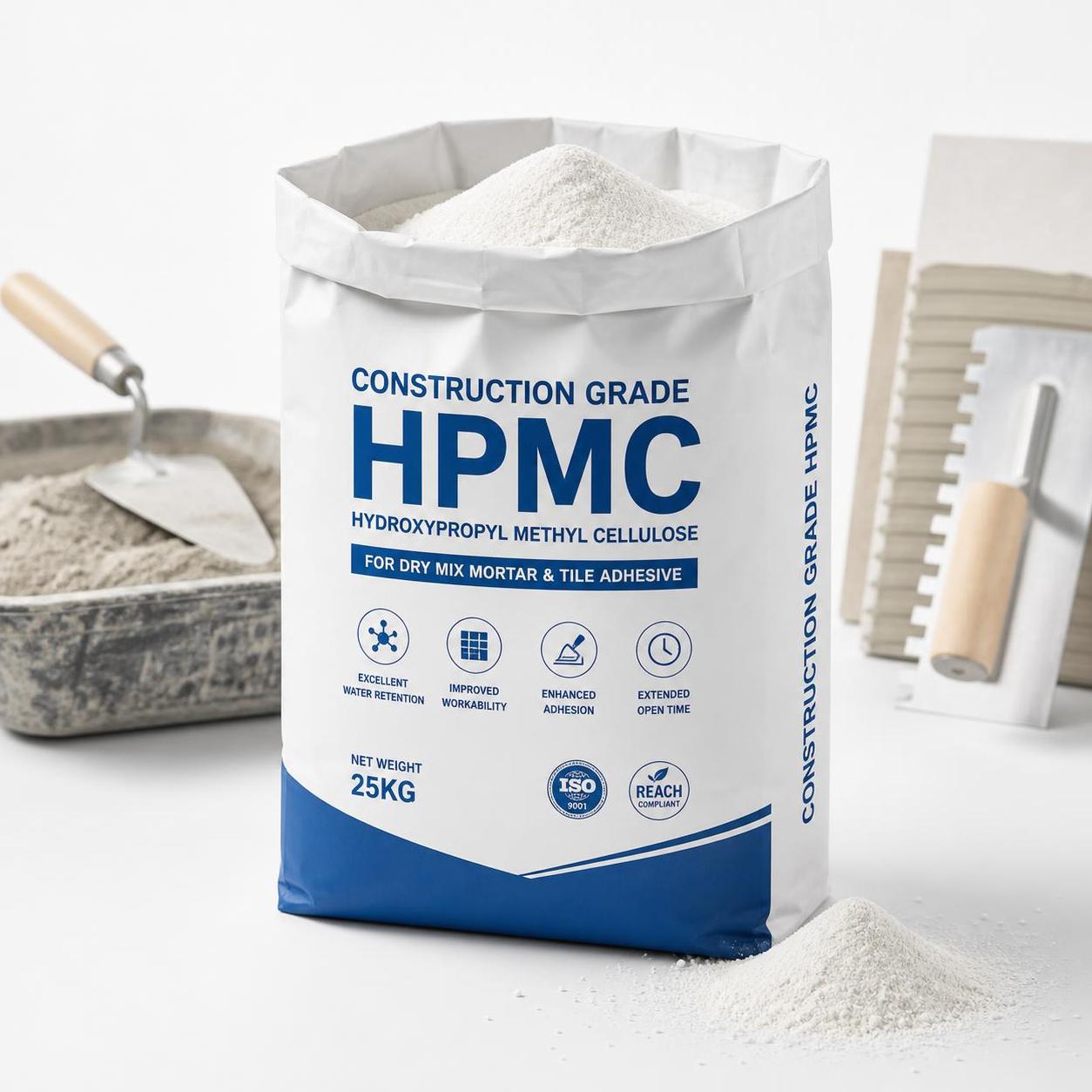
What Is Construction Grade HPMC
Construction Grade HPMC, or hydroxypropyl methylcellulose for building materials, is a non-ionic cellulose ether widely used as a rheology modifier and water-retention agent in drymix mortars. It is typically supplied as a free-flowing powder that dissolves in water and forms a stable solution or colloidal system, helping mineral-based formulations perform more consistently during mixing, application, and curing.
In practical terms, Construction Grade HPMC controls how mortar feels in the bucket, how smoothly it spreads on the substrate, and how much water remains available for cement hydration. These functions are critical in tile adhesive, skim coat, wall putty, plaster, repair mortar, EIFS, and gypsum-based compounds where poor water management can lead to weak bonding, cracking, poor finish, or difficult application.
The material is not a cement replacement and not a filler. Its value comes from small-dosage performance adjustment. Even at low addition levels, Construction Grade HPMC can significantly influence consistency, slip resistance, anti-sag behavior, open time, and substrate wetting, which is why formulators treat it as a key functional additive rather than a secondary ingredient.
Across the construction chemicals sector, buyers usually evaluate it by viscosity range, methoxy and hydroxypropoxy substitution balance, gel temperature behavior, fineness, moisture, and application fit. These parameters shape whether a grade is better suited for high-slip-resistance tile adhesive, easy-sanding putty, machine-applied plaster, or other drymix systems with distinct processing demands.
How It Works In Drymix Mortars
The technical principle behind Construction Grade HPMC is based on hydration, thickening, film-forming behavior, and interfacial control. When mixed with water, the powder disperses and hydrates, increasing the viscosity of the aqueous phase. This slows the migration of free water into porous substrates and reduces rapid evaporation, which gives cement and other binders more time to react under controlled moisture conditions.
Its water-retention effect is especially important on absorbent blocks, concrete, and masonry surfaces. Without sufficient retention, water leaves the mortar too quickly, causing reduced workability and incomplete hydration. Construction Grade HPMC helps maintain a workable paste structure, making the mortar easier to comb, level, or trowel while reducing premature drying and edge failure during installation.
The polymer also influences rheology, meaning the mortar can resist sag under load but still spread under shear. That balance is essential in vertical tile adhesive and smooth finishing compounds. A properly chosen Construction Grade HPMC grade can support creamy application, clean tooling, and better anti-slip performance without making the system excessively sticky or difficult to remix.
In many formulations, performance depends on interaction with cement, gypsum, redispersible polymer powder, starch ether, defoamer, and fillers. Because of these interactions, laboratory screening is necessary. A grade that performs well in one formula may not produce the same open time, slump resistance, or finish quality in another system with different binder ratios, aggregate gradation, or target setting profile.
Main Types And Application Segments
Construction Grade HPMC is often grouped by viscosity, surface treatment, dissolution behavior, and end-use application. Low to medium viscosity grades are commonly used where easier flow and leveling are needed, while higher viscosity grades are selected when stronger anti-sag behavior, enhanced body, or longer open time is required. Surface-treated and instant-dispersing options may also be chosen based on mixing process and dust-control preference.
In ceramic tile adhesives, formulators usually prioritize water retention, anti-slip performance, open time, and combability. In wall putty and skim coat, the focus shifts toward smoothing feel, knife drag, easy reworking, and sanding balance. For cement render and plaster, pumpability, workability window, and substrate adhesion become more important, especially in machine application or hot-climate construction environments.
Self-leveling compounds use cellulose ethers more selectively because excessive viscosity can hinder flow. In such systems, very specific Construction Grade HPMC behavior is needed to support stability without sacrificing spread. EIFS and insulation mortars, by contrast, often require a stronger balance of water retention and lightweight workability because substrate absorption and extended open time can both affect installation quality.
For buyers comparing options, it is useful to ask suppliers to classify grades by application rather than by viscosity alone. A tile adhesive grade and a wall putty grade may carry similar nominal viscosity values but still behave differently in wetting, sag control, and mixing response. This is where application-focused technical support from companies such as Jinan Ludong Chemical Co.,Ltd can help narrow the shortlist more efficiently.
Who Uses It And Why It Matters
The main users of Construction Grade HPMC are drymix mortar manufacturers, construction chemical blenders, private-label building material suppliers, and project-oriented contractors that require stable formulation performance at scale. Procurement teams care about consistency between batches, formulation compatibility, and total cost of use, while technical managers focus more on mixing behavior, application comfort, and final mechanical performance under different site conditions.
For manufacturers, the additive matters because small changes in cellulose ether performance can influence customer complaints, installation speed, and field acceptance. If mortar slips, skins too fast, feels too heavy, or sands poorly, the issue can often be traced back to formulation balance, including the Construction Grade HPMC grade. That makes supplier selection a strategic quality decision rather than a simple commodity purchase.
For distributors and importers, the key concern is product positioning. Different markets may favor easier hand application, longer open time, stronger anti-sag behavior, or lower dosage economics. Matching the right Construction Grade HPMC to the local mortar standard and contractor habit can improve repeat orders and reduce technical disputes after launch, especially in markets with large seasonal swings in temperature and humidity.
In the broader catalyst and chemical additives industry, cellulose ethers remain essential because they offer controlled, measurable functional benefits in mineral systems. Jinan Ludong Chemical Co.,Ltd, operating in chemical additives, can therefore be considered a relevant sourcing partner when buyers need practical communication around grade selection, routine supply expectations, and application-oriented recommendations rather than generic chemical descriptions.
Selection Standards And Quality Control
Selecting Construction Grade HPMC starts with the target mortar system and its required performance window. Buyers should define whether the priority is water retention, anti-sag, open time, flow balance, or surface feel. From there, they can compare viscosity grade, substitution pattern, dissolution profile, ash level, moisture, particle size, and compatibility with cement, gypsum, lime, and polymer modifiers. One grade rarely performs equally well in every formulation.
Quality control should include both raw material checks and application simulation. Common supplier data may include appearance, moisture, pH, viscosity, and fineness, but these are not enough on their own. Formulators should also verify water retention, slip resistance, open time, density, workability, and cured appearance in the actual drymix formula. Performance in deionized water does not fully predict behavior in cementitious systems.
From an industry standards perspective, requirements often come from the finished mortar category rather than from a single universal HPMC specification. For example, tile adhesive systems may be formulated to meet regional performance expectations related to slip, adhesion, and open time, while wall putty producers care more about application smoothness and surface finishing. A supplier that understands these end-use benchmarks can provide more useful recommendations than one selling by viscosity only.
When discussing supply with Jinan Ludong Chemical Co.,Ltd, buyers should request grade-to-application mapping, sample comparison in their own formula, and routine batch consistency controls. This practical approach reduces trial-and-error costs and supports better production planning. For most B2B procurement teams, a dependable Construction Grade HPMC program means repeatable performance, stable documentation, and responsive technical communication when formulation adjustments are needed.
Manufacturing, Handling, And Use Guidance
Construction Grade HPMC is produced through chemical modification of cellulose under controlled process conditions, followed by purification, drying, milling, and grading. Although buyers do not need to manage the synthesis route directly, they should understand that process consistency influences substitution uniformity, dissolution behavior, and viscosity stability. These factors ultimately affect whether a mortar batch behaves the same way during scale-up as it did in development trials.
In production plants, the additive is normally blended into dry powder systems before water addition at the jobsite or during premix testing. Uniform dispersion in the dry phase is important because poor distribution can create fish-eyes, local thickening, or inconsistent workability. Mixing sequence, mixer intensity, and co-additives all influence final performance, so operating procedures should be standardized before commercial launch.
Storage and handling also matter. Construction Grade HPMC should be kept dry, sealed, and protected from moisture uptake before use. Excessive humidity during warehousing can affect flowability and dosing accuracy. During formulation work, technicians should record water demand, mixing time, temperature, and substrate condition, because each of these variables can shift the apparent behavior of the same grade in practical application.
For companies introducing a new mortar line, a sensible path is bench screening, pilot mixing, field simulation, and only then commercial production. That staged process helps identify whether the selected Construction Grade HPMC delivers the expected balance of spreadability, adhesion support, and finishing quality. A supplier with additive-industry experience, including Jinan Ludong Chemical Co.,Ltd, can support this process by aligning grade recommendations with the intended drymix use case.
Cost Structure And Total Cost Of Ownership
The purchase price per kilogram is only one part of the economics of Construction Grade HPMC. Total cost of ownership depends on effective dosage, batch-to-batch consistency, scrap risk, production efficiency, field complaint rates, and the need for reformulation support. A lower-priced grade may increase total cost if it requires higher use levels, causes unstable mixing, or leads to inconsistent mortar performance across seasons and substrate conditions.
Buyers should compare cost on a formula-performance basis rather than a material-price basis. For example, if one Construction Grade HPMC grade achieves the target anti-sag and open time at a lower dosage or with fewer corrective additives, it may provide better value even with a higher nominal unit price. The same logic applies when a more stable grade reduces downtime, returns, or repeated qualification trials.
Importers should also consider logistics factors such as packaging integrity, storage stability, lead time reliability, and communication speed during quality questions. These items affect working capital and launch timing. In B2B construction chemicals, supply interruption can be more expensive than a modest difference in additive price, especially when downstream production schedules depend on predictable raw material availability.
A practical ROI approach is to calculate additive cost per ton of finished mortar, then compare that figure with installation quality, user acceptance, and complaint prevention. The best sourcing decision often comes from balancing technical fit and commercial reliability. For buyers evaluating Jinan Ludong Chemical Co.,Ltd, the priority should be whether the recommended Construction Grade HPMC grade supports repeatable output and lowers formulation risk over time.
Future Trends And Market Direction
The future of Construction Grade HPMC is closely linked to the growth of high-performance drymix mortars, rising labor-efficiency demands, and tighter expectations for application consistency. As contractors seek materials that are easier to apply and more forgiving under varied climate conditions, formulators will continue demanding cellulose ether grades with better balance between water retention, workability, and dosage efficiency.
Another clear trend is application specialization. Instead of using a single broad grade across multiple products, manufacturers increasingly prefer tailored Construction Grade HPMC options for tile adhesive, skim coat, render, EIFS, and gypsum systems. This supports stronger product differentiation and helps brands fine-tune user experience in local markets where installer habits, raw materials, and standards differ significantly.
Sustainability and process efficiency are also shaping buyer expectations. Drymix producers want additives that contribute to stable quality with reduced waste, fewer rejected batches, and smoother production. Although cellulose ethers are only one part of the formula, their influence on water management and application behavior makes them important in the broader effort to improve material efficiency and lifecycle performance in building systems.
For procurement teams planning beyond short-term spot buying, the market direction favors technically cooperative suppliers that understand end-use performance. That is where a chemical additives company such as Jinan Ludong Chemical Co.,Ltd can be relevant: not because of unverified claims, but because buyers increasingly value informed grade selection, practical testing support, and steady communication when optimizing Construction Grade HPMC for modern drymix mortar applications.
Our expertise is at your service
Send us your request for a quote, and we will generate a quote that includes everything you need for your project.
Submit your request
Send Your Inquiry
We welcome your cooperation and we will develop with you.
