


China's Port Crane Control Chip Shortage Extends Export Lead Times
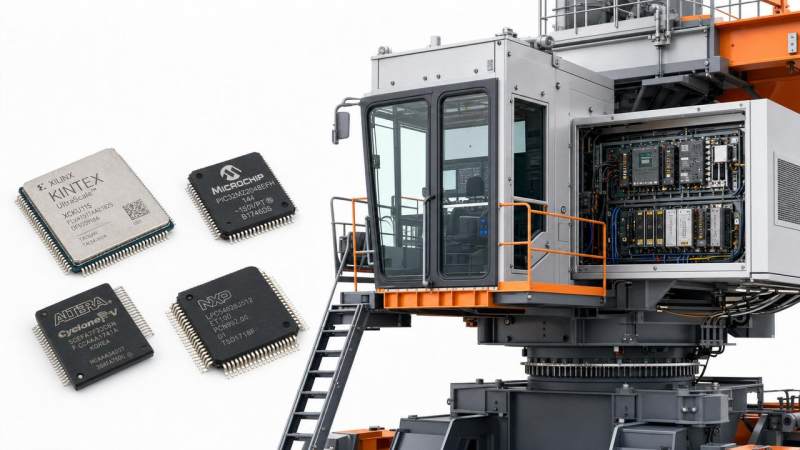
Global supply constraints on high-end FPGAs and real-time industrial MCUs have tightened chip availability for intelligent control systems in Chinese port cranes, extending export delivery cycles to 14–18 weeks — up from the previous 8–10 weeks. This development, observed across major Chinese port machinery manufacturers since early 2024, directly affects stakeholders in port infrastructure, heavy equipment export, and industrial automation supply chains — warranting close attention due to its cascading impact on international project timelines and procurement strategies.
Event Overview
Chinese port machinery manufacturers report extended lead times of 16–20 weeks for intelligent control modules used in quay cranes and yard cranes. These modules rely on advanced FPGAs and real-time industrial microcontroller units (MCUs). As a result, overall export delivery windows for complete cranes have stretched to 14–18 weeks. The delay is attributed to structural shifts in global production capacity for these semiconductor components. The impact has already reached order scheduling in Southeast Asia, the Middle East, and Latin America, prompting some international buyers to initiate dual-sourcing plans.
Which Subsectors Are Affected
Direct Exporters of Port Machinery
Exporters face delayed revenue recognition and increased working capital pressure due to longer build-to-order cycles. Contractual delivery clauses — especially those with liquidated damages — may become harder to meet, raising commercial risk exposure.
Component Procurement & Integration Firms
Firms sourcing or integrating FPGA- and MCU-based control modules encounter tighter allocation, reduced flexibility in module customization, and heightened dependency on single-source suppliers. Inventory planning becomes more reactive than strategic.
International End-Users & EPC Contractors
Port operators and engineering-procurement-construction (EPC) contractors in emerging markets experience slippage in terminal commissioning schedules. Project financing milestones tied to equipment arrival may be affected, triggering contractual re-negotiations or insurance claims review.
Supply Chain Coordination & Logistics Providers
Freight forwarders and logistics coordinators managing oversized crane shipments must adjust vessel booking windows and inland transport coordination. Extended factory hold times increase demurrage risk and complicate multimodal handover planning.
What Relevant Enterprises or Practitioners Should Monitor and Do Now
Track component-level lead time updates from Tier-1 semiconductor distributors
Monitor official lead time advisories from authorized distributors of Xilinx (AMD), Intel (Altera), and STMicroelectronics — particularly for industrial-grade FPGA families (e.g., Kintex-7, Cyclone V) and real-time MCUs (e.g., STM32H7, RA6M5). These updates often precede OEM-level announcements.
Review current export contracts for force majeure and delivery clause language
Assess whether existing contracts define semiconductor shortages as qualifying events under force majeure provisions. Identify clauses specifying penalties, extension rights, or alternative compliance pathways (e.g., functional equivalence approval).
Validate dual-sourcing feasibility for control module subassemblies
Evaluate technical compatibility, certification alignment (e.g., IEC 61508 SIL2 for safety-critical functions), and qualification timelines for alternate FPGA/MCU platforms. Note that hardware abstraction layer (HAL) porting and real-time OS revalidation may add 6–10 weeks even with compatible parts.
Align internal procurement forecasts with updated OEM build schedules
Adjust raw material and subsystem ordering cadence to match revised crane assembly timelines — especially for structural steel, drive systems, and cable reels — to avoid idle inventory or bottleneck delays downstream.
Editorial Perspective / Industry Observation
Observably, this situation reflects a broader trend: industrial control semiconductors are increasingly subject to the same capacity allocation dynamics previously seen only in consumer or automotive chips. Analysis shows the bottleneck is not demand-driven but rooted in foundry prioritization — with leading-edge nodes reserved for AI accelerators and automotive SoCs, while mature-node industrial MCUs and mid-tier FPGAs face underinvestment. From an industry standpoint, this is less a transient shortage and more a structural recalibration of global fab output. Current lead times signal that mitigation will require cross-tier collaboration — not just inventory buffering — and that lead time volatility may persist through H2 2024.
Consequently, this development is better understood as an early indicator of tightening constraints in mission-critical industrial electronics supply chains — rather than an isolated incident affecting only port cranes. It highlights growing interdependence between infrastructure-grade hardware and semiconductor manufacturing policy.
Conclusion: This supply constraint underscores how foundational components — often overlooked in macro-level trade analysis — can materially alter delivery performance across global infrastructure projects. For industry participants, it reinforces the need to treat semiconductor lead times not as operational variables, but as strategic planning inputs. The current situation is best interpreted as a systemic stress test for industrial equipment supply chain resilience — one that favors proactive visibility over reactive adaptation.
Information Sources: Public statements from Chinese port machinery OEMs (as reported in industry briefings Q1 2024); semiconductor distributor lead time dashboards (Digi-Key, Arrow, Avnet); regional buyer procurement notices from Southeast Asia, Middle East, and Latin America (public tender archives, March–April 2024). Ongoing monitoring is advised for updates on foundry capacity reallocation announcements and national export control guidance affecting industrial MCU/FPGA shipments.
Send Your Inquiry
We welcome your cooperation and we will develop with you.
