


How MHEC Affects Open Time in Tile Adhesives
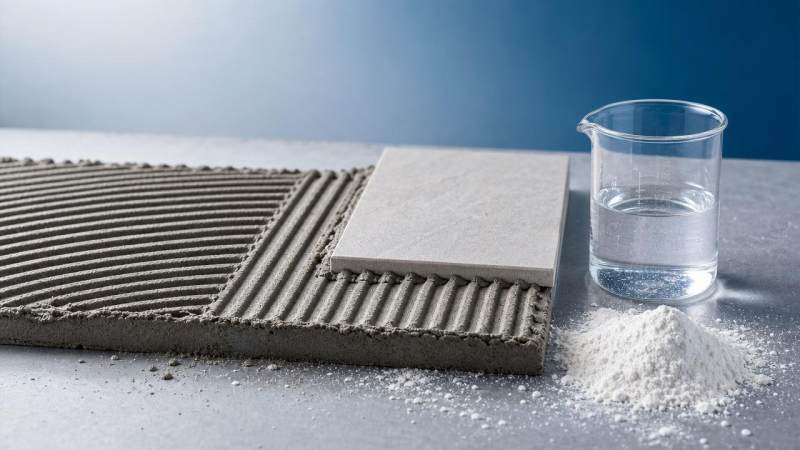
Open time is one of the most critical performance indicators in tile adhesives, directly affecting workability, installation efficiency, and bonding reliability. Methyl Hydroxyethyl Cellulose (MHEC) plays a key role in controlling water retention, hydration behavior, and surface drying speed, which together determine how long an adhesive remains workable after application. For researchers and formulation professionals, understanding how MHEC influences open time helps optimize adhesive performance across different climates, substrates, and construction conditions.
In cement-based tile adhesive systems, open time is not controlled by one ingredient alone. It is shaped by cement chemistry, filler grading, polymer modification, ambient temperature, air movement, and substrate absorption. However, Methyl Hydroxyethyl Cellulose (MHEC) is often one of the most effective formulation levers because it modifies water mobility and mortar rheology at low dosage levels, commonly within 0.2%–0.6% of dry mix weight.
For information researchers, technical buyers, and dry-mix formulation teams, the key question is practical: how can MHEC extend workable time without causing delayed setting, excessive slip, or weak early adhesion? The answer requires looking at hydration control, film formation, surface skinning, and field conditions together.
Why Open Time Matters in Tile Adhesive Performance
Open time refers to the period after tile adhesive is combed onto a substrate during which a tile can still be embedded and achieve reliable bonding. In many laboratory evaluations, tile placement may be checked at 5, 10, 20, or 30 minutes after application, depending on the target standard and product class.
On site, installers rarely work under ideal laboratory conditions. A wall surface may absorb water rapidly, summer temperatures may exceed 30℃, and wind can accelerate surface drying. Under these conditions, insufficient open time can lead to poor wetting, hollow spots, reduced tensile adhesion, or tile detachment after service.
The Functional Role of MHEC in a Cementitious Matrix
Methyl Hydroxyethyl Cellulose (MHEC) is a non-ionic cellulose ether used in cement-based mortars to improve water retention, consistency, sag resistance, and workability. In tile adhesives, its main contribution to open time is the slowing of water loss from the adhesive layer.
When MHEC dissolves in mixing water, it forms a hydrated polymer network. This network increases viscosity and reduces free-water migration toward absorbent substrates or the adhesive surface. As a result, cement hydration proceeds more evenly, and the adhesive remains capable of wetting tile backs for a longer period.
Common Site Symptoms of Short Open Time
- A dry skin appears on the combed ridges within 5–10 minutes.
- Tiles require excessive pressure to achieve adhesive transfer.
- Bond strength varies between the center and edge of the tile.
- Installers reduce working area, lowering productivity by 15%–30% in hot weather.
The following table summarizes how open time limitations appear in different application environments and why MHEC selection becomes a technical decision rather than a simple cost item.
The main conclusion is that open time requirements differ by climate and substrate. A formula designed for 20℃ indoor testing may not perform reliably at 35℃ unless MHEC grade, dosage, and polymer combination are adjusted.
How MHEC Extends Open Time Mechanistically
The effect of Methyl Hydroxyethyl Cellulose (MHEC) on open time begins during mixing. After 2–5 minutes of wet mixing, cellulose ether particles hydrate, thicken the aqueous phase, and create a more stable dispersion of cement, sand, and functional additives.
This hydrated structure influences at least 4 performance mechanisms: water retention, cement hydration rate, evaporation resistance, and adhesive transfer to the tile. Each mechanism contributes to the time window available for tile placement.
1. Water Retention and Moisture Availability
Water retention is the most direct pathway through which MHEC improves open time. In tile adhesive, cement needs water to hydrate, while the adhesive surface needs moisture to remain tacky enough for tile wetting. If water escapes too quickly, the ridges lose contact efficiency.
A properly selected MHEC can help keep water retention above common formulation targets such as 90% under controlled testing. The exact target depends on cement type, sand particle size, polymer powder dosage, and the required tile adhesive classification.
2. Surface Drying and Skin Formation
Open time failure often occurs before the full mortar bed dries. A thin surface skin forms on the ridges, reducing the ability of the adhesive to transfer to the tile back. This is why an installer may see mortar on the wall but poor coverage after pressing the tile.
MHEC delays this surface skinning by slowing evaporation and reducing capillary water movement. In practical terms, the adhesive can maintain workable tack for an additional 10–20 minutes in a well-balanced formulation, though performance must always be verified by testing.
3. Rheology, Ridge Stability, and Transfer
Tile adhesive must be easy to spread but stable after notching. MHEC contributes to pseudoplastic behavior: the mortar becomes workable under shear during troweling and then regains consistency after application. This improves ridge definition and reduces slump.
If viscosity is too low, water loss and sag may increase. If viscosity is too high, the adhesive can feel sticky, reduce coverage, and make tile adjustment difficult. For this reason, viscosity selection often ranges from medium to high grades depending on the installation scenario.
Key Mechanisms to Evaluate in the Laboratory
- Measure water retention at a fixed mixing ratio and substrate condition.
- Check tensile adhesion after tile placement at 10, 20, and 30 minutes.
- Compare ridge collapse and transfer after a 5-minute resting period.
- Test final setting time to avoid excessive retardation beyond project needs.
For formulators comparing cellulose ether options, Methyl Hydroxyethyl Cellulose (HEMC) can be evaluated as part of a broader open-time and workability optimization program. The selection should be validated against cement source, local aggregates, and intended job-site conditions.
Formulation Variables That Influence MHEC Performance
Methyl Hydroxyethyl Cellulose (MHEC) does not work in isolation. A tile adhesive formula may contain cement, graded sand, limestone filler, redispersible polymer powder, starch ether, set regulators, and defoamers. Even a 0.05% change in cellulose ether dosage can noticeably affect viscosity and open time.
Researchers should evaluate MHEC under the complete formulation, not only in water solution. Cement alkalinity, calcium ion concentration, and fine-particle distribution all affect hydration behavior and final mortar properties.
Viscosity Grade and Dosage Balance
Higher viscosity MHEC generally improves water retention and anti-sag behavior, but it may also increase mixing demand and reduce ease of troweling. A typical dry-mix tile adhesive may use cellulose ether at around 2–6 kg per metric ton, depending on performance target.
Dosage should be optimized through comparative testing. A small increase may extend open time, while excessive addition can delay cement hydration, increase stickiness, or reduce early strength. The best grade is usually the one that achieves required open time with stable application feel.
Interaction with RDP and Starch Ether
Redispersible polymer powder improves flexibility, adhesion, and deformability. MHEC supports the polymer by maintaining moisture long enough for better film formation. In many modified tile adhesives, RDP may be used at 1%–5% depending on C1, C2, or flexible adhesive requirements.
Hydroxypropyl starch ether can enhance anti-slip performance and adjust workability. However, when combined with MHEC, the total thickening effect must be monitored. A formula that feels excellent after mixing may become too stiff after 20 minutes if the balance is not correct.
The table below outlines practical formulation factors and the way they affect open time. It can support early-stage screening before detailed laboratory testing.
This comparison shows why MHEC should be selected through system testing. A higher grade may not automatically deliver better results if aggregate absorption, polymer level, or mixing water is not aligned with the performance target.
Testing Methods and Evaluation Criteria for Open Time
Open time evaluation should combine standard laboratory methods with practical application checks. Common approaches include tensile adhesion testing after delayed tile placement, surface skin observation, transfer coverage evaluation, and workability retention after 10–30 minutes.
Because different regions may use different standards, researchers should define the target before choosing an MHEC grade. A basic indoor adhesive may require a different open-time profile than a premium large-format tile adhesive used in warm climates.
A 5-Step Evaluation Workflow
- Prepare 3–5 trial formulas with controlled MHEC dosage or viscosity grade changes.
- Mix each sample using the same water ratio and 3-minute mixing procedure.
- Apply adhesive with a notched trowel and place tiles at 10, 20, and 30 minutes.
- Measure tensile adhesion after curing under defined temperature and humidity.
- Record installer feel, ridge shape, transfer coverage, and final setting behavior.
Laboratory Control Points
Temperature should be controlled when comparing samples. A formula tested at 23℃ and 50% relative humidity may show a longer open time than the same formula tested at 35℃ and 35% relative humidity.
Substrate selection is also important. Highly absorbent panels can shorten apparent open time. When evaluating Methyl Hydroxyethyl Cellulose (MHEC), using at least 2 substrate types gives a more realistic view of field performance.
Common Misinterpretations in Open-Time Testing
- Assuming high viscosity always means better open time.
- Ignoring the impact of cement source changes between production batches.
- Testing only fresh mortar and skipping 20-minute workability retention.
- Evaluating bond strength without checking adhesive transfer coverage.
A robust test plan should connect numerical results with visual and tactile observations. If tensile adhesion improves but troweling becomes difficult, the formula may not be acceptable for installers, even if open time appears longer in the laboratory.
How to Select MHEC for Different Tile Adhesive Scenarios
Selecting Methyl Hydroxyethyl Cellulose (MHEC) requires matching product performance to application priorities. A standard ceramic tile adhesive may emphasize cost efficiency and stable water retention, while a large-format tile adhesive may require longer adjustment time and stronger anti-slip behavior.
For procurement teams, the decision should include at least 4 dimensions: viscosity consistency, water retention performance, batch-to-batch stability, and supplier technical support. Delivery capability also matters when manufacturers operate continuous dry-mix lines.
Recommended Selection Logic
- For fast-drying climates, prioritize water retention and open-time stability.
- For vertical wall applications, balance open time with sag resistance.
- For large-format tiles, evaluate wetting area and adjustment time after 20 minutes.
- For cost-sensitive formulas, optimize dosage before switching to a higher grade.
Supplier Capability Considerations
Jinan Ludong Chemical Co., Ltd. is a global manufacturing enterprise focused on cellulose ethers and integrated construction chemical solutions. Its production system supports HPMC series products with controllable viscosities from 400 to 200,000 CPS and an annual capacity reaching 45,000 tons.
For companies evaluating MHEC-related performance, a supplier with cellulose ether manufacturing experience, formulation communication ability, and stable production planning can reduce trial cycles. In many projects, shortening sample adjustment from 4 rounds to 2 rounds can significantly improve launch efficiency.
Ludong Chemical’s portfolio also includes HPMC, RDP, and HPS, which allows formulation teams to discuss tile adhesive performance as a system. This is especially useful when open time, anti-slip behavior, strength development, and workability must be balanced together.
Practical Risks and Optimization Tips
While Methyl Hydroxyethyl Cellulose (MHEC) is highly effective, poor formulation control can create secondary problems. Excessive thickening may reduce spreadability, delay hydration, trap air, or make mortar difficult to comb evenly with a 6 mm, 8 mm, or 10 mm notched trowel.
Optimization should follow a measured approach. Instead of increasing MHEC dosage repeatedly, formulators should review water demand, polymer content, sand grading, and mixing protocol. A 1% change in mixing water can sometimes alter workability more visibly than a small cellulose ether adjustment.
Field-Oriented Optimization Checklist
- Confirm the target open time, such as 20 minutes for standard use or 30 minutes for extended performance.
- Test under at least 2 climate conditions, including a higher-temperature scenario.
- Check tile transfer coverage immediately and after delayed placement.
- Monitor setting time to avoid delaying grouting or project turnover.
- Verify production mixing uniformity before scaling from laboratory to batch production.
- Keep raw material records for cement, sand moisture, and cellulose ether batch numbers.
Frequently Asked Questions
Does more MHEC always mean longer open time?
Not always. Increasing MHEC may improve water retention, but excessive dosage can reduce workability or slow strength development. The optimal level should be verified through adhesion tests at 10–30 minute placement intervals.
Can MHEC replace redispersible polymer powder?
No. MHEC mainly controls water retention and rheology, while RDP contributes adhesion, flexibility, and polymer film properties. In high-performance adhesives, both materials usually play complementary roles.
Why does the same formula behave differently in summer?
Higher temperature, stronger airflow, and lower humidity accelerate moisture loss. A formula with acceptable open time at 23℃ may need MHEC adjustment or water-retention improvement when used at 35℃.
Building a More Reliable Tile Adhesive Formula
Methyl Hydroxyethyl Cellulose (MHEC) affects open time by controlling moisture retention, slowing surface drying, supporting cement hydration, and improving workable rheology. Its value is most visible when adhesives are used on absorbent substrates, in warm climates, or with large-format tiles requiring longer adjustment time.
For researchers and formulation professionals, the best approach is not simply choosing the highest viscosity grade. A reliable tile adhesive requires balanced cellulose ether performance, suitable polymer modification, controlled water demand, and testing under realistic field conditions.
Jinan Ludong Chemical Co., Ltd. provides cellulose ether-based construction chemical solutions supported by large-scale production and formulation-oriented service. To evaluate MHEC performance for your tile adhesive system, consult product details, request sample guidance, or contact the technical team to obtain a customized solution for your market and application conditions.
Send Your Inquiry
We welcome your cooperation and we will develop with you.
