


How an HPMC Manufacturer Controls Viscosity, Purity, and Production Consistency
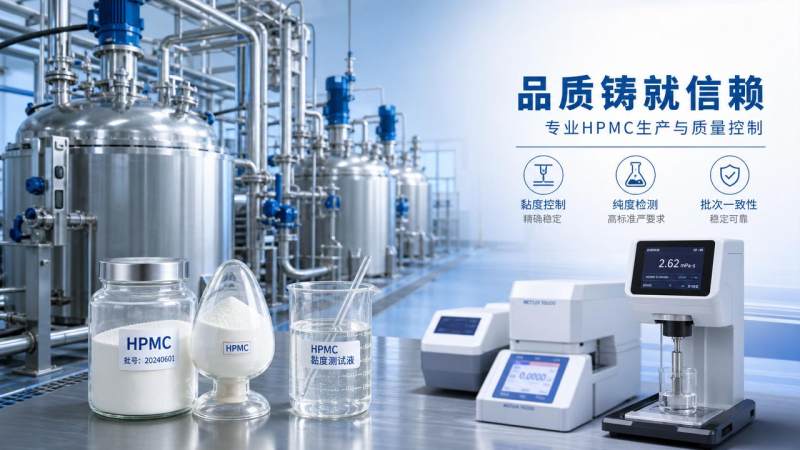
Why process control matters in HPMC production
Choosing an HPMC Manufacturer is rarely a simple sourcing decision. In construction additives and chemical auxiliaries, product stability directly affects formulation behavior, application feel, and final performance.
A small shift in viscosity can change water retention, sag resistance, open time, or film behavior. A minor purity issue can introduce unwanted reactions, odor, insoluble particles, or inconsistent dissolution.
That is why the real value of an HPMC Manufacturer lies in control. The question is not only whether HPMC can be produced, but whether it can be reproduced with dependable results across batches.
For cellulose ether users, this matters across tile adhesives, drymix mortars, self-leveling materials, detergents, paints, and other specialty formulations. In each case, process discipline is closely tied to downstream reliability.
What viscosity, purity, and consistency really mean
Viscosity is often the first parameter checked, but it is not just a number on a data sheet. It reflects molecular structure, substitution balance, and how the material behaves in a defined test system.
Purity refers to more than low impurity content. It also includes controlled moisture, limited ash, low residual byproducts, and clean dissolution without visible contamination.
Production consistency means that one shipment performs like the last one. In practical use, that reduces reformulation work, lowers quality complaints, and supports more predictable plant operation.
A capable HPMC Manufacturer therefore manages chemistry, equipment, testing, and production rhythm as one connected system rather than as isolated quality checkpoints.
How an HPMC Manufacturer controls viscosity at the source
Viscosity control starts with raw material selection. Cellulose quality, particle size, moisture condition, and pretreatment uniformity all influence how the etherification reaction proceeds.
From there, reaction temperature, alkalization level, reagent ratio, holding time, and mixing efficiency must stay within a narrow process window. Variability at this stage usually appears later as unstable rheology.
An experienced HPMC Manufacturer uses standardized recipes and automated control points to keep these variables stable. That is especially important when covering a wide viscosity spectrum.
Jinan Ludong Chemical Co., Ltd. operates integrated production lines that combine established manufacturing practice with intelligent automation. This approach supports controlled output from 400 to 200,000 CPS across different HPMC grades.
In other words, viscosity control is not achieved by one final adjustment. It is built step by step through material preparation, reaction management, drying, milling, and final classification.
Why test conditions also matter
Viscosity values can be misleading when methods differ. Concentration, solution temperature, spindle selection, and rotational speed all affect the reported result.
A reliable HPMC Manufacturer makes test methods transparent and repeatable. That allows technical comparison on a like-for-like basis rather than on a nominal CPS label alone.
Purity depends on both chemistry and plant discipline
Purity is influenced by raw material cleanliness, reagent quality, washing efficiency, and drying conditions. If one of these steps slips, the final product may still pass appearance checks but behave poorly in use.
This is especially relevant in catalyst-related chemical auxiliaries and sensitive formulations, where trace impurities can affect compatibility, foam profile, dispersion, or storage stability.
A disciplined HPMC Manufacturer controls purification through monitored washing stages, residue management, and contamination prevention between grades. Equipment cleaning and material handling rules are just as important as synthesis itself.
Drying and packaging also deserve attention. Excess moisture pickup or dusty packing environments can reduce flowability, change storage behavior, and complicate dissolution at the customer site.
That is why purity should be evaluated as a full manufacturing outcome, not only as a lab specification taken at one point in time.
Consistency is built through scale, data, and repeatability
Batch-to-batch consistency becomes more demanding as product portfolios expand. Different grades, seasonal operating changes, and variable order volumes can all introduce hidden instability.
This is where manufacturing scale can help, provided the system is well managed. Ludong Chemical reports annual capacity of 45,000 tons, supported by comprehensive production lines for HPMC, RDP, and HPS.
Scale alone is not the advantage. The advantage comes from standardized production sequences, traceable batch records, calibrated testing, and coordinated supply planning that reduces unnecessary process switching.
A strong HPMC Manufacturer typically uses consistency controls across four layers: incoming inspection, in-process monitoring, finished product verification, and retained sample review.
What to examine beyond the data sheet
When comparing one HPMC Manufacturer to another, the specification sheet is only the starting point. The more useful question is how those values are produced and maintained.
Several indicators usually reveal the difference between nominal compliance and real manufacturing control.
- Whether viscosity ranges are broad but still supported by stable production history.
- Whether test methods are clearly defined and reproducible.
- Whether the plant combines automated systems with experienced process management.
- Whether grade switching, cleaning, and packaging control reduce cross-contamination risk.
- Whether application support connects lab values to actual formulation behavior.
This is also where application-specific options become relevant. In cleaning formulations, for example, Detergent-grade HPMC should be assessed not only for viscosity, but also for solubility profile, suspension behavior, and compatibility with surfactant systems.
How these controls affect real applications
In tile adhesive systems, stable HPMC supports water retention and workable open time. If viscosity drifts, the mortar may feel inconsistent from one batch to the next.
In skim coat and render applications, purity and particle behavior influence smoothness, anti-sag performance, and mixing response. Poor consistency often shows up first on the job site, not in storage.
In chemical auxiliaries, the same logic applies. Thickening efficiency, suspension effect, and dissolution rate all depend on stable molecular design and controlled production conditions.
A dependable HPMC Manufacturer therefore helps reduce formulation trial cycles. It also lowers the risk of hidden variation that only becomes visible after scale-up or export delivery.
A practical comparison framework
For a more grounded evaluation, compare suppliers using both lab indicators and operating signals.
- Check viscosity tolerance, not only target viscosity.
- Review moisture and ash alongside dissolution appearance.
- Ask how batches are traced and how deviations are handled.
- Confirm whether supply capacity matches ongoing demand stability.
- Test in the final formulation, not only in water.
A more informed next step
The best HPMC Manufacturer is usually the one that can explain its control logic as clearly as its product range. Viscosity, purity, and consistency should make sense as a connected production story.
For technical comparison, it helps to build a short checklist around process transparency, test standards, application fit, and batch repeatability. That creates a stronger basis than price or nominal grade matching alone.
Where multiple applications are involved, including construction materials and specialty chemical systems, it is worth comparing how each HPMC Manufacturer supports different viscosity levels, grade families, and long-term supply consistency.
A careful review of production capability, quality discipline, and formulation performance will usually reveal which source is best aligned with the demands of stable, scalable use.
Send Your Inquiry
We welcome your cooperation and we will develop with you.
