


Indonesia Raises Local Content Requirement to 45% for Construction Equipment
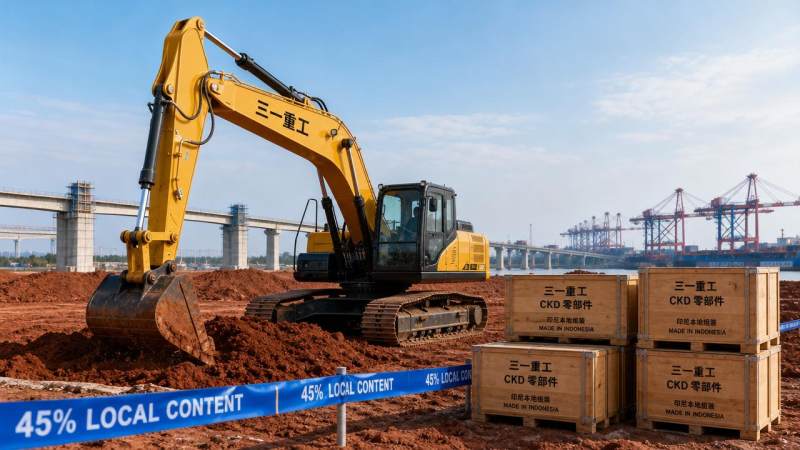
On May 5, 2026, Indonesia’s Ministry of Industry updated its National Strategic Project Procurement Guidelines, mandating a 45% local content rate—including local assembly, service networks, technical training, and spare parts warehousing & distribution—for foreign construction equipment suppliers bidding on government infrastructure projects (e.g., highways, ports, power plants). This requirement, effective immediately, directly affects Chinese OEMs and knock-down (KD) exporters seeking market access in Indonesia.
Event Overview
On May 5, 2026, the Indonesian Ministry of Industry issued an update to the National Strategic Project Procurement Guidelines. The revision stipulates that foreign suppliers of construction machinery participating in tenders for national strategic infrastructure projects must achieve a minimum 45% local content ratio. Local content is defined to include local assembly, establishment of service networks, provision of technical training to Indonesian personnel, and localization of spare parts warehousing and distribution. Additionally, applicants must submit a notarized Commitment Letter on Technology Transfer and Capacity Building. The policy entered into force on the date of issuance.
Which Subsectors Are Affected
Direct Exporters (OEMs and KD Suppliers)
Chinese original equipment manufacturers and knock-down (KD) exporters supplying excavators, wheel loaders, cranes, and piling rigs to Indonesian infrastructure projects are directly impacted. Their current export models—especially those relying on fully imported units or minimal local assembly—may no longer meet eligibility criteria for public tenders.
After-Sales Service Providers
Companies operating maintenance, repair, and technical support networks in Indonesia face expanded compliance obligations. The 45% local content metric explicitly includes service network coverage and certified local technician training—meaning service providers must now demonstrate verifiable capacity, not just presence.
Supply Chain and Logistics Operators
Firms managing spare parts importation, warehousing, and last-mile distribution must align with the new local content definition. The requirement to localize spare parts warehousing and distribution implies greater investment in Indonesian inventory hubs and logistics partnerships—and tighter linkage between physical infrastructure and procurement eligibility.
What Relevant Companies or Practitioners Should Focus On — and How to Respond
Monitor official implementation guidance from Indonesia’s Ministry of Industry
The guideline introduces a quantitative threshold (45%) and a formal commitment instrument, but detailed calculation methodologies, verification procedures, and grandfathering provisions for ongoing contracts remain unconfirmed. Stakeholders should track official circulars or technical notes expected in Q3 2026.
Assess exposure by project type and procurement channel
This rule applies only to projects classified as National Strategic Projects—not all public infrastructure. Companies should map their current and pipeline bids against the official NSP list (published annually by the Coordinating Ministry for Economic Affairs) to prioritize compliance efforts where required.
Distinguish between policy signal and operational readiness
The notarized Commitment Letter is mandatory for tender submission, but actual technology transfer execution (e.g., curriculum delivery, joint R&D, IP licensing) is subject to post-award monitoring. Firms should treat the letter as a binding contractual obligation—not merely a procedural formality—and prepare internal alignment across legal, engineering, and HR functions.
Review and adjust supply chain localization plans ahead of tender deadlines
Local assembly, technician certification, and spare parts hub setup require lead time. Companies with active bids scheduled for Q4 2026 or early 2027 should initiate feasibility studies for local CKD assembly or third-party service partnerships by mid-June 2026 to avoid disqualification.
Editorial Perspective / Industry Observation
Observably, this update signals a deliberate tightening of industrial policy enforcement—not just a rhetorical shift. While Indonesia has long promoted local content, the explicit linkage of procurement eligibility to both a quantified local content rate *and* a notarized technology transfer commitment marks a step toward enforceable, audit-ready industrial upgrading. Analysis shows the 45% threshold likely targets mid-to-high-value equipment categories where localized service and parts logistics offer measurable economic spillovers. It is more accurately understood as an operational checkpoint than a long-term structural barrier: firms able to document progressive localization (e.g., phased assembly, tiered training programs) may retain competitiveness without full vertical integration.
From an industry perspective, this development reflects Indonesia’s broader strategy to convert infrastructure demand into domestic capability—particularly in capital-intensive, skills-dependent segments. Continuous attention is warranted because subsequent updates may extend similar requirements to non-NSP projects or introduce sector-specific sub-targets (e.g., higher thresholds for electrical systems or digital control modules).
Current evidence suggests this is neither a temporary pilot nor a blanket restriction—but a calibrated, procurement-driven lever to accelerate localization in priority infrastructure supply chains.
Conclusion
This policy change redefines market access conditions for foreign construction equipment suppliers in Indonesia—not by raising tariffs or banning imports, but by making tender eligibility contingent on verifiable, locally embedded capabilities. For affected firms, it underscores that commercial success in Indonesia’s infrastructure sector increasingly depends less on product specification alone, and more on demonstrable contributions to local capacity, service resilience, and technology absorption. The measure is best understood not as a trade barrier per se, but as a structured incentive to deepen operational integration within Indonesia’s industrial ecosystem.
Information Sources
Main source: Republic of Indonesia Ministry of Industry, National Strategic Project Procurement Guidelines (revised edition, effective May 5, 2026). Pending observation: official methodology for calculating local content percentage and verification protocol for the Commitment Letter—expected to be published separately by the Directorate General of Chemicals, Textiles, and Construction Machinery.
Send Your Inquiry
We welcome your cooperation and we will develop with you.
