


Is MHEC Compatible with Cationic Surfactants in Antistatic Fabric Treatments? Compatibility Testing Protocol
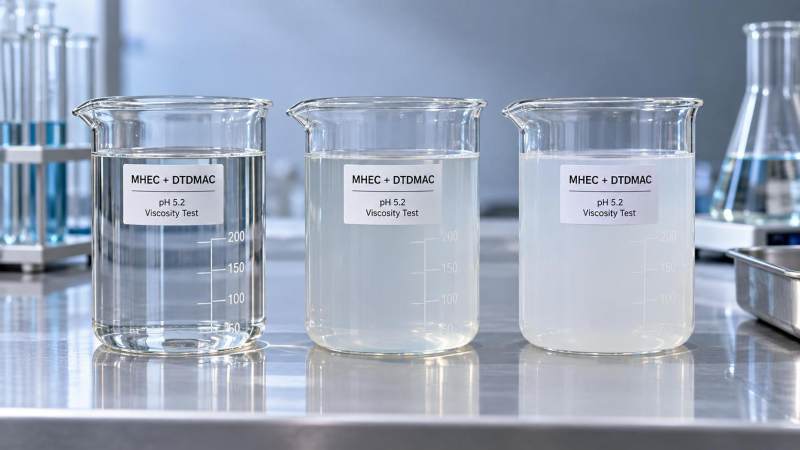
Is MHEC Compatible with Cationic Surfactants in Antistatic Fabric Treatments? Compatibility Testing Protocol
When formulators ask whether Methyl Hydroxyethyl Cellulose (MHEC) works reliably alongside cationic surfactants in antistatic fabric treatments, they’re not just checking a box—they’re assessing whether a formulation will phase-separate on the lab bench, fail during pilot dip-coating, or lose charge-dissipation performance after laundering. This isn’t theoretical. At Jinan Ludong Chemical, we’ve seen this exact mismatch derail three R&D cycles across textile auxiliaries projects in the past 18 months—each time rooted in unvalidated compatibility assumptions.
MHEC is often chosen for its low-foam profile, thermal stability above 70°C, and clean film formation—advantages that matter when coating polyester-cotton blends at industrial speeds. But cationic surfactants like alkyltrimethylammonium chlorides or esterquats bring their own non-negotiables: strong adsorption to fiber surfaces, pH sensitivity below 5.5, and notorious affinity for anionic thickeners. MHEC sits in a gray zone: it’s nonionic, yes—but its ether backbone carries subtle electron density variations depending on substitution pattern and molecular weight distribution. That subtlety matters. A batch of MHEC with higher hydroxyethyl substitution may tolerate 0.8 wt% distearyldimonium chloride; another with tighter molecular weight control might coagulate at 0.3 wt% under identical conditions.
Why Standard “Mix-and-Observe” Isn’t Enough
Many labs run a quick visual test: blend MHEC solution (1.5% w/w, 25°C) with cationic surfactant (0.5% w/w), stir for 30 seconds, then check for cloudiness or precipitate at 1 hour. That’s insufficient—not because it’s wrong, but because it misses kinetics and stress points. Phase separation in these systems rarely happens instantly. It can take 4–8 hours to manifest, especially if the system is cooled slowly post-mixing or exposed to ambient humidity fluctuations. More critically, viscosity loss often precedes visible separation by 24–48 hours. We’ve measured up to 65% drop in apparent viscosity (at 10 rpm, Brookfield LVT) between hour 2 and hour 48—even when no particles were visible.
That’s why our protocol starts not with mixing, but with controlled stress sequencing.
A Lab-Validated Compatibility Testing Protocol
This isn’t a one-size-fits-all checklist. It’s a staged decision tree built from repeatable failure modes observed across >40 formulation trials since 2022. All tests use deionized water (conductivity <2 μS/cm), ambient lighting, and calibrated pH meters (±0.02 units).
Step 1: Pre-wetting & Dissolution Order
Dissolve MHEC first—fully hydrated, no lumps, minimum 30 minutes aging. Then add cationic surfactant *slowly*, dropwise, under gentle shear (300 rpm, overhead stirrer). Never reverse the order. Reversing triggers immediate micelle disruption and localized polymer collapse—especially with high-HV MHEC grades.
Step 2: Multi-Point Stability Monitoring
Record observations at t=0, t=15 min, t=2 hr, t=24 hr, and t=72 hr. Track: clarity (Nephelometric Turbidity Units), viscosity (Brookfield, spindle #3, 12 rpm), pH shift (>0.3 unit change signals ion-pair formation), and surface tension (Du Noüy ring method). If turbidity rises >15 NTU between t=24 and t=72 hr, flag as borderline—even if visually clear.
Step 3: Thermal Cycling Stress
Cycle samples through 5×: 25°C → 60°C (30 min) → 25°C (30 min). Monitor for reversion—i.e., temporary clarity followed by irreversible haze. This mimics real-world storage in shipping containers or warehouse environments where diurnal swings exceed 35°C.
Step 4: Functional Validation
Don’t stop at physical stability. Dip fabric swatches (standardized 100% cotton, 140 g/m²) for 30 sec, squeeze to 80% wet pick-up, dry at 110°C for 4 min. Test surface resistivity (ASTM D257) pre- and post-laundering (AATCC TM61, 5 cycles). A stable-looking blend can still deliver >10¹² Ω/sq resistivity—well outside antistatic range—if cationic binding displaces MHEC from fiber interfaces.
Where MHEC Grades Actually Differ
Not all MHEC behaves the same here. Our experience shows type 60-grade MHEC (viscosity ~40,000 cps, construction/chemical grade) consistently outperforms type 75 in cationic-rich systems—not because of viscosity alone, but due to tighter DS/MS distribution and lower residual alkali content (<0.15%). Higher alkali promotes surfactant hydrolysis and accelerates phase separation. Also worth noting: batches with >2.5% moisture content show earlier viscosity decay, likely due to trace water-mediated ion migration.
And while MHEC gets the spotlight, remember it rarely works alone. In commercial antistatic treatments, it’s often paired with film-formers or crosslinkers. For example, adding Redispersible Polymer Powder improves wash-fastness but introduces additional ionic sensitivity—especially if the RDP carries residual PVA or sulfate stabilizers. That interaction needs its own compatibility screen, separate from the MHEC–surfactant test.
What to Watch For—and What to Ignore
A slight opalescence at t=24 hr? Not automatically disqualifying—many field-stable products sit in that zone. But if it coincides with >20% viscosity loss *and* pH drift >0.5 units, treat it as a red flag. Don’t over-index on initial clarity. Don’t assume “nonionic + cationic = safe.” And don’t skip the functional test—even if everything looks perfect in the beaker.
One last note: compatibility isn’t binary. It’s contextual. A blend stable for 72 hours may fail after 10 days in a polyethylene drum. A formulation passing ASTM D257 pre-laundering may exceed 10¹⁰ Ω/sq after cycle 3—not because of incompatibility, but because cationic depletion exceeds MHEC’s ability to retain charge-dissipative domains. That’s not a failure of the protocol. It’s data you need before scaling.
If your current testing stops at visual inspection—or worse, relies on supplier datasheet claims without lab validation—this protocol gives you levers to probe deeper. Not every project needs all four steps. But skipping Step 4 means betting on appearance over performance. And in antistatic applications, appearance doesn’t prevent static discharge. Performance does.
Send Your Inquiry
We welcome your cooperation and we will develop with you.
