


Red Sea Crisis Pushes Shanghai-Rotterdam 40HQ Freight to $4,952
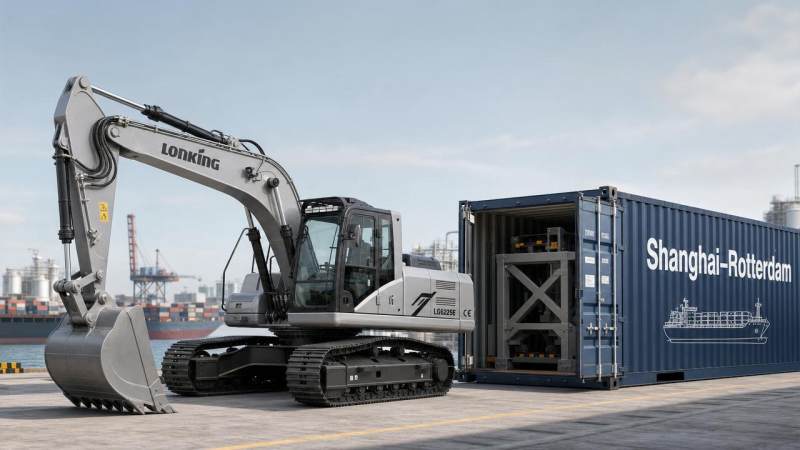
Red Sea security disruptions and sustained Suez Canal rerouting have driven a sharp 18.3% surge in spot freight rates for 40HQ containers on the Shanghai–Rotterdam route, reaching $4,952 as of May 4, 2026, per Drewry’s World Container Index (WCI). This development directly affects exporters of construction machinery, heavy equipment, and oversized components—and signals mounting pressure on lead times, landed costs, and order fulfillment across global industrial supply chains.
Event Overview
According to Drewry’s WCI composite index published on May 4, 2026, the spot rate for 40HQ containers on the Shanghai–Rotterdam route stood at $4,952—a 18.3% increase within 24 hours. The rise is attributed to ongoing Houthi militant attacks in the Red Sea and the institutionalization of Cape of Good Hope diversions. As of publication, non-contract shippers face a 5–7-day average booking wait time, and major carriers have suspended acceptance of new bookings for shipments scheduled after May 20, 2026.
Industries Affected
Direct Exporters of Construction Machinery & Heavy Equipment
These enterprises rely heavily on the Shanghai–Rotterdam corridor for full-unit exports (e.g., excavators, cranes) and large structural components. The $4,952 rate applies specifically to 40HQ mechanical containers—standard for such cargo. Rising freight now directly inflates unit export costs and extends delivery timelines due to constrained vessel space and booking delays.
Component Suppliers to OEMs in Europe
Suppliers shipping large subassemblies (e.g., hydraulic booms, powertrain modules) under JIT or build-to-order frameworks face cascading schedule risk. With carrier capacity prioritized for contract customers and booking windows closing early, late deliveries may trigger production line stoppages or penalty clauses in OEM supply agreements.
International Freight Forwarders & NVOCCs
Forwarders handling non-contract, spot-market shipments are encountering reduced carrier allocation, longer confirmation cycles, and increased customer negotiation pressure. The May 20 booking cutoff forces earlier planning for Q2–Q3 European deliveries—shifting quoting, documentation, and inland coordination timelines forward by 10–14 days.
Distribution & Aftermarket Parts Importers
Importers managing European distribution networks for service parts must now reassess landed cost models. A $1,000+ freight jump on a single 40HQ impacts margin thresholds, especially for low-margin consumables or time-sensitive replacement kits—potentially triggering price adjustments or regional stock reallocation decisions.
What Enterprises Should Monitor and Do Now
Track carrier capacity announcements—not just rate indices
Rate spikes reflect immediate supply-demand imbalance, but operational constraints (e.g., vessel repositioning, crew rotations, port congestion at Rotterdam) determine duration. Monitor weekly updates from Maersk, MSC, and Hapag-Lloyd regarding blank sailings and revised ETAs on this lane—not just index changes.
Prioritize contract renewals and slot confirmations for May–July shipments
Given the May 20 cutoff for non-contract bookings, firms with upcoming European deliveries should verify existing contract terms—including guaranteed slot allocations, surcharge pass-through clauses, and force majeure definitions—before finalizing Q2 production schedules.
Reassess inland transport and warehouse timing buffers
With average booking lead time extended to 5–7 days, and potential further delays at transshipment hubs (e.g., Algeciras, Bremerhaven), shippers should add minimum 3-day buffer to container yard pickup and rail/truck handover windows—and confirm warehouse readiness for earlier-than-expected arrivals.
Document all freight cost escalations for commercial negotiations
For contracts with fixed pricing or delayed invoicing, retain dated screenshots of WCI reports and carrier booking confirmations. These serve as objective evidence when requesting price adjustment clauses or delivery date extensions with European buyers or distributors.
Editorial Observation / Industry Perspective
This freight surge is not merely a short-term volatility event—it reflects the structural recalibration of Asia–Europe maritime logistics following the de facto suspension of reliable Suez access. Observably, the 18.3% single-day jump signals that market participants no longer treat Red Sea risks as transient; instead, they’re pricing in sustained detour costs, fuel surcharges, and insurance premiums as baseline. Analysis shows this episode functions less as an isolated shock and more as a threshold marker: once spot rates exceed $4,900 consistently on key lanes, it triggers automatic reevaluation of routing strategies, inventory safety stock levels, and even nearshoring feasibility studies among Tier-1 equipment manufacturers. From an industry standpoint, continued monitoring of both WCI data and carrier operational advisories—not just headline rates—is now essential for strategic continuity.
Conclusion
The $4,952 Shanghai–Rotterdam 40HQ rate is best understood not as a temporary anomaly, but as an indicator of entrenched logistical friction in a critical trade corridor. It confirms that Red Sea instability has transitioned from a contingency risk to an embedded cost factor—one that reshapes procurement cycles, contract terms, and cross-border service commitments. For affected businesses, proactive adaptation—not reactive mitigation—is now the operational norm.
Information Sources
Main source: Drewry World Container Index (WCI) report, published May 4, 2026. Data reflects verified spot rate assessments for the Shanghai–Rotterdam 40HQ lane. Ongoing developments—including carrier policy updates beyond May 20, 2026, and potential shifts in Houthi targeting patterns—remain subject to observation and are not yet confirmed.
Send Your Inquiry
We welcome your cooperation and we will develop with you.
