


UL Updates ANSI/UL 6201-2026: New EMC & Thermal Runaway Tests for Robotic Arm Chargers
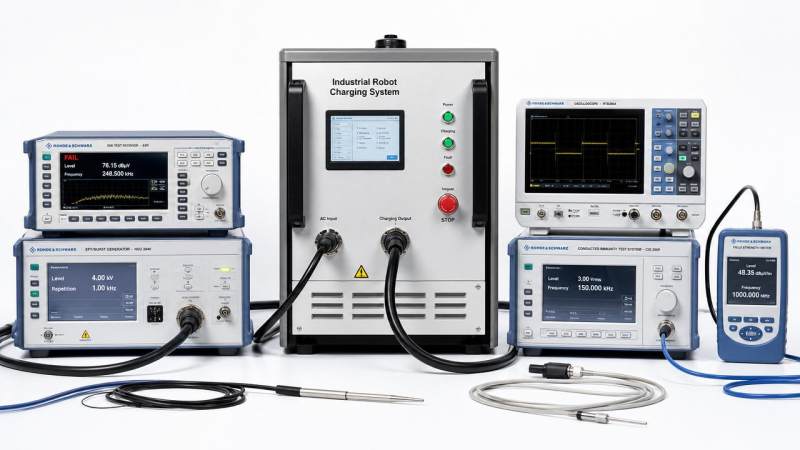
On May 7, 2026, UL Solutions officially published the revised ANSI/UL 6201-2026 standard, introducing mandatory electromagnetic compatibility (EMC) immunity and battery thermal runaway propagation testing for robotic arm charging devices. This update directly affects manufacturers and exporters of industrial robot charging systems, AGV battery-swap modules, and intelligent warehouse mechanical power units targeting the North American market.
Event Overview
UL released ANSI/UL 6201-2026 on May 7, 2026. The standard newly includes robotic arm charging devices under mandatory certification scope and adds two compulsory test requirements: EMC immunity testing and battery thermal runaway propagation testing. Enforcement begins November 1, 2026. No additional implementation timelines, transitional provisions, or technical interpretations have been publicly confirmed beyond this announcement.
Industries Affected by Segment
Direct Exporters to North America
These enterprises supply charging systems, AGV swap modules, or powered mechanical units to U.S./Canadian customers. They are affected because compliance with ANSI/UL 6201-2026 becomes a legal prerequisite for market access after November 1, 2026 — non-compliant products may be denied entry, rejected by distributors, or subject to post-market enforcement actions.
OEMs and System Integrators
Companies integrating charging hardware into industrial robots or automated material handling systems must now ensure their subsystems meet the new EMC and thermal propagation requirements. Impact manifests in design validation cycles, component sourcing constraints, and potential redesign of battery management or shielding architecture.
Component Suppliers (Battery Modules, Charging Controllers, Enclosures)
Suppliers providing critical subassemblies — especially lithium-based battery packs, onboard chargers, or thermally insulated enclosures — face downstream qualification pressure. Buyers will increasingly require pre-validated test reports aligned with the new clauses, shifting verification responsibility earlier in the supply chain.
Distribution & Certification Service Providers
Importers, logistics partners, and third-party testing labs serving North America–bound robotics hardware must update compliance checklists and client advisories. Delayed awareness may result in shipment holds or retesting costs if products arrive without verified ANSI/UL 6201-2026 documentation.
What Relevant Enterprises or Practitioners Should Focus On and How to Respond Now
Monitor official UL communications for test method details and interpretation guidance
ANSI/UL 6201-2026’s EMC immunity and thermal runaway propagation test protocols have not yet been publicly detailed. Enterprises should track UL’s official bulletins and technical FAQs, as implementation hinges on finalized test setups, pass/fail criteria, and acceptable alternative methods.
Identify high-priority product categories based on North American sales exposure
Not all mechanical arm charging configurations carry equal risk. Companies should prioritize review of products already certified to prior editions (e.g., UL 6201-2021), those with integrated lithium-ion batteries >10 Ah capacity, or models deployed in enclosed or densely packed warehouse environments — where thermal propagation risk is elevated.
Distinguish between regulatory signal and enforceable requirement
The May 7, 2026 publication is a formal standard release, but enforcement begins November 1, 2026. Until then, existing certifications remain valid. However, new applications submitted after May 7 may already be assessed against the 2026 edition at UL’s discretion — making early alignment prudent, not urgent.
Initiate internal cross-functional readiness planning
Engineering, procurement, and regulatory affairs teams should jointly map current product architectures against the new clauses. Where thermal propagation testing applies, confirm whether battery pack suppliers can provide validated cell-level propagation data; where EMC immunity applies, verify enclosure shielding and filter design documentation is traceable and test-ready.
Editorial Perspective / Industry Observation
Observably, this revision signals UL’s response to evolving safety expectations around energy-dense, autonomously managed power systems in industrial automation. It does not represent an isolated technical update but reflects broader regulatory attention toward system-level failure modes — particularly cascading thermal events and operational resilience in electromagnetically noisy factory environments. Analysis shows that while the standard itself is narrowly scoped to charging devices, its test logic may inform future revisions of related standards (e.g., UL 3300 for industrial robots). From an industry perspective, this is currently best understood as a compliance milestone with defined timing — not a sudden disruption — but one requiring deliberate, staged preparation due to test complexity and limited lab capacity for thermal propagation validation.
This update underscores how safety standards for auxiliary power systems are converging with core robotics certification frameworks. Its significance lies less in novelty and more in enforceability: for the first time, battery safety and EMC robustness in robotic charging infrastructure are no longer optional considerations but codified, auditable requirements. Current understanding should treat this as a binding timeline-driven obligation — not a recommendation — with November 1, 2026 as the definitive inflection point for market access.
Source: UL Solutions official standard release notice for ANSI/UL 6201-2026 (published May 7, 2026). No further technical annexes, test procedure documents, or enforcement guidance have been released as of the publication date. Ongoing monitoring of UL’s Standards Development Portal and regulatory alerts is advised.
Send Your Inquiry
We welcome your cooperation and we will develop with you.
