


UL Updates ANSI/UL 6201-2026: New EMC and Thermal Runaway Tests for Robotic Arm Charging Systems
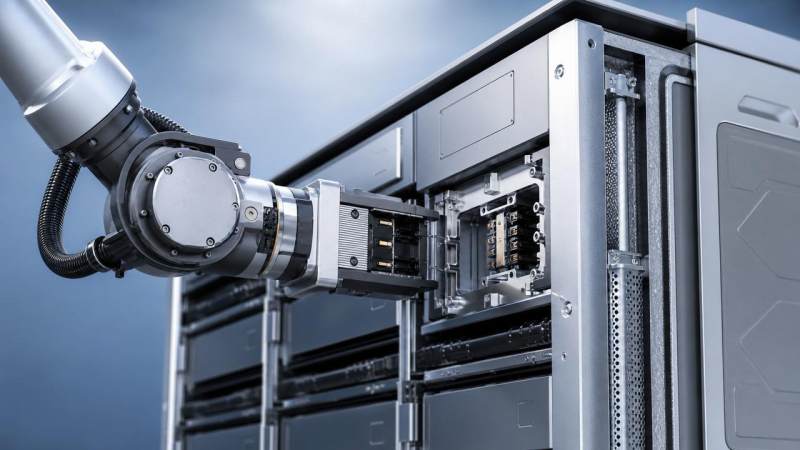
UL Solutions has updated ANSI/UL 6201—effective October 1, 2026—to introduce mandatory electromagnetic compatibility (EMC) testing per Class B limits and thermal runaway propagation resistance testing (per UL 9540A Tier 2) for automated charging stations and battery swap cabinets designed for industrial robotic arms. This revision directly affects manufacturers, OEMs, and suppliers serving the U.S. industrial automation, logistics robotics, and battery infrastructure sectors—and signals a tightening of safety and interoperability requirements for power delivery systems in dynamic robotic environments.
Event Overview
On May 8, 2026, UL Solutions officially published the revised standard ANSI/UL 6201-2026. The update mandates two new test requirements for mechanical arm charging equipment: (1) electromagnetic compatibility compliance under FCC Class B emission limits, and (2) multi-cell thermal runaway propagation mitigation verified via UL 9540A Tier 2 testing methodology. As of October 1, 2026, products failing to meet this edition may not be sold in the U.S. market or supplied to U.S.-based OEMs.
Industries Affected by Segment
Original Equipment Manufacturers (OEMs) of Industrial Robots
OEMs integrating automatic charging or battery-swap solutions into robotic arm systems must now ensure their selected charging hardware complies with the updated standard. Non-compliant units risk supply chain exclusion and design rework delays ahead of product launch or field deployment cycles.
Manufacturers of Robotic Charging Stations and Swap Cabinets
These manufacturers face direct certification obligations. The addition of Class B EMC and UL 9540A Tier 2 testing introduces new validation steps—including radiated/conducted emissions testing and full-scale thermal propagation testing with multi-module battery configurations—which may extend time-to-certification and require hardware redesigns (e.g., shielding, thermal barrier integration, cell spacing adjustments).
U.S.-Based Distributors and System Integrators
Distributors and integrators sourcing charging hardware for North American deployments must verify conformance documentation prior to procurement. Inventory holding non-compliant units after October 1, 2026, could result in inability to fulfill contracts or support warranty claims under UL-regulated applications.
Battery Module and Thermal Management Subsystem Suppliers
Suppliers providing battery modules, busbars, cooling plates, or fire-retardant barriers used within charging systems may see revised specification requests from charging equipment makers—particularly regarding cell-level thermal isolation performance and EMI suppression integration points.
Key Focus Areas and Recommended Actions for Stakeholders
Monitor official UL guidance on transition timelines and grandfathering provisions
While the standard takes effect on October 1, 2026, UL may issue clarifications on acceptance of legacy test reports or phased implementation for existing certified models. Stakeholders should subscribe to UL’s Regulatory Updates and review any addenda published between May and September 2026.
Confirm applicability scope before initiating retesting
ANSI/UL 6201-2026 applies specifically to charging equipment intended for robotic arms—not general-purpose EV chargers or stationary energy storage. Companies should verify whether their product falls under the defined “mechanical arm” use case (e.g., articulated arms in manufacturing, warehousing, or mobile manipulation platforms) to avoid unnecessary testing investment.
Align internal development and procurement schedules with Q3 2026 readiness milestones
Given typical UL certification lead times (8–16 weeks for full re-evaluation), stakeholders should initiate pre-assessment or gap analysis by July 2026. This includes reviewing PCB layout for EMC, validating thermal barrier materials against UL 9540A Tier 2 protocols, and preparing test samples with production-intent firmware and mechanical assemblies.
Update technical documentation and supplier agreements to reflect new compliance obligations
OEMs and system integrators should revise procurement specifications, bill-of-materials compliance clauses, and technical data sheets to explicitly reference ANSI/UL 6201-2026. Contracts signed after June 2026 should include clauses requiring evidence of conformance prior to shipment or integration.
Editorial Perspective / Industry Observation
Observably, this update reflects an industry-wide shift toward treating robotic charging infrastructure not as peripheral accessories—but as safety-critical subsystems subject to the same rigor as onboard electronics and battery management systems. Analysis shows that UL’s inclusion of UL 9540A Tier 2—originally developed for grid-scale energy storage—signals heightened concern over cascading failure modes in densely packed, high-power, autonomously managed battery systems. From an industry perspective, the timing suggests growing alignment between industrial automation safety frameworks and evolving battery safety consensus standards. It is more accurately understood as a regulatory signal than an immediate market disruption—yet one that demands proactive alignment, given the absence of transitional allowances in the published text.
Conclusion
This revision marks a formal elevation of safety expectations for robotic arm power infrastructure in the U.S. market. Rather than representing a broad-based regulatory expansion, it represents a targeted tightening around two well-defined risk vectors: electromagnetic interference in shared factory environments and thermal propagation in compact, high-density battery handling systems. Stakeholders are advised to treat this as a defined, actionable compliance milestone—not a speculative trend—and to prioritize verification and documentation readiness ahead of the October 2026 enforcement date.
Source Attribution
Primary source: UL Solutions, ANSI/UL 6201-2026 Standard for Safety for Robotic Arm Charging Equipment, published May 8, 2026.
Note: Ongoing observation is recommended for any UL-issued interpretations, test method clarifications, or enforcement guidance released between May and September 2026.
Send Your Inquiry
We welcome your cooperation and we will develop with you.
