


What Do Wall Putty Additives Do in Cement-Based Formulations?
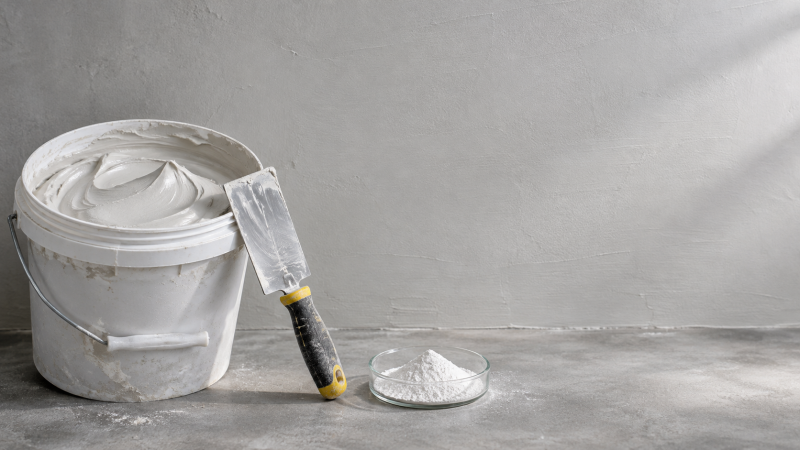
Wall Putty Additives influence how a cement-based mixture behaves from the moment water is added to the time the finished surface hardens. They can help the fresh putty hold water, spread smoothly and stay in place on a wall. After application, some additives also contribute to adhesion and resistance to cracking.
Their effects depend on the whole formulation and the conditions on site. An additive that improves spreading, for example, cannot compensate for a dusty substrate or an unsuitable water addition. Understanding what each material contributes helps explain why two putties made with similar cement and filler can feel and perform quite differently.
What changes when additives are included?
A cement-based wall putty typically contains cement, mineral fillers and selected additives. Cement provides the hydraulic binder: it reacts with water and develops a hardened structure. Fillers contribute to the body and surface characteristics of the mixture. Additives are used to adjust specific properties that the cement and fillers alone may not deliver consistently.
For the person applying the putty, those properties appear as practical differences: how easily the powder mixes, whether it drags under the trowel, how long it remains workable and whether a thin layer can be finished smoothly. For the formulator, the question is how to balance those application properties with adhesion, hardening and the intended service conditions.
The main contributions can be grouped by when they are most visible:
- During mixing: Additives affect wetting, dispersion and the consistency of the fresh paste.
- During application: They influence water retention, spreadability, slip and resistance to sagging.
- During drying and hardening: They can help maintain conditions for cement hydration and contribute to the integrity of the hardened layer.
- In service: Some polymer additives can improve adhesion and flexibility, although performance still depends on the substrate and the complete formulation.
These functions overlap. A change that makes the wet paste feel better may also alter drying behavior or the final bond, so an additive should be assessed in the finished putty rather than by a single property in isolation.
Water retention: giving the putty time to work
Water has two jobs in fresh cement putty. It makes the mixture workable, and it is needed for cement hydration. A porous wall can draw water from a thin putty layer quickly; warm or dry conditions can also increase water loss from the exposed surface. If the layer loses water too rapidly, the applicator may have less time to spread and finish it, and cement hydration near the surface can be impaired.
Hydroxypropyl methylcellulose, or HPMC, is a cellulose ether used to improve water retention and thicken the fresh mix. By helping the paste hold water, it can make application more forgiving and support the development of the cementitious structure. The effect matters especially on absorbent backgrounds, where a putty that initially feels workable may stiffen quickly after it touches the wall.
Water retention is not a substitute for substrate preparation. A very dry or highly absorbent wall may still require preparation suited to the putty manufacturer’s instructions. Dust, loose material and incompatible coatings can also interfere with bonding even when the fresh mix retains water well.
HPMC grades differ in properties such as viscosity and dissolution behavior. A higher stated viscosity does not automatically make a better putty: it may change the feel of the paste, its water demand or its ease of application. The useful grade is the one that gives the desired water retention and working properties at a practical dosage in the intended formulation.
Workability is more than thickness
Two putties can appear equally thick in a mixing container but behave differently under a trowel. One may spread smoothly and stay where it is placed; another may feel sticky, drag across the wall or slump after application. These differences relate to rheology: how the material flows and changes shape under force.
Cellulose ethers contribute to the body of the paste, while hydroxypropyl starch ether, often called HPS, can be used to adjust application feel and resistance to sagging. Depending on the formulation, a starch ether may help the putty hold its shape on a vertical surface while remaining workable during spreading.
The balance matters because wall putty is often applied in thin layers. If the paste is too mobile, it may slip or be difficult to build evenly. If it is excessively thick or sticky, the applicator may need more effort to spread it and may leave trowel marks. Adding extra water can make a stiff paste easier to move, but it also changes the formulation and may affect shrinkage, strength and drying behavior.
Mixing procedure affects the result as well. Incomplete dispersion can leave lumps or produce an uneven paste. A fair comparison between formulations therefore uses the same water addition, mixing method and waiting time, followed by application to a comparable surface. Judging a putty only in the bucket misses how it responds when the wall begins to absorb water.
Adhesion and crack resistance after application
Once putty is on the wall, the concern shifts from how it spreads to how well the layer remains attached and intact. Cement contributes to the hardened matrix, but the bond and resistance to damage depend on more than cement content. The substrate, layer thickness, curing conditions and polymer content can all influence the result.
Redispersible polymer powder, or RDP, is added to dry mixes to modify properties of the hardened material. After the powder is mixed with water and the applied layer dries, the polymer can form a film within the cementitious structure. Depending on the polymer grade and formulation, this can improve adhesion and increase the material’s ability to accommodate limited deformation.
That contribution can be useful where a putty must bond to a demanding substrate or tolerate small movements. It does not make a thin surface layer capable of bridging every crack in a wall. Structural movement, an unstable underlying coating, excessive application thickness or rapid drying can still cause cracking or debonding. A crack that originates in the substrate may reappear through the finish even when the putty itself has been well formulated.
Polyvinyl Alcohol is another polymer material that may be considered in cement-based formulations for its film-forming and binding characteristics. Its suitability depends on the grade, the rest of the mix and the exposure conditions. It should be evaluated as part of the complete system rather than assumed to provide the same performance as a particular redispersible powder.
Why the same additive can give different results
An additive does not operate on its own. Cement chemistry, filler type and particle size, the proportions of the dry ingredients and the amount of mixing water all shape the result. The surface receiving the putty is equally consequential: a dense, relatively smooth background presents a different bonding challenge from a rough, absorbent cement plaster.
Consider a putty designed for a porous interior wall. It may need sufficient water retention to prevent the fresh layer from drying out too quickly and a smooth consistency for thin finishing coats. A putty intended for exterior exposure may need additional attention to adhesion, water exposure and the durability of the complete coating system. The additive package that works for one application is not automatically appropriate for the other.
Layer thickness also changes the demands placed on the material. A thin skim coat can lose water rapidly and reveal defects in the substrate. A thicker application places greater demands on sag resistance and can be more susceptible to shrinkage-related cracking if the product or application method is unsuitable. The stated application range of the finished putty matters more than a general claim about what an individual additive can do.
Interactions between additives deserve attention too. Increasing one ingredient to correct a problem may introduce another: more thickening can reduce sagging but make spreading harder, while a change in polymer content may alter the feel and drying behavior of the mix. Adjustments are easier to interpret when one variable is changed at a time and the result is assessed across both fresh and hardened properties.
How to judge whether an additive is helping
Start with the problem observed in the intended application. “Better performance” is too broad to guide a useful comparison. A putty that dries too quickly on the wall, for example, raises different questions from one that spreads well but later loses adhesion.
For formulation work, compare candidates under conditions that resemble the intended use. Record the water needed to reach the desired consistency, observe mixing and trowel feel, and apply the putty to representative substrates at the intended thickness. Then allow the samples to harden and assess the properties relevant to the application, including adhesion and visible defects.
Fresh-paste observations should not be treated as proof of long-term performance. A smooth, creamy mix may be pleasant to apply but still produce an unsuitable hardened layer. Conversely, a formulation with good bond needs acceptable working time and finishability to be practical on site. Where the product must meet a specified standard or project requirement, the finished formulation should be tested against those requirements under the relevant conditions.
It is also useful to separate a formulation issue from an application issue before changing ingredients. If failure occurs only over a loose paint film, improving substrate preparation may be more effective than increasing polymer content. If a putty performs well on a sealed panel but stiffens rapidly on absorbent plaster, water retention and substrate preparation deserve closer examination. The additive choice becomes clearer once the failure condition is defined.
Choosing an additive package for the job
HPMC, HPS and RDP address different, sometimes overlapping needs. HPMC is commonly selected for water retention and thickening; HPS helps tune rheology and application behavior; RDP is used to modify properties such as adhesion and flexibility. None has a universally correct dosage or grade for every cement putty.
A practical starting point is to define the substrate, whether the surface is interior or exterior, the expected coat thickness and the finish required. From there, the formulator can decide which properties need the most support and compare suitable grades in the complete mix. Product data and supplier guidance can narrow the options, but the finished putty must still be assessed under representative conditions.
The most useful result is a balanced formulation: enough water retention for the wall and working conditions, a paste that can be applied cleanly, and a hardened layer suited to the intended surface. Each additive earns its place by contributing to that balance.
Send Your Inquiry
We welcome your cooperation and we will develop with you.
