


What Documents Should an HPMC Supplier Provide Before Bulk Purchase?
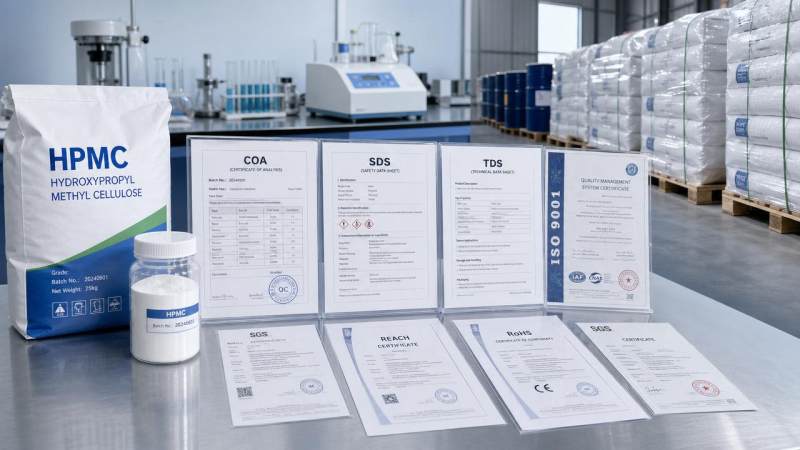
Before a bulk order is approved, paperwork matters almost as much as price and lead time. A dependable HPMC Supplier should be ready to present clear technical, safety, and quality documents that reduce uncertainty, especially in construction chemicals and related additive applications. When documentation is complete, product consistency becomes easier to judge, risks are easier to trace, and supplier comparison becomes far more practical.
Why documentation is central in HPMC sourcing
HPMC is not a simple commodity in real purchasing decisions. Its viscosity, substitution stability, moisture level, and application fit can directly affect mortar workability, water retention, open time, and final performance.
That is why a serious HPMC Supplier should not rely on verbal promises. Bulk procurement needs evidence that the delivered grade matches the approved sample and remains stable across batches.
In the catalyst and chemical additives sector, this discipline is even more important. Buyers often evaluate not only product function, but also traceability, compliance exposure, and supply continuity.
The first documents that should be requested
A reliable HPMC Supplier should provide a core package before contract confirmation. These papers form the first layer of screening and usually reveal how mature the supplier really is.
Certificate of Analysis
The COA is the most direct quality record. It should show batch number, test date, specification range, and actual measured results for the delivered lot.
For HPMC, useful COA items often include viscosity, moisture, ash, pH, particle size, methoxy or hydroxypropoxy content, and appearance. Missing batch detail is a warning sign.
Safety Data Sheet
An MSDS or SDS explains handling, storage, transport, emergency measures, and exposure information. Even when HPMC is considered relatively safe, a current SDS is still a basic requirement.
This document also helps confirm whether the supplier understands export compliance and downstream industrial use. In cross-border purchases, outdated SDS files can delay customs or internal approval.
Technical Data Sheet
A TDS explains what the product is designed to do. It usually includes recommended applications, viscosity ranges, dissolution behavior, dosage guidance, and packaging details.
This is where business evaluation becomes more practical. A TDS connects laboratory numbers with field performance, making it easier to compare one HPMC Supplier with another.
Quality certifications that support supplier credibility
Certifications do not replace testing, but they show whether the supplier runs under a structured system. For bulk purchase, system evidence matters because repeatability matters.
What matters is not only the certificate itself, but whether the supplier can provide a valid copy, issuing body, expiry status, and product relevance.
Documents that show manufacturing strength
For large-volume decisions, buyers often look beyond certificates and ask whether the HPMC Supplier can support stable long-term delivery.
A capable manufacturer should be able to share company profile material, plant overview, production capacity, and basic quality control flow. These are not decorative files. They show whether scale and process control align.
For example, Jinan Ludong Chemical Co., Ltd. operates as a large-scale global cellulose ether enterprise with integrated production, trading, and service capabilities. Its annual capacity reaches 45,000 tons.
That kind of capacity statement becomes more meaningful when supported by real documentation, product range detail, and testing discipline. It suggests the HPMC Supplier can handle varied viscosity demands from 400 to 200,000 CPS.
In practice, a strong file set may also mention construction and chemical grades, automated production integration, and lot traceability procedures. These points help explain how consistency is maintained at scale.
Sample validation records are often more revealing
Documents are essential, but pre-shipment confidence usually depends on sample validation. A good HPMC Supplier should support this step with clear sample identification and matching records.
- Sample batch number linked to later production lots
- Test method used for viscosity and other indicators
- Application notes for tile adhesive, mortar, putty, or gypsum systems
- Retention sample policy for dispute review
If the supplier cannot connect the approved sample to commercial production, the evaluation remains incomplete. Sample success without documentation can still lead to large-order failure.
How supporting documents improve commercial judgment
Not every file is about chemistry alone. Some documents help determine whether commercial cooperation will remain smooth after the first shipment.
Packaging and labeling specifications
These confirm bag type, net weight, pallet method, mark format, and storage conditions. They also reduce disputes over damaged goods or unclear batch identity.
Declaration of origin and export documents
For international orders, these papers affect customs handling and landed cost planning. An experienced HPMC Supplier usually understands this requirement early.
Product comparison or grade recommendation sheet
When several grades are available, a mapping sheet helps identify the right viscosity and application profile. This can be useful when a project also involves related additives such as Hydroxypropyl Starch Ether.
That broader view matters because formulation choices are rarely made in isolation. A supplier that understands adjacent additive systems often provides more practical guidance.
Warning signs hidden in incomplete paperwork
Weak documentation often appears before weak product performance. Several signals deserve attention during review.
- COA values are copied across different batches
- SDS version is old or not market-specific
- TDS lacks test conditions or application boundaries
- Certificates cannot be verified or are unrelated to the offered grade
- Sample records do not match future production references
These issues do not always mean the supplier is unreliable. Still, they justify deeper questioning before any bulk commitment is made.
A practical checklist before approval
A structured review keeps supplier assessment objective. The following checklist is usually enough to support a solid first decision.
- Request COA, SDS, and TDS for the exact grade offered
- Check whether batch control data matches internal specifications
- Review quality and compliance certificates for validity
- Confirm plant capacity, production scope, and traceability practice
- Validate sample performance against the intended formulation
- Clarify packaging, storage, shipment, and document issuance timing
Once these points are organized, comparing one HPMC Supplier against another becomes less subjective and more defensible.
What to do next with the document package
The best next step is to build a simple review matrix, not just collect files. Rate each HPMC Supplier on completeness, consistency, traceability, and sample alignment.
Where multiple cellulose ether or additive products are involved, document comparison becomes even more useful. It can show whether the supplier supports formulation continuity beyond one product line.
A bulk order should move forward only when paperwork, sample results, and production capability tell the same story. That approach reduces surprises and creates a stronger basis for long-term supply evaluation.
Send Your Inquiry
We welcome your cooperation and we will develop with you.
