


What Is Methyl Hydroxyethyl Cellulose (MHEC) and Where Is It Used in Construction Materials?
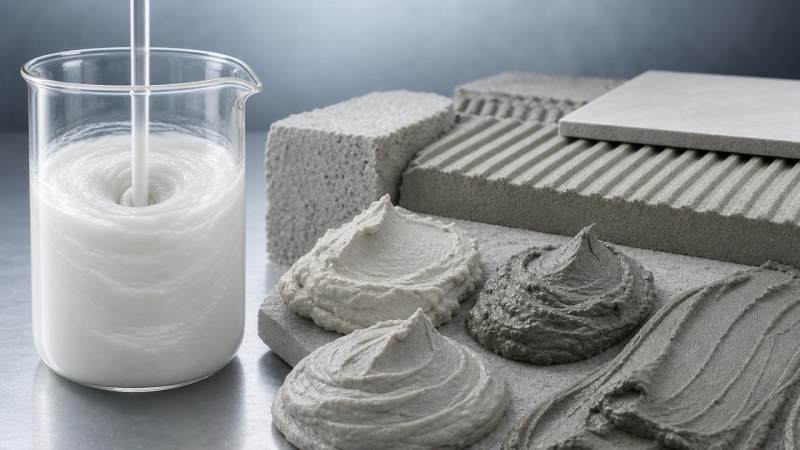
Why does Methyl Hydroxyethyl Cellulose (MHEC) matter in construction materials?
Methyl Hydroxyethyl Cellulose (MHEC) is a cellulose ether used as a performance modifier in dry-mix building products.
It is valued less for bulk content and more for control. A small dosage can change water retention, consistency, open time, and ease of application.
That is why Methyl Hydroxyethyl Cellulose (MHEC) appears so often in tile adhesive, skim coat, wall putty, plaster, and cement-based mortar discussions.
In practical terms, it helps a mix stay workable longer, spread more evenly, and cure with fewer defects linked to fast water loss.
For anyone comparing construction additives, MHEC is one of the core materials to understand because it affects both application feel and finished quality.
So, what exactly is MHEC and how does it work?
MHEC is a non-ionic cellulose ether derived from natural cellulose through chemical modification.
This modification gives it the ability to dissolve in water and form a stable solution with thickening and film-forming behavior.
When added to dry mortar systems, Methyl Hydroxyethyl Cellulose (MHEC) traps water within the mix instead of letting it disappear too quickly into porous substrates.
That retained water supports cement hydration and gives installers more time to spread, level, and adjust materials.
It also improves slip resistance and sag control in many vertical applications. This matters when tile adhesive or render must hold shape after placement.
Another useful point is consistency. With the right grade, MHEC helps a formulation behave more predictably across temperature and substrate changes.
That is one reason global cellulose ether suppliers invest in viscosity control, substitution stability, and production precision.
Jinan Ludong Chemical Co., Ltd., established in 2020, works in this broader cellulose ether field, combining production, trading, and integrated support for construction formulations.
Its manufacturing system covers large-volume output and controlled viscosity ranges, which reflects how performance additives are judged in real project conditions.
Where is MHEC most commonly used, and why there?
The most common use of Methyl Hydroxyethyl Cellulose (MHEC) is in dry-mix construction materials that need water control and better workability.
Its role changes slightly from one product to another, so the application context matters.
- Tile adhesives: improves open time, anti-slip behavior, and smoother troweling.
- Wall putty and skim coat: supports smooth spreading, edge retention, and reduced cracking from uneven drying.
- Cement render and plaster: helps water retention and pumping or hand-application stability.
- Self-leveling and repair mortars: may contribute to viscosity balance, though the required grade must be chosen carefully.
- EIFS and insulation systems: assists adhesion and application control in layered systems.
A useful way to read these applications is simple. Wherever water leaves too fast or the mix becomes hard to handle, MHEC often becomes relevant.
In some formulas, it is also paired with other modifiers. For example, starch ethers can fine-tune sag resistance and working feel.
That is why some formulators review options such as Hydroxypropyl Starch Ether alongside cellulose ethers rather than treating one additive as a complete solution.
How do you judge whether one MHEC grade is suitable for a formula?
This is where many searches become more specific. Knowing what MHEC is does not automatically tell you which grade fits a construction material.
A better approach is to judge by performance targets, not by product name alone.
In real evaluation, the question is rarely “Which MHEC is best?”
The more useful question is “Which grade gives the right balance for this substrate, climate, application method, and cost target?”
That is why large suppliers emphasize controlled manufacturing. Ludong Chemical, for example, operates integrated production lines and viscosity control from 400 to 200,000 CPS in related cellulose ether products.
That kind of range matters because a tile adhesive and a wall putty rarely need the same rheology behavior.
What is MHEC often confused with, and do those differences matter?
Yes, they matter, especially during formula design. MHEC is often compared with HPMC and sometimes discussed together with starch ethers and redispersible polymer powders.
These materials do not do the same job, even when they appear in the same mortar system.
MHEC mainly helps with water retention, thickening, and workability control.
HPMC can offer similar core functions, but formulation response may differ depending on substitution pattern, thermal behavior, and target application.
Redispersible polymer powder improves flexibility, adhesion, and deformation performance rather than acting as a direct replacement for MHEC.
Starch ethers are usually introduced to adjust anti-sag properties and application texture. In some systems, Hydroxypropyl Starch Ether may complement cellulose ether performance instead of competing with it.
A common mistake is trying to substitute one additive for another only by comparing price per kilogram.
The better comparison is cost per finished performance, including rework risk, ease of use, and final surface quality.
What problems appear when MHEC is chosen or used incorrectly?
Most issues are not dramatic at first. They show up as small application problems that later become quality complaints.
- Insufficient water retention can shorten open time and weaken bonding.
- Excessive viscosity can make mixing heavy and spreading difficult.
- Poor grade matching may cause sagging, uneven texture, or delayed setting behavior.
- Ignoring climate and substrate absorption can distort trial results.
Another frequent misunderstanding is assuming lab success guarantees field success.
Actual site conditions introduce temperature shifts, water quality differences, and inconsistent mixing energy.
Because Methyl Hydroxyethyl Cellulose (MHEC) influences rheology and moisture behavior, those variables can noticeably change the result.
A practical safeguard is to confirm three things together: dosage window, substrate response, and compatibility with the full additive package.
If the goal is better decisions, what should be checked next?
Start with the application, not the chemical name alone.
If the target is tile adhesive, focus on open time, anti-slip performance, and spreadability. If the target is putty, surface feel and crack control may matter more.
Then compare candidate grades under realistic water addition and substrate conditions.
It also helps to review the supplier’s production consistency, technical range, and related additive portfolio.
That broader view is useful because construction formulas often combine cellulose ethers, polymer powders, and specialty auxiliaries rather than relying on one ingredient.
Methyl Hydroxyethyl Cellulose (MHEC) remains a key starting point, but the right decision comes from matching grade, dosage, and formula design to the job requirement.
A sensible next step is to define the end-use scenario, list the performance issues to solve, and test against a clear acceptance standard for workability, retention, and finish quality.
Send Your Inquiry
We welcome your cooperation and we will develop with you.
