


2026 Xinjiang International Agri-Machinery Expo Opens May 25
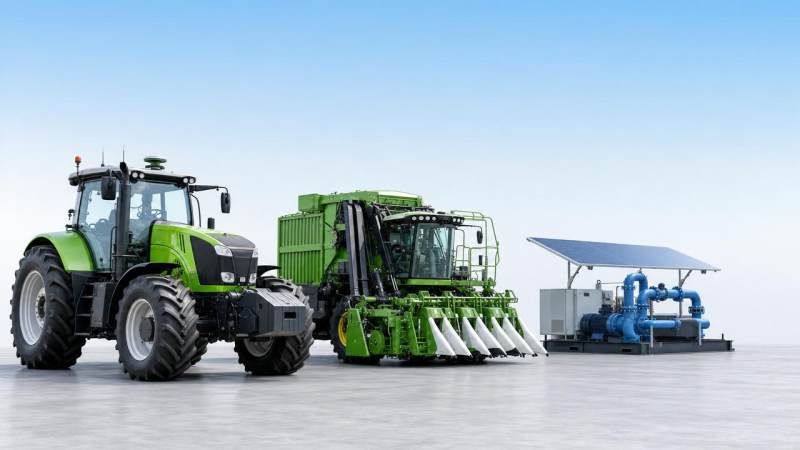
The 2026 Xinjiang International Agricultural Machinery Exhibition opens on May 25, 2026, in Urumqi — signaling a concentrated delivery window for Chinese intelligent agricultural machinery exports to Central Asia under the Belt and Road Initiative. Stakeholders in agricultural equipment manufacturing, export logistics, precision farming technology integration, and cross-border trade compliance should monitor developments closely, as this event reflects evolving institutional support for regional agri-machinery trade.
Event Overview
The 2026 Xinjiang International Agricultural Machinery Exhibition will be held from May 25 to 27, 2026, in Urumqi. It is jointly organized by China’s three national-level agricultural machinery associations. For the first time, the exhibition features a dedicated ‘Central Asian Agricultural Machinery Procurement Matching Zone’. Official procurement delegations from Kazakhstan, Uzbekistan, and three other Central Asian countries — led by their respective Ministries of Agriculture — have confirmed attendance. Their priority procurement items include BeiDou-guided tractors, intelligent cotton harvesting systems, and photovoltaic-powered irrigation equipment. Concurrently, an ‘Export Customs Clearance Green Channel’ has been launched in coordination with Urumqi Customs, offering RCEP Certificate of Origin issuance on a ‘review-and-issue-immediately’ basis.
Impact on Specific Industry Segments
Direct Exporters & OEM Manufacturers: These enterprises face direct demand signals from five Central Asian governments. The official nature of the procurement delegations implies formal tendering processes may follow post-event; impact manifests in near-term order pipeline visibility and potential shifts in product certification priorities (e.g., GNSS interoperability, local language UI, or solar compatibility standards).
Smart Farming System Integrators: As北斗 navigation tractors and intelligent cotton harvesters are highlighted procurement targets, integrators supplying core modules — such as real-time kinematic (RTK) receivers, machine vision subsystems, or cloud-based fleet management platforms — may see upstream demand acceleration. Impact centers on technical alignment with end-use requirements in arid, large-scale cotton production environments.
Renewable-Powered Equipment Suppliers: PV-driven irrigation devices are explicitly named as priority imports. Suppliers of solar pumps, MPPT controllers, and low-voltage DC irrigation motors may experience increased inquiry volume from regional distributors — particularly those already active in Xinjiang or neighboring provinces with similar climatic conditions.
Export Compliance & Logistics Service Providers: The introduction of the ‘Green Channel’ for RCEP origin certification directly affects service providers handling documentation, customs brokerage, and inland transport coordination. Impact includes higher demand for rapid origin verification services and tighter synchronization between factory dispatch timelines and customs submission windows.
What Relevant Enterprises or Practitioners Should Focus On and How to Respond
Monitor official procurement frameworks beyond the exhibition
While delegation attendance is confirmed, formal procurement procedures — including tender announcements, technical specifications, and financing mechanisms (e.g., buyer credit lines or intergovernmental agreements) — remain unconfirmed. Enterprises should track communications from the five Central Asian agriculture ministries and China’s Ministry of Commerce for subsequent procedural guidance.
Validate technical and regulatory readiness for target markets
BeiDou navigation systems, cotton harvester autonomy levels, and PV irrigation efficiency metrics may be subject to local testing or registration requirements. Exporters should proactively review existing certifications (e.g., CE, EAC, or national type-approval status) and assess gaps against likely Central Asian regulatory expectations — especially where no bilateral mutual recognition agreement currently exists.
Distinguish policy facilitation from immediate commercial execution
The ‘Green Channel’ expedites RCEP origin certification but does not guarantee tariff reduction applicability — actual duty treatment depends on Harmonized System (HS) code classification, product origin criteria, and importer-side customs administration. Companies should verify HS code eligibility and confirm importers’ capacity to utilize RCEP preferences before finalizing pricing or delivery terms.
Prepare for post-event follow-up coordination
Given the official nature of the delegations, follow-up may involve provincial-level agricultural bureaus in Xinjiang or China’s Ministry of Agriculture and Rural Affairs. Exporters should designate internal points of contact familiar with both technical documentation and intergovernmental cooperation protocols — and ensure digital asset repositories (e.g., bilingual spec sheets, test reports, installation manuals) are updated and accessible.
Editorial Perspective / Industry Observation
Observably, this event functions less as a standalone transaction platform and more as a formalized inflection point in institutional coordination between China and Central Asian agricultural authorities. Analysis shows that the co-location of procurement delegations, targeted product focus, and embedded customs facilitation suggests a shift toward structured, government-anchored trade rather than purely market-driven export activity. From an industry perspective, it is better understood as a signal of emerging standardization pathways — not yet a fully operationalized export corridor. Continued attention is warranted because implementation fidelity (e.g., consistency of green channel application, timeliness of RCEP certificate issuance, and transparency of post-event tendering) will determine whether this becomes a replicable model for other Belt and Road regions.
Conclusion: The 2026 Xinjiang International Agricultural Machinery Exhibition marks a procedural milestone in Sino–Central Asian agri-machinery trade infrastructure — not a sudden surge in volume. Its significance lies in the alignment of policy intent, official engagement, and operational support mechanisms. Currently, it is more appropriately interpreted as a coordinated readiness test for export ecosystems, rather than evidence of immediate scale-up. Stakeholders should treat it as a calibration opportunity: assessing capability gaps, verifying documentation pathways, and refining cross-border coordination protocols — ahead of broader regional rollout.
Source Attribution: Information derived solely from the provided briefing on the 2026 Xinjiang International Agricultural Machinery Exhibition, including confirmed participation of Central Asian procurement delegations, establishment of the ‘Central Asian Procurement Matching Zone’, and launch of the RCEP origin certification green channel with Urumqi Customs. No external data, third-party reports, or speculative background context has been incorporated. Ongoing observation is required regarding actual tender issuance, contract signing volumes, and post-event implementation of the green channel mechanism.
Send Your Inquiry
We welcome your cooperation and we will develop with you.
