


China HPMC Supplier Comparison: Lead Time, MOQ, Grades, and Documentation
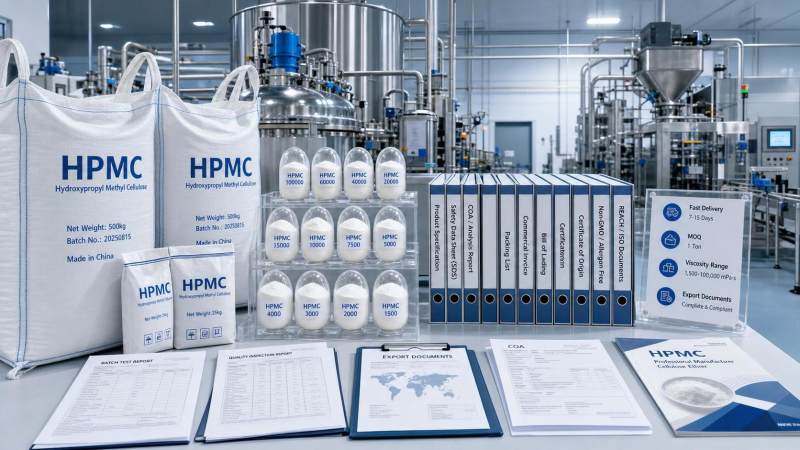
Start with the four items that actually cause purchasing trouble
When buyers compare a China HPMC supplier, the discussion usually begins with price and sample performance. In practice, the deals that go wrong tend to break somewhere else: production lead time slips, MOQ does not match inventory reality, the grade offered is too broad to control application results, or the paperwork is not usable for import, quality release, or customer audits.
That is why a serious comparison has to stay grounded in operations. If you are evaluating suppliers for construction or chemical applications, treat lead time, MOQ, grade range, and documentation as linked checks rather than separate boxes. A supplier may look strong on one item and still create avoidable supply risk on the next.
Check lead time in layers, not as one number
A quoted lead time is only useful if you know what it covers. Buyers often ask, “What is your lead time?” and receive a clean answer in days. That number may refer only to ex-works production after payment, or only to standard grades, or only to a period when raw material supply is stable.
Break it down:
- Time to issue and confirm the final specification
- Production scheduling time for the specific HPMC grade
- Time required for packaging, labeling, and batch release
- Time to prepare export documents
- Port delivery window or container booking readiness
This matters even more when your purchase includes multiple viscosities, special packaging marks, or mixed products such as HPMC with RDP or HPS in the same shipment. The more variation you add, the less meaningful a single headline lead time becomes.
A useful comparison question: ask each supplier to define lead time separately for sample order, first commercial order, and repeat order. Those are different operational scenarios. A supplier that handles repeat orders smoothly may still move slowly on first-order documentation alignment.
Treat MOQ as a planning issue, not just a negotiation point
MOQ is usually discussed as a price lever. That is too narrow. For business evaluators, MOQ is a signal about production flexibility, stock strategy, and the supplier’s willingness to support trial-stage business.
A low MOQ sounds attractive, but it only helps if the supplier can keep batch consistency and documentation discipline on smaller runs. On the other side, a high MOQ may be reasonable for standard, high-volume grades if your usage is predictable and freight economics improve with full loads.
What you need to pin down is the real MOQ structure:
- MOQ per grade
- MOQ per order value
- MOQ for private label or custom packaging
- MOQ for first trial order versus repeat order
- Whether mixed grades can be combined in one shipment
A common mistake is comparing two suppliers only on the minimum tonnage shown in a quotation sheet. That misses the operational burden. If one supplier allows mixed loading across several HPMC viscosities and another requires separate minimums for each grade, the second offer may lock up more working capital even when unit price looks lower.
Do not accept “construction grade” as a complete answer
Grades need to be matched to the application decision you are actually making. “Construction grade” and “chemical grade” are useful broad labels, but they are not enough for procurement approval. You need to know whether the supplier’s range covers the functional window your formulation requires.
For HPMC, buyers typically compare by viscosity range first, because that is how many internal teams screen options. That helps, but it still does not complete the picture. Two materials with the same nominal viscosity band can behave differently in use depending on formulation fit, substitution profile, moisture control, and batch consistency.
A supplier with a broad portfolio is usually easier to work with when your demand spans different use cases. For example, some manufacturers offer HPMC series used across building materials and other chemical applications, with viscosity options running from low to very high ranges. That kind of range can shorten supplier consolidation work, but only if the supplier can clearly map each grade to intended use and provide stable batch documentation.
What to ask for during comparison:
- Grade list with viscosity categories and intended applications
- Internal naming logic for product series, so you are not comparing mismatched items
- Whether the same grade is produced routinely or only on request
- Whether commercial samples come from standard production batches or lab-prepared material
That last point is not minor. If the sample is not representative of normal production, your lab approval can give a false sense of security.
Documentation is where many supplier comparisons become real
A supplier may have acceptable product and acceptable price, but weak documentation can still derail the purchase. In cross-border chemical sourcing, paperwork is not an administrative afterthought. It affects customs clearance, internal quality release, downstream customer acceptance, and sometimes even whether the material can be booked into your system on time.
For a China HPMC supplier comparison, check whether the supplier can provide a clean document set tied to each shipment and batch. The exact list depends on your market, application, and customer requirements, but the evaluation method is consistent: ask for sample documents early and review them field by field.
The trap here is assuming all suppliers provide equivalent documents because they all say they can. Look for consistency between the grade name on the quotation, the sample label, the technical sheet, and the COA format. If those do not line up early, they usually do not get better under shipping pressure.
Compare production scope, because it affects continuity
A supplier’s available grade range and production capacity are not just marketing points. They shape supply continuity and how easily the relationship scales. If your company may later add adjacent cellulose ether needs, it is useful to know whether the manufacturer is built around a wider cellulose ether platform or a narrow trading model.
For example, some producers operate integrated cellulose ether lines and offer HPMC across construction and chemical grade series, sometimes alongside products such as RDP and HPS. That can simplify vendor management when your procurement roadmap goes beyond a single item. It does not automatically make the supplier better, but it does change the risk profile: broader manufacturing scope can support consolidation, while a narrower scope may still work well if your demand is focused and the execution is disciplined.
Ask how they handle batch consistency before you debate price
Price discussions often come too early. If your application is sensitive to viscosity stability or formulation behavior, the real cost sits in rework, complaint handling, and downtime. A lower quote loses value quickly when every new batch requires extra internal adjustment.
You do not need a theoretical lecture from the supplier. You need practical answers: how is the batch identified, what release data is tied to it, and whether repeat orders are controlled under the same grade definition used during sample approval. If the supplier has modern and large-scale production capability, ask how that translates into repeatability, not just output volume.
Use a simple decision sequence during supplier screening
This is the order that usually saves time:
- Confirm that the supplier’s grade range actually covers your application window.
- Test whether MOQ fits your launch volume, safety stock plan, and warehouse turnover.
- Break down lead time for first order and repeat order, including document preparation.
- Review sample documents before commercial negotiation is finished.
- Only then compare price against the total execution burden.
That sequence keeps you from approving a supplier that looks competitive on paper but creates avoidable friction after PO issuance.
What usually separates a workable supplier from a risky one
In this category, the difference is rarely one dramatic red flag. It is usually a pattern. The workable supplier answers with specific grade mapping, realistic lead-time logic, MOQ terms that match actual production conditions, and documents that line up across sales, quality, and shipping. The risky supplier stays vague, mixes broad product language with narrow commitments, and treats documentation as something to sort out after payment.
If you are comparing more than one China HPMC supplier, keep the scorecard operational. Put each supplier through the same four checks, review sample paperwork before final approval, and make sure the offered grade is tied to repeatable supply rather than a one-off sample. That is the cleaner way to reduce procurement risk and choose a supplier you can keep using after the first order.
Send Your Inquiry
We welcome your cooperation and we will develop with you.
