


What to Check Before Choosing a China HPMC Supplier for Tile Adhesive Production
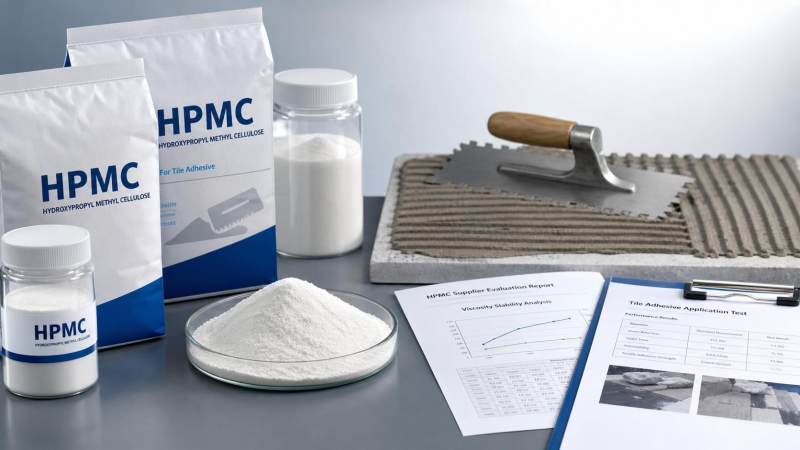
Start with the grade, not the quote
When a technical team screens a China HPMC supplier for tile adhesive production, the first mistake is usually the same: comparing offers before locking down the actual HPMC profile needed by the formula. Price only makes sense after the material target is clear. A supplier may offer a competitive number, but if the product drifts on viscosity behavior, water retention, or mixing feel, the low quote gets paid back later through reformulation time, production instability, and site complaints.
For tile adhesive, HPMC is not just a thickener. It affects open time, sag resistance, slip behavior, workability, water retention, and how consistently the dry mix behaves from batch to batch. That is why technical evaluation should go beyond a sample pass/fail test. You need a checklist that exposes whether the supplier can support stable production at scale, not just send one acceptable sample.
Define the application window before asking for samples
Before you contact suppliers, write down the actual use case the HPMC must serve. Interior wall adhesive, floor tile adhesive, large-format tile systems, and formulas adjusted for hot or dry climates do not stress the material in exactly the same way. If your team asks for a “tile adhesive grade” without describing the mortar system, the sample selection becomes guesswork.
At minimum, define these points in your internal brief:
- Target application type and substrate conditions
- Current binder system and whether RDP is included
- Expected workability and anti-sag behavior
- Target open time and water retention range used in your own lab practice
- Production scale, mixer type, and any known dusting or dispersion issues
This sounds basic, but it changes the whole conversation. A capable supplier will ask follow-up questions here. A weak one will immediately push whatever standard grade is easiest to sell.
Check whether the supplier can match the viscosity range you actually use
Viscosity is usually the first number people ask for, and it still matters. But the useful question is not “What viscosity do you have?” It is “Which viscosity range is stable in production, and how is it controlled across batches?”
Some manufacturers can supply a broad portfolio, from low to very high viscosity grades. That is useful only if the grade definitions are consistent and repeatable. A technical buyer should ask for the product grade sheet, the nominal viscosity range, and the supplier’s own batch control approach. If the number on paper looks fine but test results move around from lot to lot, the problem is not the target value. The problem is process control.
Do not treat two products with the same stated CPS level as interchangeable. Similar nominal viscosity can still produce different mixing feel, build, and anti-slip performance in tile adhesive.
Look past viscosity and evaluate application behavior in mortar
A supplier can pass a viscosity specification and still fail in real adhesive performance. What your lab needs to know is how the HPMC behaves inside the full tile adhesive formula. That means screening for the things production and end users actually notice:
- Water retention under your normal dosage range
- Workability during mixing and troweling
- Resistance to sag on vertical application
- Open time retention, especially after standing
- Compatibility with cement, fillers, and polymer powder already in the formula
- Whether the mix feels smooth, sticky, or overly heavy in use
This is where experienced teams save time. They do not only ask for a standard TDS. They run side-by-side mortar tests against the current benchmark material and watch for trade-offs. A sample that improves water retention but makes the mix slow to spread may not be the right replacement. Another sample may give good feel but poor open time margin in dry weather. Those are commercial risks later, so they should be found early.
Ask how the supplier manages batch stability
For tile adhesive producers, one good sample is easy. Consistent supply is hard. A reliable China HPMC supplier should be able to explain how batches are controlled, how retained samples are managed, and what happens when a lot falls near the edge of the internal specification.
You do not need a marketing answer here. You need signs of an operating system. Ask for the certificate of analysis format, batch identification method, and whether the same grade is produced through a standardized process line. If the supplier cannot describe how a commercial lot is tied back to internal records, the risk is obvious: once a field issue happens, tracing the cause becomes slow and expensive.
A useful practical check is to request samples from different production lots rather than testing only one retained sample. If the performance spread is wide, that tells you more than any sales presentation will.
Verify production capacity in the context of your demand pattern
Capacity matters, but only in a specific way. A supplier may have large stated output, yet still struggle with your order rhythm, packaging format, or lead-time expectations. Technical teams should involve purchasing and planning early enough to compare real supply conditions, not headline numbers.
What to check:
- Whether the grade you need is a regular production grade or a special-order item
- Typical lead time for repeat orders, not just first samples
- Support for the packaging size your plant uses
- Ability to hold stable supply if your monthly demand rises quickly
- Whether multiple grades are available if formula adjustment becomes necessary
This is especially relevant when you are scaling a new tile adhesive line. Supply interruptions do not only delay raw material receipt. They can force last-minute substitutions that reset lab validation work.
Review the technical documents as working tools, not paperwork
A decent supplier should be able to provide a technical data sheet, safety data sheet, and certificate of analysis for the grade under evaluation. The point is not to collect files. The point is to read them for decision value.
If product naming, batch coding, and document details do not line up cleanly, stop there and ask questions. Documentation gaps usually show up elsewhere too.
Test the supplier’s application support, not just the sample quality
A good sample without useful technical support is still a risk. During evaluation, notice how the supplier responds when your lab shares trial feedback. Do they ask about dosage, cement type, filler ratio, and mixing procedure? Do they suggest another grade when the first one shows weak anti-sag or unsatisfactory open time? Or do they simply repeat that the product is “widely used”?
That response quality matters because most selection projects do not end with the first sample. Adjustment is normal. The real question is whether the supplier can help your team shorten the tuning cycle.
Check compatibility with the rest of the dry-mix system
HPMC is evaluated inside a formula, not in isolation. If your tile adhesive uses RDP, starch ether, or a specific cement-filler balance, ask the supplier how they typically position the grade within that kind of system. You are not looking for generic application claims. You are looking for whether they understand interaction effects.
A common mistake is to approve a grade after one positive lab result, then discover during scale-up that the mixing sequence or water demand shifts enough to affect throughput. This is why pilot-level confirmation matters, especially when changing more than one additive source at the same time.
Do not ignore packaging, storage, and shipment details
Technical teams sometimes leave this to procurement, but it can directly affect material condition on arrival. Review packaging type, moisture protection, labeling clarity, and whether each unit links clearly to the batch documentation. For imported material, ask how the product is packed for longer transit cycles and warehouse handling.
If bags arrive poorly sealed, hard to identify, or inconsistent in net condition, the issue does not stay in logistics. It comes back to the plant as handling loss, traceability problems, or questionable raw material performance after storage.
Use a short decision filter before moving to commercial approval
By the time the lab work is done, the choice is usually clearer than people think. The final screen should be practical:
- Does the grade perform consistently in your tile adhesive formula, not only in a single sample test?
- Can the supplier explain batch control and provide usable lot documentation?
- Can they support repeat orders at the pace your plant actually needs?
- When trial feedback is shared, do they respond like a technical partner or only like a trader?
- Has the material been checked under the same processing conditions your production line uses?
If one of those answers is weak, keep the supplier in the sample stage. Do not rush to qualification because the initial quote looks attractive.
What a solid evaluation usually looks like
The best technical evaluations follow a simple order. Define the adhesive application window. Screen the HPMC grade against the real formula. Compare multiple lots, not one. Review traceability documents. Then pressure-test supply capability and support response. That sequence catches more risk than spending weeks arguing over headline price.
For tile adhesive production, the right China HPMC supplier is the one that can keep performance stable when orders get larger, seasons change, and formula tolerances tighten. That is the standard worth buying against.
Send Your Inquiry
We welcome your cooperation and we will develop with you.
