


China Port Container Throughput Down 5.3% MoM in April 2026
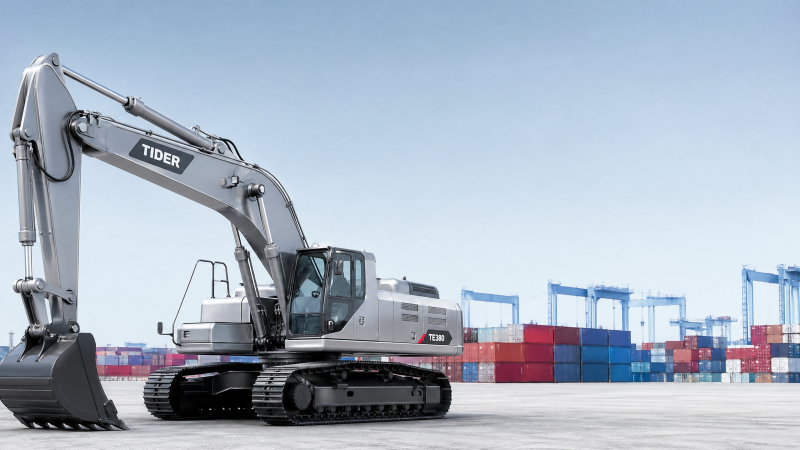
China’s national container throughput at major ports declined 5.3% month-on-month in April 2026, with extended equipment consolidation lead times at Qingdao and Ningbo ports signaling operational adjustments for exporters targeting RCEP and Middle Eastern markets—particularly those in the construction machinery sector.
Event Overview
According to statistics released by China’s Ministry of Transport on April 28, 2026, national container throughput across key Chinese ports fell 5.3% month-on-month during April 1–28, 2026. The decline is attributed to a temporary reduction in vessel capacity on Southeast Asia routes and carrier-level adjustments in slot allocation. At Qingdao Port and Ningbo Port, average inland consolidation time for exported construction machinery bound for RCEP and Middle Eastern markets increased from 14 days in March to 18–22 days in April. For oversized units, coordination with roll-on/roll-off or specialized heavy-lift vessels became necessary.
Industries Affected
Direct Exporters (Construction Machinery Manufacturers)
These enterprises face longer pre-shipment lead times due to extended port dwell and scheduling constraints. Delays directly impact delivery commitments, especially under fixed-incoterm contracts (e.g., FOB or CIF), and may trigger demurrage or storage cost exposure if inland transport or yard planning does not accommodate the new 18–22-day window.
Supply Chain Service Providers (Freight Forwarders & NVOCCs)
Forwarders managing consolidated shipments for machinery exporters must now adjust inland pickup windows, documentation timelines, and vessel booking buffers. The shift from 14-day to 18–22-day consolidation requires recalibration of transit time guarantees and increases dependency on real-time port slot visibility—especially for non-standard cargo requiring special handling approvals.
Logistics & Terminal Operators (Port-adjacent Warehousing & Yard Services)
Extended consolidation cycles increase demand for secure, long-duration equipment staging space. Operators with limited heavy-equipment parking capacity or insufficient roll-on/roll-off infrastructure may face bottlenecks, particularly when coordinating with specialized carriers whose sailings are less frequent and require advance reservation.
International Buyers (RCEP & Middle East Importers)
Importers relying on just-in-time project schedules—such as infrastructure contractors in Vietnam, Indonesia, or Saudi Arabia—may experience downstream delays. Longer port consolidation times reduce visibility into final departure dates, complicating customs clearance planning and local logistics synchronization.
What Enterprises Should Monitor and Do Now
Track official updates on vessel deployment patterns
Monitor weekly announcements from China’s Ministry of Transport and liner alliance advisories (e.g., THE Alliance, Ocean Alliance) for signals of sustained capacity rebalancing—not just April’s one-off adjustment. Capacity shifts on Southeast Asia routes often precede broader network changes affecting transshipment hubs like Singapore or Port Klang.
Review and adjust internal consolidation timelines for high-value machinery exports
Reassess current inland transport, documentation submission, and yard entry schedules. If current processes assume ≤14-day consolidation, revise SOPs to incorporate an 18–22-day baseline—and build in at least 3-day contingency for oversized units requiring special vessel coordination.
Verify vessel availability and booking lead times for RCEP/Middle East lanes
Contact carriers and terminal operators directly to confirm rolling availability of roll-on/roll-off or heavy-lift services at Qingdao and Ningbo. Avoid reliance solely on standard container vessel schedules; dedicated equipment transport slots are booked weeks in advance and subject to stricter cut-off deadlines.
Clarify responsibility for extended dwell time in contracts
Where export contracts do not explicitly allocate risk for port consolidation delays beyond standard terms, revisit Incoterms® 2020 clauses—especially those governing loading responsibilities (e.g., FCA vs. FOB) and associated costs (e.g., yard storage, handling surcharges). Document all coordination efforts related to special vessel requests for audit and claim purposes.
Editorial Perspective / Industry Observation
Observably, this throughput dip and consolidation extension are better understood as a short-term operational recalibration than a structural downturn. The 5.3% MoM decline aligns with seasonal post-Q1 capacity optimization cycles seen in prior years, and the extended machinery lead time reflects targeted carrier resource reallocation—not systemic port congestion or policy-driven restrictions. Analysis shows that such adjustments typically stabilize within 4–6 weeks unless accompanied by concurrent trade policy shifts or regional port disruptions. From an industry perspective, this event functions more as an early signal of evolving carrier routing priorities than as evidence of weakening export demand.
Current more relevant interpretation: It highlights growing operational complexity in exporting capital goods via standard containerized channels—especially where physical dimensions or weight exceed conventional TEU limits. As more manufacturers pursue RCEP market access, the need for integrated planning across manufacturing, inland logistics, port operations, and vessel procurement becomes increasingly critical.
Conclusion: This April data point underscores a tightening linkage between maritime capacity management and industrial export execution. Rather than indicating broad-based softness, it reflects a localized but operationally significant shift in how containerized heavy equipment moves through key Chinese gateways. Stakeholders should treat it as a prompt to stress-test end-to-end logistics resilience—not as a macroeconomic warning sign.
Source: Ministry of Transport of the People’s Republic of China — Official Statistical Bulletin, April 28, 2026.
Noted for ongoing observation: Whether the 18–22-day consolidation window persists beyond May 2026, and whether similar extensions emerge at other RCEP-facing ports (e.g., Shanghai, Guangzhou).
Send Your Inquiry
We welcome your cooperation and we will develop with you.
