


Chip Shortage Delays Port Crane Control Systems and Construction Equipment Exports
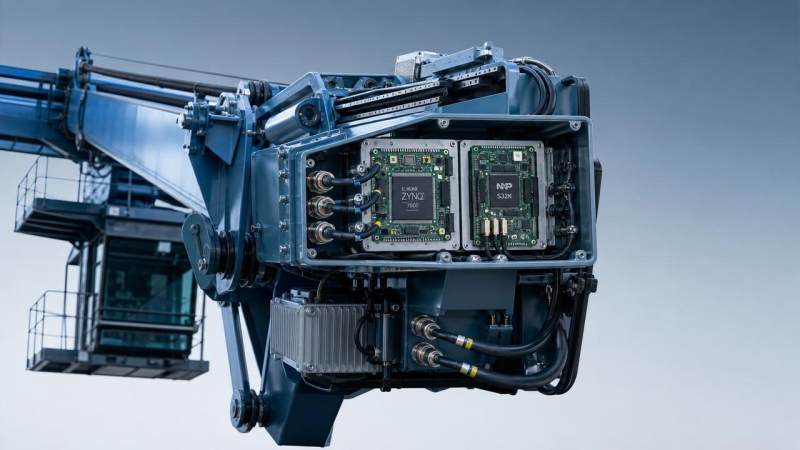
Global shortages of industrial-grade FPGAs and real-time control MCUs—including Xilinx Zynq-7000 and NXP S32K series chips—have tightened supply for port quay crane control systems in China, extending lead times for exported construction machinery to 14–18 weeks. Though the exact onset date is not publicly specified, multiple leading exporters confirmed the extended delivery window applies to orders signed in May 2026, directly affecting project timelines in key markets including North America, Europe, and the Middle East. This development warrants close attention from manufacturers of automated port equipment, global construction machinery exporters, and suppliers embedded in industrial control electronics supply chains—because it signals a tangible constraint at the intersection of semiconductor availability and heavy equipment deployment.
Event Overview
Domestic manufacturers of automated port quay cranes in China are experiencing constrained production capacity due to sustained global shortages of industrial-grade field-programmable gate arrays (FPGAs) and real-time microcontroller units (MCUs), specifically models such as the Xilinx Zynq-7000 and NXP S32K series. As a result, delivery of integrated systems—including smart spreaders, remote operation interfaces, and unified construction machinery control platforms—is delayed. Several top-tier Chinese construction equipment exporters have confirmed that the standard delivery timeline for new orders signed in May 2026 has increased from the previous 10 weeks to 14–18 weeks. This delay impacts overseas project execution in priority markets: North America, Europe, and the Middle East.
Industries Affected
Port Automation Equipment Manufacturers
These firms rely on imported FPGA and MCU components for real-time motion control, safety interlocking, and sensor fusion in quay cranes. The shortage directly limits their ability to assemble and commission fully integrated control systems—especially those requiring certified, deterministic response times. Impact manifests as delayed system integration cycles, postponed site commissioning, and potential contractual penalties where fixed delivery milestones apply.
Construction Machinery Exporters
Export-oriented OEMs integrating these control subsystems into complete machines face cascading delays. Extended lead times (now 14–18 weeks versus 10) compress available scheduling windows for shipping, customs clearance, and on-site installation—particularly problematic for turnkey infrastructure projects with rigid start dates. Revenue recognition timing may also shift, affecting quarterly financial reporting and cash flow planning.
Industrial Electronics Suppliers & Distributors
Suppliers handling logistics, programming, certification, or board-level assembly for FPGA/MCU-based control modules face reduced order intake and higher qualification overhead. With no near-term relief in component allocation visibility, they must manage customer expectations amid uncertain build schedules and potential substitution requests—many of which require revalidation under IEC 61508 or ISO 13849 functional safety standards.
What Stakeholders Should Monitor and Do Now
Track allocation updates from authorized distributors and regional sales offices of Xilinx (now AMD) and NXP
Official allocation notices—not informal channel forecasts—are the most reliable indicators of near-term availability. Exporters and system integrators should request written confirmation of component commitments tied to specific order numbers and delivery quarters, rather than relying on verbal estimates.
Review contractual delivery clauses for force majeure and schedule adjustment provisions
Contracts signed before May 2026 may not reflect current supply constraints. Legal and procurement teams should audit active agreements—especially those governing projects in EU or GCC jurisdictions—to assess flexibility around delivery windows, liquidated damages, and milestone-based payments.
Validate alternative part numbers or dual-sourcing options within existing hardware design constraints
Some Zynq-7000 or S32K variants may be substituted with functionally equivalent but less constrained parts (e.g., certain Artix-7 FPGAs or S32K14x derivatives), provided firmware compatibility and safety certification remain intact. Engineering teams should prioritize validation efforts on designs already in pilot or low-volume production—not greenfield platforms.
Adjust production planning to align with confirmed chip delivery dates—not historical throughput rates
Manufacturing operations should decouple master scheduling from legacy cycle-time assumptions. Instead, weekly alignment meetings between procurement, engineering, and export logistics should use verified component arrival dates (with buffer) as the primary input for release-to-build decisions.
Editorial Observation / Industry Perspective
Observably, this delay reflects more than a transient logistics hiccup—it underscores a structural dependency on a narrow set of industrial-grade semiconductors with limited second-source options and long qualification cycles. Analysis shows the extension to 14–18 weeks is not merely a reflection of backlog, but of constrained wafer capacity allocation for automotive- and industrial-grade process nodes (e.g., 28nm and 40nm), where demand from EV and ADAS applications continues to absorb available output. From an industry standpoint, this is best understood not as an isolated component shortage, but as an early indicator of cross-sectoral pressure on legacy-node foundry capacity—a trend likely to persist through 2026. Current visibility remains limited, and the situation warrants ongoing monitoring, particularly as major foundries report Q2 2024 utilization rates for mature nodes.
This development is less a short-term disruption and more a signal of evolving supply chain risk profiles for capital equipment exporters. It highlights how dependencies once considered manageable—such as single-source FPGA procurement for safety-critical motion control—can rapidly become critical path constraints when broader industrial demand shifts. The fact that delays are now formally reflected in new-order delivery windows (not just internal forecasts) suggests the issue has transitioned from operational concern to commercial reality.
The broader significance lies in its implications for infrastructure project execution timelines—especially in markets where port automation and construction equipment imports are tightly coupled with national development plans. For stakeholders, this is best interpreted not as a temporary bottleneck, but as a catalyst for reassessing design resilience, component lifecycle management, and contractual risk allocation in high-value industrial exports.
Information Source: Public statements from multiple Tier-1 Chinese construction machinery exporters (as reported in internal order acknowledgment documents dated May 2026); component shortage data referenced aligns with publicly disclosed allocation guidance from AMD (Xilinx) and NXP regional distribution channels in Q2 2024. Ongoing observation is required regarding foundry capacity reports from TSMC and UMC for 28nm/40nm industrial process nodes—data not yet publicly updated beyond Q2 2024.
Send Your Inquiry
We welcome your cooperation and we will develop with you.
