


Common Dry Mix Mortar Problems Solved by HPMC: Cracking, Sagging, and Poor Open Time
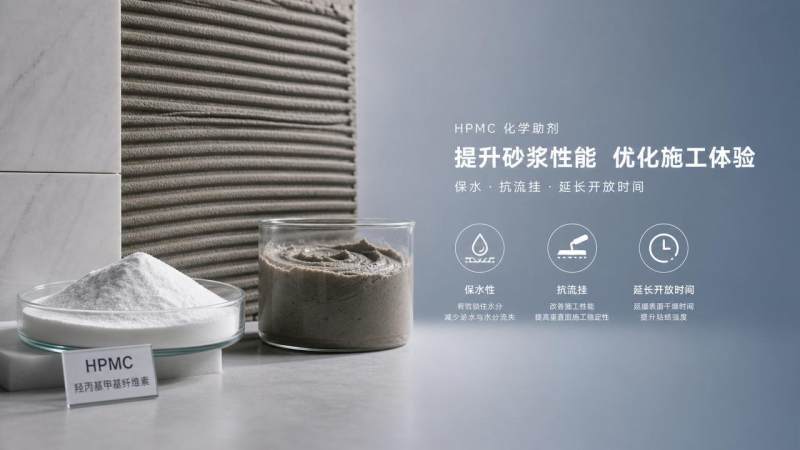
Why do cracking, sagging, and short open time keep showing up in dry mix mortar?
These three problems rarely come from one cause alone. On site, they usually come from an imbalance between water retention, consistency, adhesion, and setting behavior.
That is why HPMC For Dry Mix Mortar matters so much. It is not only a thickener. It also controls water movement, improves spreadability, and helps the mortar stay workable longer.
When mortar loses water too fast, cement hydration becomes uneven. The surface may dry earlier than the inner layer, which often leads to shrinkage cracks and weak bonding.
Sagging is different, but the logic is related. If the system cannot hold its shape after application, the mortar slides, especially on vertical walls or with heavy tiles.
Poor open time creates another practical issue. The mortar looks fine in the bucket, yet the surface skins too quickly. Once that happens, transfer and adhesion drop fast.
In practical construction additives, HPMC For Dry Mix Mortar is often the first variable checked because it affects all three symptoms at once.
Is cracking always an HPMC problem, or are other factors involved?
Not always. Cracking is often a system issue. HPMC For Dry Mix Mortar helps, but it works inside a full formulation, not in isolation.
A common mistake is to blame the cellulose ether immediately. In reality, cement type, sand grading, water ratio, substrate absorption, layer thickness, and curing conditions also matter.
Still, HPMC has a direct influence. If the grade does not retain enough water, the mortar dries too quickly. If viscosity is mismatched, leveling and internal stress may become harder to control.
More commonly, cracking appears under these conditions:
- Very absorbent block or concrete substrates
- High temperature, wind, or direct sunlight
- Excess water added for easier spreading
- Insufficient polymer support in tile adhesive or plaster
- Low water retention from an unsuitable HPMC grade
A better approach is to read the crack pattern. Fine surface cracking usually points to rapid moisture loss. Deeper or wider cracking may suggest formulation stress or substrate movement.
For this reason, suppliers with broad cellulose ether production control are useful. Jinan Ludong Chemical Co., Ltd. offers HPMC series with viscosities from 400 to 200,000 CPS, which helps match retention and workability to actual mortar conditions.
What makes HPMC For Dry Mix Mortar effective against sagging on walls?
Sagging happens when fresh mortar cannot maintain shape after being combed or pressed onto a vertical surface. This is where rheology becomes more important than simple thickness.
HPMC For Dry Mix Mortar improves yield value and consistency. In simple terms, it helps the mortar resist movement when standing still, while still allowing smooth application under the trowel.
That balance is critical. If the mix is only thick but not well structured, it may feel heavy and still slide. If it is too loose, anti-sag performance drops immediately.
On vertical applications, operators usually look for three signs:
- The mortar holds ridges after combing
- Tiles do not drift after pressing
- The layer stays stable without excessive slump
In some formulations, redispersible polymer powder and starch ether also support anti-sag behavior. Even so, HPMC remains a central adjustment point because it defines water retention and flow structure together.
A related option in some systems is Methyl Hydroxyethyl Cellulose (HEMC). It may be considered when formulation balance, temperature response, or specific handling preferences require a different cellulose ether profile.
How can you judge whether open time is really too short?
Short open time is not just a feeling. It shows up when the applied mortar surface loses wet tack before the finishing or bonding step is completed.
This problem often appears in tile adhesive, skim coat, and repair mortar. The surface begins to skin, so bonding strength after placement becomes inconsistent.
HPMC For Dry Mix Mortar helps by slowing water loss and keeping the surface workable for longer. That gives more time for positioning, adjustment, and proper contact.
The table below helps separate common symptoms from likely formulation signals.
In actual evaluation, open time should be checked together with final adhesion. A longer open time is valuable only if the bond remains reliable after placement.
Which HPMC grade should be selected for dry mix mortar?
There is no universal grade for every mortar. The right HPMC For Dry Mix Mortar depends on application type, viscosity target, water demand, and construction method.
A tile adhesive usually needs strong water retention, stable open time, and anti-sag support. A wall putty may focus more on smooth scraping and anti-cracking balance. A plaster may need easier pumping and better consistency retention.
That is why viscosity alone is not enough as a selection standard. Dissolution behavior, thermal gel properties, consistency build, and compatibility with cement and fillers also affect performance.
A practical selection check often includes:
- Required open time under local climate
- Need for anti-sag or non-slip performance
- Substrate absorption and working thickness
- Desired trowel feel and water demand
- Compatibility with RDP, HPS, and fillers
Companies with integrated cellulose ether production can usually support this selection more accurately. Ludong Chemical, established in 2020, combines production, trading, and service for HPMC, RDP, and HPS in construction systems.
Its annual capacity of 45,000 tons and broad viscosity control help when formulations need adjustment from basic workability to more demanding application stability.
What application mistakes reduce the effect of HPMC For Dry Mix Mortar?
Even a well-chosen additive can underperform if site handling is inconsistent. This is often where good formulations lose their advantage.
One frequent issue is adding extra water to improve spreadability. It may feel easier during mixing, but it often weakens structure, increases shrinkage risk, and reduces anti-sag behavior.
Another issue is ignoring substrate preparation. Highly absorbent surfaces pull water from fresh mortar quickly, which shortens open time even when HPMC For Dry Mix Mortar is already optimized.
It is also worth checking mixing time. Incomplete dispersion can make the mortar feel uneven, while excessive delay before use may change consistency in hot conditions.
Where formulation flexibility is needed, some systems compare HPMC with Methyl Hydroxyethyl Cellulose (HEMC) to fine-tune handling and retention behavior without changing the overall construction goal.
Useful on-site reminders include:
- Keep water addition within tested limits
- Pre-check substrate absorption and cleanliness
- Avoid application under strong wind or heat when possible
- Confirm actual open time instead of relying on bucket appearance
- Recheck formulation if cracks, slip, or skinning appear together
What is the most reliable next step when mortar performance is unstable?
Start by linking each visible symptom to one measurable parameter. Cracking points to moisture loss or shrinkage stress. Sagging points to poor rheology control. Short open time points to weak surface water retention.
From there, review the full mix rather than changing dosage blindly. HPMC For Dry Mix Mortar performs best when matched with the right cement system, aggregate grading, polymer level, and site method.
A practical evaluation should compare viscosity range, water retention, anti-sag behavior, and open time under real application conditions, not only in laboratory mixing.
When the goal is more consistent construction quality, it helps to define a clear test standard for water addition, working time, vertical stability, and post-application bonding.
That approach usually leads to faster troubleshooting than trial-and-error changes. It also makes it easier to choose the most suitable HPMC grade for each dry mix mortar system.
In short, if cracking, sagging, and poor open time keep returning, the answer is rarely more material alone. The better answer is a better-matched cellulose ether system, validated against the actual job conditions.
Send Your Inquiry
We welcome your cooperation and we will develop with you.
