


Common Redispersible Polymer Powder Application Mistakes
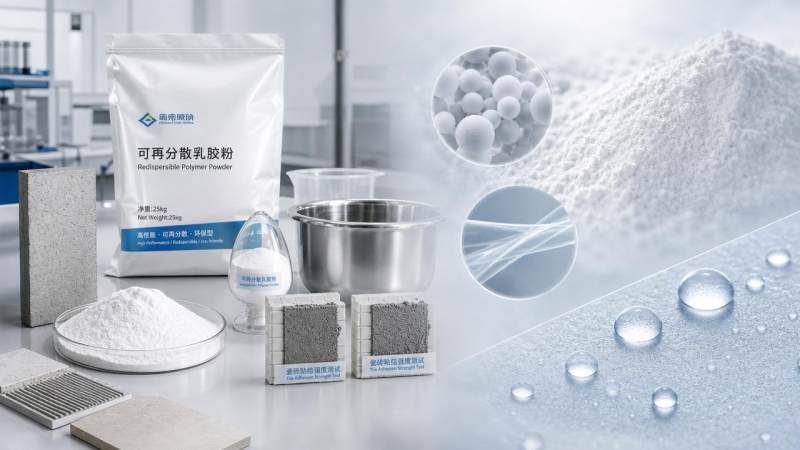
Common Redispersible Polymer Powder Application Mistakes
Redispersible Polymer Powder plays a critical role in dry-mix mortar performance, especially adhesion, flexibility, water resistance, and workability.
Many site failures are not caused by raw material quality alone. They often come from wrong selection, dosage, mixing, storage, or application conditions.
Understanding these mistakes helps reduce cracking, powdering, weak bonding, and unstable mortar performance in construction chemical formulations.
For stable results, Redispersible Polymer Powder should be judged by real application scenarios, not only by price, appearance, or basic technical data.
Scenario Background: Why Redispersible Polymer Powder Mistakes Happen
Dry-mix mortar systems look similar in bags, but their service conditions can be very different.
Tile adhesive, exterior wall putty, repair mortar, self-leveling compound, and insulation mortar all need different polymer behavior.
A Redispersible Polymer Powder grade that works well in one formula may fail in another environment.
The key is to match polymer chemistry, glass transition temperature, film formation, and compatibility with cement, fillers, and cellulose ether.
Jinan Ludong Chemical Co., Ltd. focuses on cellulose ethers, Redispersible Polymer Powder, and related construction chemical solutions for global dry-mix applications.
Its integrated production and technical service capacity support more accurate formulation adjustment across different mortar scenarios.
Mistake 1: Selecting Redispersible Polymer Powder Only by Price
Low cost is important, but using price as the only selection factor often creates hidden performance risks.
Redispersible Polymer Powder affects bond strength, deformation capacity, abrasion resistance, and water resistance after cement hydration.
If the polymer type is not suitable, more powder may not solve the problem.
For tile adhesive, tensile adhesion and open time matter. For wall putty, smoothness and anti-powdering are more important.
For repair mortar, flexibility, cohesion, and shrinkage control require a stronger balance between cement and polymer film.
Better decision method
- Define the exact mortar application before selecting Redispersible Polymer Powder.
- Check bond strength, flexibility, water resistance, and workability together.
- Compare performance after curing, not only fresh mortar feel.
- Run small formulation trials before full production.
Mistake 2: Ignoring Application Temperature and Film Formation
Redispersible Polymer Powder must redisperse in water and form a continuous polymer film during drying.
If temperature is too low, film formation may be incomplete. The mortar can look cured but remain weak inside.
This mistake is common in exterior wall systems, winter construction, basement repair, and shaded areas.
Low-temperature application can cause poor adhesion, brittle surfaces, delayed strength, and water sensitivity.
A suitable Redispersible Polymer Powder should match both the formulation and the expected curing environment.
Scenario checks before use
- Check minimum application temperature on site.
- Avoid fast drying under strong wind or direct sun.
- Allow enough curing time before water exposure.
- Test adhesion after realistic curing conditions.
Mistake 3: Using the Same Dosage in Every Mortar System
Redispersible Polymer Powder dosage should not be copied across different formulas without verification.
Too little polymer may cause powdering, low cohesion, poor water resistance, and weak bonding.
Too much polymer may increase cost, reduce early hardness, affect troweling, or create sticky mortar.
Dosage depends on cement content, filler grading, sand quality, cellulose ether viscosity, and final performance target.
In high-performance tile adhesive, Redispersible Polymer Powder is usually more critical than in basic wall leveling mortar.
Mistake 4: Poor Mixing Sequence and Insufficient Dispersion
Redispersible Polymer Powder must be evenly distributed in the dry blend before water is added.
Uneven mixing can create local polymer-rich or polymer-poor zones, causing unstable workability and bonding.
Adding water too quickly may form lumps, especially when cellulose ether and polymer powder are not dispersed well.
Dry mixing time, mixer type, batch size, and feeding order all influence final mortar uniformity.
When adjusting workability, compatible additives should be considered. For example, Hydroxypropyl Starch Ether can help improve sag resistance and application feel in suitable formulations.
Practical mixing advice
- Pre-mix cement, fillers, and functional additives evenly.
- Add Redispersible Polymer Powder under stable dry mixing conditions.
- Avoid overloading the mixer beyond effective capacity.
- Control water addition and mixing time at application.
Mistake 5: Ignoring Compatibility with HPMC, Cement, and Fillers
Redispersible Polymer Powder does not work alone in dry-mix mortar.
It interacts with HPMC, cement hydration products, mineral fillers, defoamers, fibers, starch ether, and other additives.
A change in HPMC viscosity may affect water retention, open time, slip resistance, and final adhesion.
Poor filler grading may increase water demand and weaken the effect of Redispersible Polymer Powder.
High-absorption sand or unstable cement may also cause inconsistent mortar behavior across batches.
Ludong Chemical offers HPMC products with controllable viscosity from 400 to 200,000 CPS for construction and chemical applications.
This range supports formula balancing when Redispersible Polymer Powder performance needs more stable water retention and workability.
Mistake 6: Wrong Storage Conditions Before Application
Redispersible Polymer Powder is sensitive to moisture, pressure, and long exposure to poor warehouse conditions.
If bags absorb moisture, powder may cake, lose flowability, and become difficult to disperse in mortar.
Caked material can lead to uneven distribution and reduced performance, even when the original product quality was acceptable.
Storage mistakes are more common in humid climates, rainy seasons, or warehouses without pallet protection.
Storage actions that reduce risk
- Keep Redispersible Polymer Powder sealed before use.
- Store bags in a dry and ventilated area.
- Avoid direct floor contact by using pallets.
- Follow first-in, first-out inventory control.
- Do not use heavily caked powder without testing.
Mistake 7: Misjudging Fresh Workability as Final Performance
Fresh mortar feel is important, but it cannot fully prove final performance.
Some formulas feel smooth during application but show low adhesion, weak cohesion, or poor water resistance after curing.
Redispersible Polymer Powder should be evaluated through both fresh properties and hardened performance.
Open time, slip resistance, wet density, strength development, and water immersion adhesion should be checked together.
For exterior applications, freeze-thaw resistance and weather durability may also be relevant.
Different Scenario Requirements for Redispersible Polymer Powder
A practical selection process starts with the service environment and then moves to formulation adjustment.
The same Redispersible Polymer Powder cannot automatically satisfy every construction chemical requirement.
Scenario Adaptation Suggestions for Stable Results
Stable application requires a controlled process from material selection to field verification.
Redispersible Polymer Powder should be tested in the complete formula, not as an isolated powder.
- Set clear performance targets before laboratory adjustment.
- Use local cement, sand, and fillers during trial testing.
- Evaluate fresh workability and hardened strength together.
- Check performance after water exposure when required.
- Record temperature, humidity, curing time, and water dosage.
When workability needs fine adjustment, Hydroxypropyl Starch Ether may be considered with HPMC and polymer powder compatibility tests.
Commonly Ignored Points During Field Application
Some failures appear suddenly, but the causes usually develop through small uncontrolled details.
Redispersible Polymer Powder performance can be weakened by excessive water addition, dusty substrates, or premature water exposure.
Substrate preparation is especially important for tile adhesive, repair mortar, and exterior wall systems.
- Do not apply mortar on loose, oily, or dusty surfaces.
- Do not exceed recommended water dosage for easier spreading.
- Do not ignore curing before rain or immersion exposure.
- Do not change raw materials without retesting the formula.
- Do not judge quality only by powder color or smell.
Action Guide: How to Reduce Redispersible Polymer Powder Application Risk
The best next step is to connect application conditions with formulation targets.
Start with the mortar type, substrate, climate, construction method, and expected service life.
Then verify Redispersible Polymer Powder selection through controlled trials and real curing conditions.
For consistent dry-mix mortar quality, combine suitable polymer powder with compatible HPMC, fillers, cement, and functional additives.
Jinan Ludong Chemical Co., Ltd. provides integrated construction chemical solutions supported by advanced production lines and technical formulation experience.
By avoiding these common Redispersible Polymer Powder mistakes, mortar systems can achieve better bonding, durability, workability, and application reliability.
Send Your Inquiry
We welcome your cooperation and we will develop with you.
