


Do MHEC Grades Meet EN 1276 & ASTM E1153 Standards for Disinfectant Thickening Agents?
Do MHEC Grades Meet EN 1276 & ASTM E1153 Standards for Disinfectant Thickening Agents?
Let’s be direct: EN 1276 and ASTM E1153 don’t test thickeners. They test disinfectants — specifically, the final formulated product’s ability to kill bacteria on hard, non-porous surfaces under defined conditions. So when a quality control or safety professional asks whether a Methyl Hydroxyethyl Cellulose (MHEC) grade “meets” these standards, what they’re really asking is: Does this polymer interfere with biocidal performance? Does it pass regulatory scrutiny as an excipient in validated disinfectant systems?
That distinction matters — because MHEC isn’t an active ingredient. It’s a rheology modifier. Its job is to suspend actives, improve surface contact time, and prevent runoff. But if it binds too tightly to quaternary ammonium compounds (QACs), oxidizes sodium hypochlorite, or introduces microbial nutrients (e.g., residual sugars or glycerol from synthesis), it can undermine efficacy — even if the base disinfectant chemistry is sound.
Where MHEC Fits in Real-World Disinfectant Formulations
We see MHEC used most often in ready-to-use (RTU) QAC-based disinfectants (e.g., benzalkonium chloride or didecyldimethylammonium chloride blends) at 0.1–0.5% w/w. At those levels, viscosity targets typically sit between 80–250 cP — enough to cling to vertical surfaces without dripping, but not so high that spray atomization suffers. In such systems, MHEC’s substitution pattern (methylation + hydroxyethylation) gives it better salt tolerance than HPMC — especially critical when formulations contain >0.5% NaCl or other electrolytes that stabilize QACs.
But here’s the catch: not all MHEC grades behave the same. Substitution uniformity, molecular weight distribution, and residual solvent content (e.g., isopropanol, acetone) vary significantly across suppliers — and those variables affect compatibility. For example, a batch with high low-MW fraction may leach more readily into solution, increasing background organic load during EN 1276 suspension tests. That can skew log-reduction results downward — not because the biocide failed, but because the thickener introduced competing organics.
Jinan Ludong Chemical’s Position — Not Certification, But Compatibility Control
Jinan Ludong Chemical Co., Ltd. produces cellulose ethers at industrial scale — 45,000 tons/year — with tight process control over substitution, viscosity, and residual solvents. Their MHEC offerings (often co-developed with formulators) are designed for chemical-grade applications, including disinfectant thickeners. Unlike construction-grade HPMC, which may carry higher ash or moisture content, Ludong’s chemical-grade MHEC batches undergo additional purification steps and are tested for heavy metals (Pb, As, Cd), total organic carbon (TOC), and pH stability in buffered saline — parameters directly relevant to EN 1276 suspension medium compatibility.
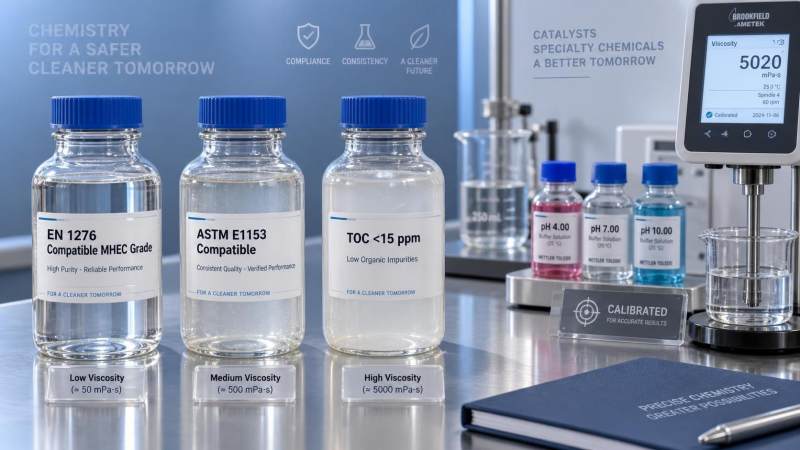
That said: Ludong does not claim “EN 1276 compliance” for MHEC — nor should any supplier. Compliance is formulation-specific. What Ludong *does* provide is documented lot-level data: substitution ratio (DS/MS), viscosity (400–200,000 cP range), TOC (<15 ppm), and residual solvent profiles. This allows QC teams to map raw material variability against their own disinfectant validation protocols — rather than treating MHEC as a black box.
The ASTM E1153 Trap — And Why “Non-Interference” Isn’t Enough
ASTM E1153 evaluates disinfectant efficacy on stainless steel carriers inoculated with Salmonella enterica and Pseudomonas aeruginosa. The standard mandates strict controls on organic load (0.3% bovine serum albumin + 0.3% yeast extract), temperature (20 ± 1°C), and contact time (10 minutes). Here’s where MHEC can quietly derail testing:
- If the polymer contains trace reducing agents (e.g., residual sodium borohydride from synthesis), it may neutralize oxidizing biocides like hydrogen peroxide or peracetic acid before contact time begins.
- If its hydroxyethyl groups hydrolyze under acidic conditions (common in some alcohol-free disinfectants), it can generate ethanolamine derivatives — known to chelate metal ions essential for QAC membrane disruption.
- If viscosity is too high (>300 cP), film thickness increases unevenly across carriers — leading to inconsistent biocide delivery and false-negative results.
So “non-interference” isn’t binary. It’s conditional — dependent on pH, ionic strength, active concentration, and even storage duration. We’ve seen cases where MHEC-thickened disinfectants passed EN 1276 at Day 0 but failed at Day 30 due to slow hydrolysis-induced pH drift — something no single certificate would flag.
A Practical Checkpoint for QC Teams
Before approving an MHEC grade for disinfectant use, ask three things:
- What’s the TOC and residual solvent profile — and has it been verified in your actual formulation matrix? Don’t rely on spec sheets alone. Spike-test your final RTU product with 1.5× the intended MHEC dose and re-run EN 1276 suspension tests.
- Is viscosity measured in your carrier solvent — not just water? MHEC behaves differently in 70% ethanol vs. aqueous QAC solutions. A grade showing 150 cP in water may drop to 60 cP in 20% ethanol — compromising dwell time.
- Are you using the same grade across all production lots — or swapping based on price? Minor DS/MS shifts alter hydration kinetics. One customer switched MHEC suppliers to cut cost and saw 0.5-log reduction loss against P. aeruginosa — traced back to higher ethoxylation variability affecting micelle formation around QACs.
And one more note: Polyvinyl Alcohol sometimes appears alongside MHEC in dual-thickener systems — mainly for freeze-thaw stability. But PVA carries its own risks: enzymatic degradation potential and higher oxygen demand in suspension media. If you’re layering thickeners, validate each combination separately.
No Shortcut — Just Better Questions
There is no “EN 1276–certified MHEC.” There is only MHEC that’s been proven — in your system, with your actives, under your storage and use conditions — not to compromise efficacy. That requires collaboration: between formulators who understand polymer-biocide interactions, QC labs that test beyond spec limits, and suppliers who share meaningful process data — not just COAs.
If your current MHEC supplier treats substitution ratio as proprietary, or won’t disclose batch-level TOC trends, treat that as a signal — not a gap to fill with internal testing alone. Because in disinfectant validation, the thickest layer isn’t the gel on the surface. It’s the uncertainty you haven’t measured yet.
Send Your Inquiry
We welcome your cooperation and we will develop with you.
