


MHEC in Low-Foam Industrial Cleaners: Balancing Rheology Control and Foaming Threshold
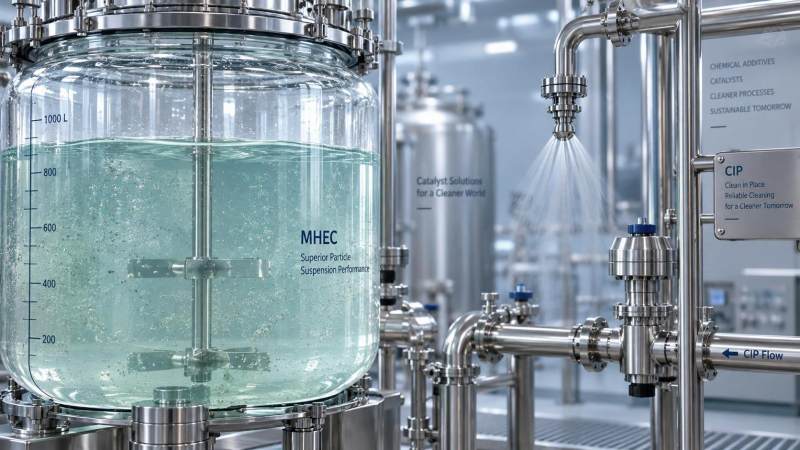
MHEC in Low-Foam Industrial Cleaners: Balancing Rheology Control and Foaming Threshold
You’re not just formulating a cleaner—you’re designing a system interface. For project managers overseeing CIP lines, automated spray washers, or high-throughput parts cleaning stations, the rheology modifier isn’t an afterthought. It’s the silent governor of flow, suspension, and surface contact time—and it must not generate foam where foam disrupts.
That’s why Methyl Hydroxyethyl Cellulose (MHEC) is gaining traction—not as a generic thickener, but as a purpose-built solution for low-foam industrial cleaners where viscosity stability and foaming threshold coexist under real-world constraints.
Why “Low Foam” Isn’t Just About Surfactant Selection
Foam control starts with surfactants, yes—but ends with the polymer architecture. Even low-foaming nonionics can over-foam when paired with polymers that trap air, stabilize bubbles, or delay drainage. In practice, many teams discover foam surges only after scaling up from lab beaker to 5,000-L tank—especially during recirculation or high-shear nozzle discharge.
MHEC avoids this by design. Its substitution pattern—methyl and hydroxyethyl groups grafted onto the cellulose backbone—delivers steric stabilization without strong interfacial activity. Unlike some HPMC variants, MHEC exhibits lower surface affinity and reduced air entrapment under shear. That means it adjusts viscosity without becoming a foam amplifier. You get predictable yield stress, improved particulate suspension, and consistent response across temperature shifts—without triggering foam alarms on your CIP controller.
Rheology That Responds—Not Resists
Industrial cleaners aren’t static fluids. They’re dynamic systems: pumped, sprayed, heated, cooled, mixed with soils, and reprocessed. A polymer that thickens at rest but shears too readily loses suspension capability mid-cycle. One that resists shear entirely may clog fine nozzles or reduce penetration into crevices.
MHEC delivers intermediate shear-thinning behavior—moderate viscosity reduction under pump shear, rapid recovery post-shear. This supports stable dispersion of abrasives or chelators while maintaining enough body to prevent settling during line idle periods. It also helps buffer pH shifts common in alkaline cleaner blends, reducing viscosity drift over shelf life.
For project managers evaluating alternatives, this translates to fewer formulation iterations, less rework during scale-up, and tighter control over application consistency—particularly critical when validating cleaning efficacy per ASTM D4488 or ISO 15877.
Where MHEC Fits in the Broader Cellulose Ether Landscape
Not all cellulose ethers behave alike—even within the same chemical family. HPMC dominates construction applications for its water retention and film-forming properties. But in low-foam industrial formulations, its higher ethoxy content can increase surface activity. Ethylhydroxyethyl cellulose (EHEC) offers better thermal stability but often at the cost of solubility in cold water or compatibility with high-salt systems.
MHEC sits in a functional sweet spot: sufficient hydrophobicity for rheology control, balanced hydrophilicity for rapid hydration, and inherently low foaming due to molecular asymmetry. It’s not a drop-in replacement for every HPMC grade—but for targeted low-foam applications, it solves a specific tension: how to control flow without destabilizing foam thresholds.
Manufacturing Consistency Matters—Especially at Scale
A well-designed polymer is only as reliable as its supply chain. Variability in DS (degree of substitution), MS (molar substitution), or particle size distribution affects hydration rate, clarity, and batch-to-batch rheology performance. In large-volume cleaner production, even minor deviations compound across thousands of liters—leading to inconsistent spray patterns, uneven soil removal, or unexpected viscosity spikes during filling.
Jinan Ludong Chemical Co., Ltd., established in 2020, operates integrated production lines designed for reproducibility—not just volume. Its 45,000-ton annual capacity covers both construction and chemical-grade cellulose ethers, including tailored MHEC grades with viscosity ranges from 400 to 200,000 cP. Crucially, their intelligent manufacturing platform enables tight control over substitution profiles and particle morphology—factors that directly impact foam generation and shear response in finished cleaners.
This isn’t about theoretical specs. It’s about knowing that a Type 60 MHEC batch delivered today will hydrate at the same rate, thicken with the same profile, and suppress foam to the same degree as the one used in your last validation run—whether you're sourcing in Shanghai, Rotterdam, or São Paulo.
When to Consider MHEC—And When to Look Elsewhere
MHEC excels where low foam, moderate shear sensitivity, and robust suspension are primary requirements. Think: metal parts washers using alkaline chelating blends, pharmaceutical equipment CIP solutions requiring visual clarity and no residue, or electronics cleaning fluids needing controlled dwell time without bubble masking.
It’s less ideal where extreme thermal stability (>90°C sustained), very high electrolyte tolerance (>15% NaOH + Na₂CO₃), or ultra-low viscosity (<100 cP) are non-negotiable. In those cases, synthetic associative thickeners or modified polyacrylates may offer more headroom—but often at the cost of biodegradability, regulatory scrutiny, or raw material traceability.
One practical note: if your formulation includes Polyvinyl Alcohol, verify compatibility early. While PVA offers film-forming and binder functionality, its interaction with MHEC can affect clarity and long-term storage stability—especially in acidic or high-ionic-strength systems.
What to Confirm Before Integration
Before finalizing MHEC into your cleaner, check three things:
- Hydration protocol: Does your process allow for pre-hydration, or must it disperse directly into high-shear mix? MHEC performs best with controlled dispersion—avoid dumping dry powder into agitated tanks without pre-wetting.
- pH window: Most grades perform reliably between pH 4–12, but viscosity loss accelerates outside that range. If your cleaner cycles through acidic rinse stages, confirm MHEC retention post-rinse.
- Regulatory alignment: While MHEC itself carries no REACH or TSCA red flags, verify that the specific grade meets your regional compliance needs—especially for food-contact or pharmaceutical use.
None of these require overhaul—just calibration. And with Ludong’s flexible production capabilities and technical support infrastructure, adjusting substitution levels, viscosity targets, or packaging formats is part of standard service—not custom engineering.
Ultimately, selecting MHEC isn’t about chasing novelty. It’s about resolving a persistent trade-off: how to tune rheology without destabilizing the very thing your system is built to avoid—excess foam. When your next pilot batch goes from bench to line, that balance becomes measurable—not theoretical.
Send Your Inquiry
We welcome your cooperation and we will develop with you.
