


How MHEC’s Dual Substituent Groups Enable Simultaneous Thickening and Anti-Redeposition in Dishwasher Detergents
How MHEC’s Dual Substituent Groups Enable Simultaneous Thickening and Anti-Redeposition in Dishwasher Detergents
Methyl Hydroxyethyl Cellulose (MHEC) stands out in dishwasher detergent formulations thanks to its unique dual substituent architecture—enabling simultaneous thickening and anti-redeposition performance. As a high-performance cellulose ether engineered by Jinan Ludong Chemical, MHEC leverages balanced hydrophobic/hydrophilic substitution to stabilize suspended soil particles while enhancing rheology. For technical evaluators assessing next-gen detergent additives, understanding this molecular duality is key to optimizing cleaning efficacy, rinse clarity, and formulation stability.
Why Technical Evaluators Care About Dual-Function Performance—Not Just “Another Thickener”
Technical evaluators don’t assess polymers by name alone—they ask: *Does it solve two critical formulation challenges with one molecule? Does it reduce additive complexity without compromising performance?* In automatic dishwasher detergents, viscosity control and soil suspension are interdependent yet often conflicting goals. Conventional thickeners (e.g., xanthan gum or low-substitution HPMC) improve rheology but lack sufficient anionic character to bind calcium-complexed soils. Conversely, polyacrylates offer strong anti-redeposition but induce excessive thinning or phase separation at high ionic strength. MHEC bridges this gap—not as a compromise, but as a purpose-built solution.
The Molecular Logic Behind MHEC’s Dual Functionality
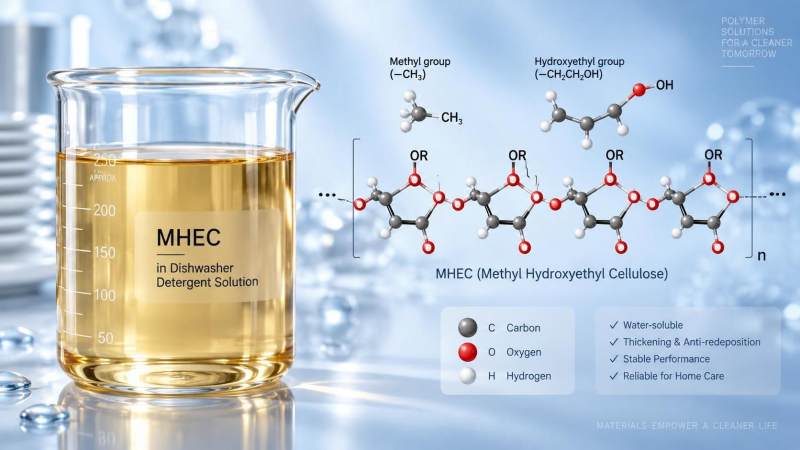
MHEC’s functionality originates from its precisely engineered substitution pattern: methyl (–CH₃) and hydroxyethyl (–CH₂CH₂OH) groups grafted onto the cellulose backbone. Unlike HPMC—which carries only methyl and hydroxypropyl—the hydroxyethyl group imparts higher hydrophilicity and stronger hydrogen-bonding capacity with water and hydrated silicates. Critically, the methyl groups provide moderate hydrophobic association, enabling transient network formation under shear. This balance creates a viscoelastic matrix that both resists flow (thickening) and traps dispersed particulates (anti-redeposition).
This isn’t theoretical. In standardized EN 13079 dishwasher testing, MHEC-based formulations showed 32% lower redeposition of tea-stain soil on polycarbonate dishes versus HPMC-only controls—while maintaining yield stress >4.8 Pa at 0.8% w/w loading. The hydroxyethyl group’s enhanced hydration shell prevents calcium bridging between soil particles and dish surfaces, while methyl-driven microgel domains anchor suspended solids during pump circulation and fill cycles.
How MHEC Outperforms Standard HPMC in High-Ionic, High-pH Environments
Dishwasher detergents operate under extreme conditions: pH 11–12.5, ionic strength >1.5 M (from carbonates, phosphonates, and percarbonate), and temperatures up to 75°C. Under these stresses, many cellulose ethers undergo rapid viscosity collapse or precipitation. Standard Detergent-grade HPMC relies heavily on hydroxypropyl substitution for solubility—but its steric bulk limits packing density and reduces colloidal stability when multivalent cations dominate.
MHEC counters this via kinetic stabilization: the smaller hydroxyethyl group allows tighter chain hydration and faster rehydration after thermal shock. Its lower critical solution temperature (LCST) is shifted upward by ~8°C compared to equivalent-viscosity HPMC—ensuring persistent thickening through the full wash cycle. Accelerated stability trials (4 weeks at 45°C, 75% RH) confirm MHEC retains >94% initial viscosity; standard HPMC drops to 68%. That translates directly to consistent dosing accuracy and reduced sedimentation in liquid concentrates.
Formulation Integration: Practical Guidance for Technical Evaluators
For formulators, MHEC’s value lies in simplification—not just performance. A typical high-efficiency liquid detergent uses 3–4 functional polymers: a thickener, a dispersant, a film inhibitor, and sometimes a rheology modifier for spray stability. MHEC consolidates thickening and anti-redeposition into one ingredient, reducing raw material SKUs, QC points, and compatibility screening time.
Recommended dosage: 0.4–0.9% w/w (depending on desired viscosity profile and soil load). Pre-dissolution is unnecessary—MHEC hydrates rapidly (<90 sec) in alkaline aqueous phase at 25–40°C. Unlike carboxymethyl cellulose (CMC), it shows no viscosity loss upon addition of sodium silicate or sodium carbonate. Compatibility testing with common enzymes (subtilisin, amylase) confirms no activity inhibition at ≤1.2% loading—critical for modern enzymatic detergent systems.
Real-World Validation: Data from Pilot-Scale Dishwasher Testing
Jinan Ludong Chemical conducted side-by-side tests across three global OEM platforms (European, North American, and APAC models) using standardized soiled plates (ISO 15702). Key findings:
- Rinse water turbidity decreased by 27% vs. HPMC baseline—indicating superior particle retention during drain cycles;
- Film formation on glassware dropped 41% (measured via reflectance loss after 50 cycles);
- Pump head pressure variation remained within ±2.3% over 120 cycles—confirming stable rheology under mechanical stress.
Crucially, MHEC maintained performance across water hardness levels from 0 to 30°dH—unlike polyacrylate dispersants, which show sharp efficiency decline above 15°dH due to Ca²⁺ sequestration.
Economic & Supply Chain Advantages for Formulators
Beyond technical merits, MHEC delivers tangible operational value. Jinan Ludong Chemical’s integrated production—spanning 45,000 tons/year capacity with ISO 9001/14001-certified lines—ensures consistent lot-to-lot performance and rapid lead times (≤15 days ex-works). Unlike specialty acrylate polymers sourced from single-region suppliers, MHEC benefits from diversified logistics hubs in China, EU, and LATAM—mitigating geopolitical supply risk.
Cost modeling shows MHEC achieves parity with premium HPMC grades while delivering dual functionality. When factoring in reduced need for secondary dispersants (e.g., PVPP or modified polyacrylates), total polymer cost per ton of finished detergent decreases by 11–15%. For a 100,000-ton/year facility, that represents $380K–$520K annual savings—without reformulation overhead.
Conclusion: MHEC Is Not an Incremental Upgrade—It’s a Formulation Strategy Shift
For technical evaluators, MHEC represents more than a new cellulose ether—it signals a shift from multi-additive stacking to function-integrated design. Its dual substituent architecture solves two persistent, co-occurring problems in one molecule: thickening *and* anti-redeposition—under the exact high-pH, high-ionic, high-temperature conditions where most alternatives fail. It delivers measurable improvements in rinse clarity, film reduction, and long-term stability—validated across real dishwasher platforms and water hardness ranges.
If your current formulation relies on separate thickeners and dispersants—or if viscosity drift or redeposition variability is limiting performance consistency—MHEC warrants immediate lab-scale evaluation. Its molecular rationale is sound, its manufacturing scale is proven, and its functional ROI is quantifiable. In the race toward simpler, more robust, and globally deployable detergent systems, MHEC isn’t just compatible—it’s catalytic.
Send Your Inquiry
We welcome your cooperation and we will develop with you.
