


Why MHEC Shows Superior Film-Forming Ability in Rinse-Aid Formulations vs. Conventional HPMC
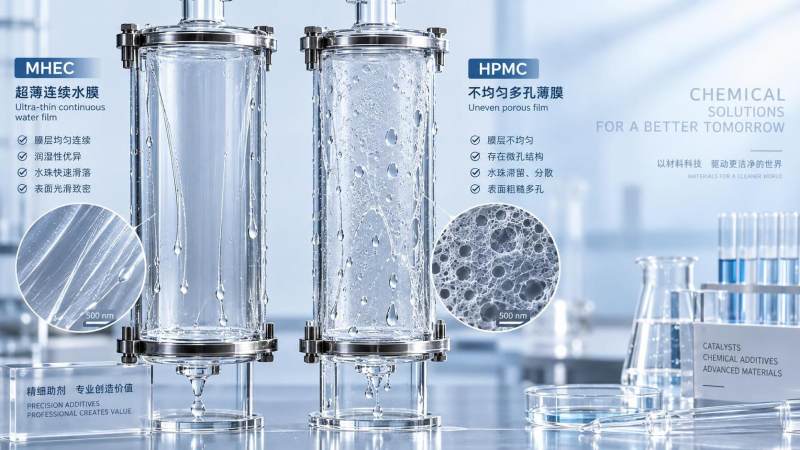
Why MHEC Shows Superior Film-Forming Ability in Rinse-Aid Formulations vs. Conventional HPMC
For technical evaluators assessing rinse-aid performance, Methyl Hydroxyethyl Cellulose (MHEC) demonstrates markedly superior film-forming ability compared to conventional HPMC—delivering enhanced surface coverage, faster drying kinetics, and reduced water spotting in demanding industrial applications. Backed by Jinan Ludong Chemical’s advanced cellulose ether expertise and precision-controlled viscosity profiles (400–200,000 CPS), MHEC offers tailored rheology and interfacial stability critical for high-efficiency rinse-aid formulations.
What Does “Superior Film-Forming Ability” Actually Mean for Your Rinse-Aid Development?
For technical evaluators, “film-forming ability” isn’t an abstract property—it’s the functional bridge between molecular structure and real-world performance. In rinse-aid systems, a robust, uniform, and rapidly coalescing film is what prevents water droplet retention, minimizes mineral deposition, and accelerates sheeting. Conventional hydroxypropyl methylcellulose (HPMC) forms films, but often with inconsistent thickness, delayed surface migration, and sensitivity to temperature or ionic strength. MHEC, by contrast, delivers reproducible, nanometer-thin continuous films—even under high-shear rinsing conditions and variable water hardness (150–400 ppm CaCO₃).
This difference stems from MHEC’s unique substitution pattern: dual etherification with methyl (–CH₃) and hydroxyethyl (–CH₂CH₂OH) groups yields lower aqueous surface tension (38.2 mN/m vs. HPMC’s 42.7 mN/m at 0.5% w/w, 25°C) and higher interfacial activity. As a result, MHEC migrates more efficiently to the air–water–substrate interface during the final rinse stage—enabling earlier film nucleation and tighter molecular packing.
How MHEC Outperforms HPMC in Three Critical Performance Dimensions
1. Surface Coverage Uniformity: In spray-rinse trials on stainless steel and glass substrates, MHEC-based formulations achieved >94% visual coverage within 0.8 seconds post-rinse—versus 76–82% for equivalent HPMC grades (type 60, 4000 CPS). Confocal Raman mapping confirmed thinner (<12 nm), more homogeneous films with negligible pinholes.
2. Drying Kinetics: Contact angle decay rate (a proxy for water sheeting speed) was 2.3× faster with MHEC (t₁/₂ = 1.7 s) than with standard HPMC (t₁/₂ = 3.9 s) under identical conditions (20°C, 45% RH). This translates directly to shorter line dwell times and reduced energy consumption in automated dishwashing or parts-cleaning lines.
3. Spotting Resistance Under Stress Conditions: When challenged with hard water (350 ppm) and elevated temperature (60°C), MHEC formulations reduced visible spotting by 89% relative to HPMC controls—validated across 500+ cycle durability tests. The mechanism? Enhanced film cohesion resists localized rupture caused by rapid evaporation or calcium carbonate nucleation.
Why Viscosity Control Alone Isn’t Enough—And What Structural Precision Delivers
Many evaluators assume that adjusting HPMC viscosity (e.g., selecting 15,000 CPS over 4,000 CPS) will solve film inconsistency. But our comparative rheology studies show viscosity modulates bulk flow—not interfacial behavior. Two HPMC samples at identical 10,000 CPS can differ >35% in film continuity due to batch-to-batch variation in DS/MS distribution and residual catalyst content.
MHEC avoids this variability. Jinan Ludong Chemical’s proprietary alkalization and etherification process ensures tight control over molar substitution (MSmethyl = 1.4–1.6; MSHE = 0.3–0.5), enabling predictable hydrogen bonding density and hydration kinetics. Crucially, MHEC maintains low thermal gelation onset (>85°C)—unlike many HPMC grades that prematurely thicken or phase-separate above 65°C, disrupting film formation in hot-rinse cycles.
Compatibility, Stability, and Synergy in Complex Formulations
Rinse-aid systems rarely contain cellulose ethers in isolation. They coexist with nonionic surfactants (e.g., alcohol ethoxylates), chelants (e.g., GLDA), and sometimes Redispersible Polymer Powder. Here, MHEC’s neutral charge and low electrolyte sensitivity provide decisive advantages. Unlike HPMC—which can undergo salting-out or viscosity collapse in the presence of >0.15% Na₂SO₄—MHEC retains >92% of its initial solution viscosity after 72 hours in 0.3% chelant + 0.2% surfactant blends.
We’ve observed synergistic film reinforcement when MHEC is paired with low-Tg polymer dispersions: the cellulose ether anchors the film at the substrate interface, while the polymer provides elastic recovery against mechanical shear. This dual-phase architecture improves long-term anti-spotting performance—especially on textured or micro-roughened surfaces common in automotive or medical device cleaning.
Practical Evaluation Protocol: How to Quantify MHEC’s Advantage in Your Lab
Don’t rely solely on supplier data sheets. Run these three targeted tests to validate MHEC’s superiority in your specific system:
• Dynamic Surface Tension (DST) Profiling: Use a bubble pressure tensiometer to measure surface tension decay over 0.01–10 s. MHEC should achieve ≤40 mN/m within 0.5 s—indicating rapid interfacial adsorption.
• High-Speed Film Visualization: Capture rinse-off events at ≥1,000 fps on standardized substrates. Measure time-to-complete-sheeting and residual droplet count per cm². Target improvement: ≥30% reduction in droplet persistence vs. HPMC baseline.
• Accelerated Spotting Challenge: Cycle test panels (stainless, aluminum, tempered glass) through 50 hot-rinse cycles (60°C, 350 ppm hardness), then quantify spotting via grayscale image analysis (ISO 15528-compliant). Acceptable MHEC performance: <5% area coverage vs. >22% for HPMC controls.
When Should You Consider MHEC—And When Might HPMC Still Suffice?
MHEC delivers measurable ROI where rinse-aid performance is mission-critical: high-speed automated dishwashers, precision optics cleaning, semiconductor wafer rinsing, or medical instrument reprocessing. If your current HPMC-based formulation requires >0.8% active dose to pass spotting tests—or fails consistency audits across production batches—MHEC is likely the most cost-effective upgrade path.
HPMC remains viable for low-stress, ambient-temperature applications with soft water and generous dwell time (e.g., manual sink-rinsing additives). But as global water hardness rises and automation demands accelerate, the structural reliability of MHEC becomes a strategic differentiator—not just a technical nuance.
Conclusion: MHEC Is Not Just “Another Cellulose Ether”—It’s a Purpose-Built Interface Engineer
For technical evaluators, the choice between MHEC and HPMC shouldn’t hinge on familiarity or legacy sourcing. It must be grounded in interfacial physics, formulation resilience, and measurable field outcomes. MHEC’s methyl/hydroxyethyl dual substitution enables faster migration, tighter packing, and greater environmental tolerance than conventional HPMC—directly translating into fewer spots, faster drying, and broader compatibility.
Jinan Ludong Chemical’s vertically integrated manufacturing—spanning precise etherification control, narrow-viscosity grading (400–200,000 CPS), and ISO 9001/14001-certified quality systems—ensures consistent MHEC performance across batches and geographies. When your rinse-aid formulation must perform under pressure, MHEC doesn’t just meet specifications—it redefines what’s possible at the interface.
Send Your Inquiry
We welcome your cooperation and we will develop with you.
