


HPMC Thickener Dosage: How to Build Body Without Reducing Coating Flow
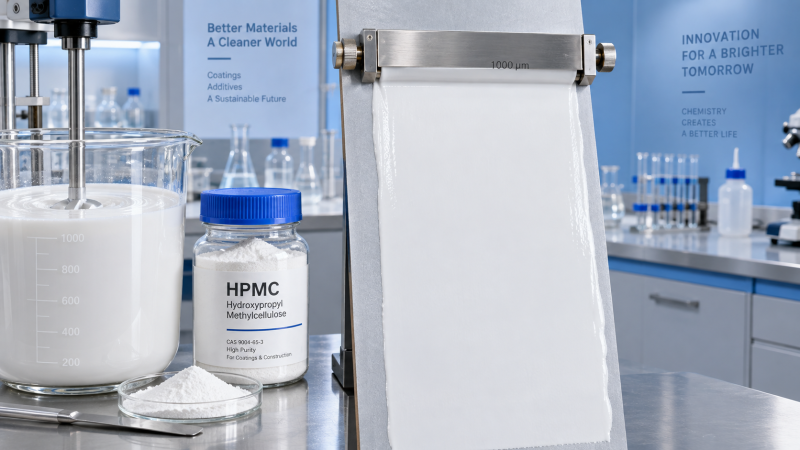
A coating can look too thin on the wall or substrate even when its measured viscosity appears acceptable. The usual reaction is to add more HPMC thickener, but this often creates a different problem: the coating gains body in the container while becoming harder to spread, slower to level, or prone to drag marks during application.
The practical answer is not simply “use less” or “use more.” Build body by matching HPMC dosage to the required low-shear viscosity, then protect flow through the right viscosity grade, hydration procedure, water balance, dispersant level, and polymer package. When coating flow drops after an HPMC increase, the first adjustment should usually be a small dosage correction or a lower-viscosity grade—not an attempt to compensate with extra water.
Separate “body” from “flow” before changing the formula
Operators often describe several different effects as thickness. A coating may feel full-bodied on the roller, resist splashing, cover uneven areas well, and still flow smoothly after application. It may also feel thick because it has excessive internal resistance, leaving roller texture or brush marks that do not level out. These are not the same condition.
HPMC mainly changes the water phase rheology. At rest and under low shear, it helps keep pigments and fillers uniformly suspended and gives the coating a more stable, substantial feel. Under application shear, the material should thin enough to move through the roller, brush, spray equipment, or coating blade. After application, it must recover enough structure to avoid sagging while remaining mobile long enough to level.
Too much HPMC can raise low-shear viscosity beyond the point where leveling is possible. Too little can lead to weak body, pigment settling, poor anti-sag control, or a watery application feel. The target is therefore a balanced rheology profile rather than the highest possible viscosity reading.
Start with the symptom seen during application
Before changing dosage, identify when the coating is failing. The timing of the failure gives a better direction than a single viscosity measurement.
A coating that is merely low in body usually needs more structure. A coating that drags, strings, or refuses to level may already have enough structure but the wrong distribution of viscosity across shear conditions. Treating both problems with another HPMC addition can make the second one worse.
Choose dosage by working upward in controlled increments
Exact dosage depends on the grade, solids content, pigment volume concentration, polymer binder, fillers, application method, and desired finish. For that reason, a universal percentage is less reliable than a disciplined adjustment sequence. Use the existing stable formula as the reference point whenever possible.
- Confirm the baseline. Record water addition, batch temperature, mixing time, pH, viscosity after maturation, and application observations. Do not compare a freshly made batch with a fully hydrated reference batch.
- Change one rheology variable at a time. Keep binder, filler loading, defoamer, dispersant, and water constant while evaluating the HPMC adjustment. Multiple simultaneous changes make the result impossible to interpret.
- Use small dosage steps. A modest increment is usually sufficient to show whether body improves without harming flow. Large jumps can overshoot the workable range and hide the point at which drag begins.
- Evaluate after full hydration. Check the coating after the selected holding period, not only immediately after mixing. Some apparent under-thickening is simply incomplete dissolution.
- Apply on a representative surface. Observe pickup, spread, open time, leveling, spatter, sagging, and finish. Container viscosity alone cannot predict all of these behaviors.
When a dosage increase improves anti-sag and pickup but causes poor leveling, reduce the level slightly before changing other materials. If the coating is still too thin after backing down to the best-flowing dosage, the problem may be that the HPMC viscosity grade is too low for the required body, or that another rheology component is needed to support the desired shear profile.
Viscosity grade matters as much as dosage
Two HPMC products used at similar addition levels can produce very different application behavior. Higher-viscosity grades build stronger aqueous-phase viscosity and may be effective when the formula needs water retention, suspension, or vertical hold. They can also narrow the workable flow window more quickly. Lower-viscosity grades are often easier to use where smooth spreading, pumping, or sprayability is the priority, but they may not provide enough body at practical dosage levels.
Do not assume that switching to a higher-viscosity grade will always reduce the required dosage while preserving the same feel. The coating may reach the desired measured viscosity yet behave differently under a roller or blade. This occurs because rheology is influenced by polymer molecular characteristics, concentration, hydration state, and interactions with the rest of the formula.
A useful decision path is straightforward:
- When the coating lacks body and also settles or sags, evaluate a grade or dosage change that raises low-shear structure.
- When the coating has acceptable body but poor leveling, test a lower dosage first; if body then becomes inadequate, assess a lower-viscosity HPMC used at a more suitable level.
- When flow is poor only after storage, investigate delayed hydration, pH drift, microbial effects, or water loss before changing the grade.
- When spray performance is the main concern, judge behavior at the actual equipment conditions rather than relying on a brush or roller assessment.
Mixing mistakes can look like a dosage problem
An HPMC thickener must be properly dispersed and hydrated. Poor addition can form agglomerates with dry material inside. The batch may initially appear too thin because part of the thickener has not developed viscosity. Later, as the trapped material hydrates, viscosity rises unexpectedly and flow becomes restricted. Operators may then add water to recover flow, leaving the next batch inconsistent.
Follow the handling guidance for the specific HPMC grade, especially its dispersion and dissolution method. In many waterborne systems, the order of addition, agitation intensity, temperature, and available water all influence hydration. Avoid dumping powder into a stagnant or poorly circulated zone. High shear can help wet and disperse ingredients, but it does not replace adequate hydration time.
When the process allows, make a controlled premix or introduce the material under sufficient agitation so particles separate rapidly. Then allow the batch to mature before final adjustment. The goal is not simply to eliminate visible lumps. It is to ensure that the polymer has developed its intended contribution before viscosity, flow, and application properties are judged.
Watch for false viscosity readings
A single viscosity measurement can be misleading when the sample temperature, spindle selection, rotational speed, or standing time changes from batch to batch. A coating can also show an acceptable reading at one shear condition while performing poorly during application. Use the same test method for comparisons, and pair it with a simple applied-film observation. The most useful records combine instrument results with notes such as “levels well after roller application,” “drag begins near end of working time,” or “slight sag on heavy vertical film.”
Water is not a neutral correction tool
Adding water after excessive thickening can restore apparent flow, but it may reduce hiding, increase drying sensitivity, lower film build, or alter sag resistance. It can also mask the actual reason the formula became too thick. Water should be adjusted within the designed formula range, not used repeatedly to correct a poorly selected HPMC dosage.
Water demand also changes when pigment, filler, or polymer levels change. A filler with higher surface area can require more water and make the same HPMC level feel stronger. Some pigments and extenders affect the available water phase enough to alter thickener efficiency. When a previously stable dosage suddenly produces drag after a raw-material change, check particle characteristics and solids balance before assuming the cellulose ether is at fault.
pH is another practical variable. Changes in neutralization sequence or alkaline additions can modify dispersion behavior and influence the response of other rheology additives. Keep pH control consistent during comparative trials. A dosage decision made from batches prepared under different pH conditions is not a reliable dosage decision.
Consider the binder and coalescence package
HPMC controls part of the rheology, but it does not work in isolation. Polymer binder content affects wet-film cohesion, pigment binding, and how the coating moves after application. A formula with insufficient binder support may feel heavy and still level poorly, particularly at high pigment or filler loading. In that situation, more cellulosic thickener can increase drag without solving the film-formation issue.
Where a dry-mix or cementitious coating system requires improved adhesion and film-forming contribution after water addition, a compatible polymer component may be evaluated alongside the cellulose ether. Redispersible Polymer Powder can be part of that broader formulation approach, but it should not be treated as a direct replacement for rheology control. The correct balance depends on the application, substrate, aggregate or filler system, and target workability.
Drying conditions matter as well. Fast water loss can make a coating appear to have poor flow because the surface starts setting before it has time to level. In that case, increasing HPMC may improve water retention but could also make spreading heavier. Check ambient temperature, substrate absorbency, air movement, and wet-film thickness before assigning every leveling problem to dosage.
A practical adjustment sequence when flow has already fallen
When a batch has good body but reduced coating flow, avoid changing every component. Work through the issue in this order:
- Verify that the batch has completed its normal hydration and maturation period.
- Confirm actual batch water, temperature, pH, and viscosity test conditions against the control batch.
- Apply a small sample using the intended method and identify whether the issue is drag, poor leveling, stringiness, reduced open time, or true high viscosity.
- Lower HPMC dosage slightly in a controlled trial while keeping water and other additives constant.
- If flow improves but body becomes insufficient, compare an alternative viscosity grade rather than returning immediately to a higher dosage.
- Review polymer, filler, dispersant, defoamer, and coalescent changes only after the HPMC response is understood.
This sequence prevents a common cycle: too much thickener causes drag, added water weakens the coating, then more thickener is added to recover body. Each correction moves the formula farther from a controlled balance.
Questions that often arise during dosage adjustment
Can a higher HPMC dosage improve leveling?
Only up to a point. A small increase may improve wet-film uniformity when the coating is excessively thin or unstable. Beyond the workable level, higher low-shear viscosity restricts film movement and leaves more visible application texture. Leveling depends on controlled mobility, not maximum thickness.
Why does the coating become thicker the next day?
Delayed hydration is a frequent cause, especially when dispersion was incomplete or the batch was adjusted before the HPMC had fully developed. Storage temperature, water loss, pH change, and interactions with other additives can also contribute. Compare samples only after the same holding time.
Should dosage be set by viscosity alone?
No. Viscosity is an important control point, but the final decision should include roller or brush feel, anti-sag behavior, leveling, open time, and finish appearance. A coating can meet a viscosity target and still have unacceptable flow.
When is a grade change more useful than another dosage change?
A grade change is worth evaluating when the current product reaches good body only at a level that causes drag, or when reducing dosage restores flow but removes needed suspension or sag resistance. That pattern suggests the required rheology profile cannot be achieved efficiently with dosage adjustment alone.
Send Your Inquiry
We welcome your cooperation and we will develop with you.
