


Foaming After Adding HPMC Thickener: Root Causes and Process Corrections
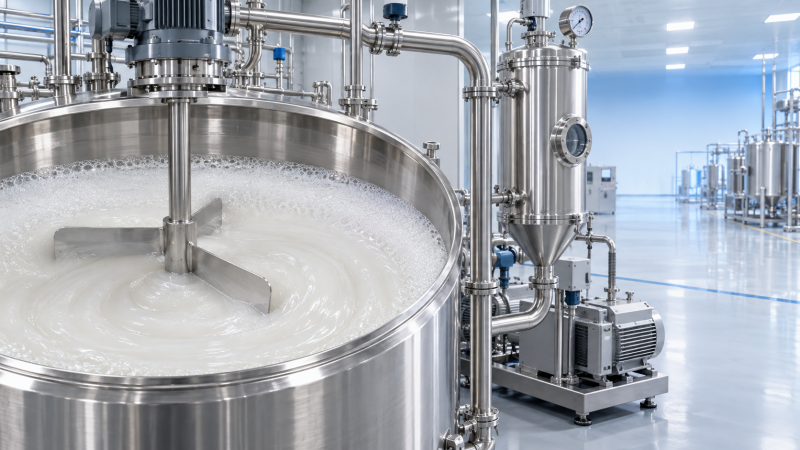
Foaming after adding an HPMC thickener can turn an otherwise stable batch into a difficult after-sales call. The operator may report a rising foam cap, inconsistent viscosity readings, pinholes after drying, poor leveling, or a tank that appears full long before the planned batch volume is reached. In many cases, the HPMC itself is blamed immediately. Yet foam is usually the visible result of a process imbalance: air has been introduced faster than it can escape, while the thickening system and other formulation components make that air easier to retain.
For maintenance teams, the practical question is not simply “Does HPMC foam?” It is: What changed in the wetting, mixing, hydration, or formulation sequence that allowed foam to become persistent? A methodical answer prevents unnecessary material replacement and helps restore production with fewer trial-and-error adjustments.
Why foam becomes more noticeable after HPMC thickener addition
Hydroxypropyl methylcellulose is widely used to build viscosity, improve water retention, support suspension, and modify application behavior in coatings, adhesives, construction products, cleaners, and other water-based systems. Once an HPMC thickener begins to hydrate, the liquid phase becomes more structured. Air bubbles that would have risen and broken quickly in plain water may now rise slowly or remain trapped.
This does not mean that every foam issue is caused by the cellulose ether. Rather, HPMC can reveal weaknesses already present in the process. A vortex pulling air from the surface, a poorly positioned return line, excessive recirculation, a high-shear disperser running too long, or a surfactant-rich formulation may all produce some entrained air. As viscosity increases, that air becomes far more visible and much harder to remove.
Maintenance personnel should also distinguish between two conditions:
- Temporary entrained air: Fine bubbles appear during mixing but gradually collapse during a controlled holding period or under low-speed agitation.
- Stabilized foam: A persistent, layered foam cap remains; bubbles are small and uniform; density, filling volume, gloss, or film appearance may be affected.
The second condition requires investigation. Adding more defoamer without identifying the source may suppress the symptom briefly, but it can introduce surface defects, cratering, poor intercoat adhesion, or compatibility concerns later.
Start at the tank: the addition method often tells the story
A common scenario is straightforward. Dry HPMC is charged into water while the mixer is operating at high speed. The powder hits the surface, forms a vortex, and is drawn below the liquid line in irregular pockets. Some particles wet rapidly, while others form partially hydrated skins. The operator increases speed to break the visible agglomerates. More air enters the batch. As the hydrated polymer raises viscosity, bubble release slows down—and the foam grows.
Fast addition is particularly risky when powder is tipped directly into the center of a deep vortex. The vortex may look like efficient mixing, but it is often acting as an air intake. A surface funnel that reaches close to the impeller is a warning sign, especially in partially filled vessels.
Corrective action should focus on controlled wetting rather than brute-force dispersion:
- Reduce agitation before powder charging to the lowest speed that still maintains circulation.
- Feed the HPMC thickener slowly and evenly into the moving liquid, preferably at a point where it can be pulled into circulation without drawing air from the surface.
- Avoid dumping bags or large scoops into the tank.
- If the system allows, use a powder induction device or an eductor designed to wet powder while limiting air entrainment.
- After the powder is dispersed, shift to the hydration procedure appropriate for the selected HPMC grade rather than continuing high shear unnecessarily.
For a troubleshooting visit, it is useful to observe the actual addition event rather than relying only on batch records. Operators may describe the speed as “normal,” while the tank geometry, fill level, impeller position, and actual vortex depth tell a different story.
Check whether the HPMC was hydrated in the right way
HPMC grades do not all behave identically during dissolution. Some process routes use cold water addition; others use a hot-water dispersion step followed by cooling, depending on the grade and the formulation requirements. If the process does not match the material’s recommended hydration method, incomplete dissolution can coexist with foam, leading the team to treat two different problems as one.
Partially hydrated particles may resemble gel specks, fish-eyes, or soft lumps. Operators often react by raising mixing intensity. That may disperse visible lumps, but it may also generate more foam and reduce the chance for bubbles to escape. The better response is to verify the hydration window, temperature history, hold time, and addition sequence.
Ask several practical questions:
- Was the water temperature within the intended operating range at the time of addition?
- Did the batch receive enough time for full hydration before viscosity adjustment or final quality testing?
- Were salts, alkalis, acids, solvents, pigments, or other additives introduced before the HPMC had properly dispersed?
- Did an operator change the order of addition to save time?
Many systems are more forgiving when HPMC is first dispersed in a relatively simple aqueous phase. Introducing high electrolyte loads, strong pH adjustments, or certain surfactant packages too early can complicate wetting and change bubble behavior. The exact sequence should be documented as a process parameter, not left as an operator preference.
Mixing equipment can create foam even when the formulation is correct
When foam develops repeatedly across different batches, inspect the mechanical side of the process. The issue may not be the raw material at all.
A high-speed disperser is excellent for pigment dispersion and rapid incorporation of some solids, but it can be a poor choice for extended deaeration. Likewise, a propeller positioned too close to the surface can create a whirlpool; a bottom-entry mixer may produce dead zones if its pumping direction is unsuitable; and a recirculation loop can continuously reintroduce air through loose fittings, leaking seals, or a return pipe discharging above the liquid surface.
Useful inspection points include:
- Impeller diameter, blade type, and clearance from the tank bottom and liquid surface.
- Agitator speed during powder charging, hydration, transfer, and final adjustment.
- Tank fill level; the same RPM can behave very differently in a half-filled tank.
- Return-line placement and whether the returning stream splashes or jets through the surface.
- Seal integrity on pumps, valves, and suction lines, where small leaks can draw in air without obvious product leakage.
- Use of overly restrictive filters or undersized transfer lines that increase turbulence and shear.
A simple field test can be revealing: run a controlled water-only trial at the same tank level and RPM, then compare it with a batch containing the HPMC thickener. If air is visibly drawn into water before any additives are introduced, the process hardware or operating conditions deserve attention first.
Formulation interactions: why a defoamer may stop working after a small change
Foam stability is rarely controlled by one ingredient. Surfactants, wetting agents, dispersants, preservatives, pigments, binders, and coalescents can all influence bubble formation or drainage. A small raw-material substitution may have a large effect when it shifts the balance between foam generation and foam breakage.
This is especially relevant in coatings and dry-mix systems reconstituted with water. Polymer binders, protective colloids, and surfactant residues can change how foam behaves after mixing. Where the formula includes a polymer modifier, review its dosage and lot-to-lot handling together with the cellulose ether. For example, when investigating a cementitious or coating-related formulation containing Redispersible Polymer Powder, it is worth confirming whether the powder was dispersed under the intended shear conditions and whether a change in addition order increased surface-active material in the water phase before HPMC hydration.
Defoamer selection must also match the system. A mineral-oil, silicone, polymeric, or hydrophobic-particle defoamer may perform differently depending on pH, binder type, viscosity, and shear history. Too little defoamer may leave a stable foam cap. Too much can create separation, fisheyes, reduced clarity, or coating defects. The correct practice is to test the minimum effective dosage under real production conditions, not only in a small beaker stirred by hand.
Do not overlook water quality. Hardness, dissolved salts, temperature, microbial contamination, and residual cleaning chemicals can all alter wetting and foam response. If a line was recently cleaned with a detergent-based product and not thoroughly rinsed, even a trace residue may create an unexpectedly persistent foam problem.
A practical correction sequence for after-sales teams
When the batch is already foaming, the goal is to stabilize it without creating a new defect. Start by reducing agitation. Do not stop the mixer abruptly if solids may settle or if localized thickening is possible, but move to a low-speed condition that maintains gentle circulation without renewing the vortex.
Allow a defined rest period and observe whether the foam drains naturally. If possible, sample from below the foam layer and compare viscosity, density, and appearance with a properly prepared reference. A density reduction is often a useful sign that air remains entrained in the bulk liquid rather than sitting only at the surface.
Next, confirm whether the batch has completed its planned hydration time. Premature viscosity readings can be misleading. If the HPMC is still developing viscosity, aggressive correction at this stage may push the final product outside specification.
If defoamer is required, add it incrementally at a low-shear point in the process and allow time for response before adding more. For severe entrained air, vacuum deaeration may be appropriate where equipment and product design permit. Vacuum is not a substitute for correcting the root cause, but it can help salvage a batch when the formulation is otherwise sound.
After recovery, document four details: the foam appearance, the stage at which it began, the mixer settings, and every raw-material or sequence change from the previous successful batch. This small record often shortens the next investigation dramatically.
What not to do when HPMC thickener foam appears
Several familiar reactions make the situation worse. Increasing RPM to “mix the foam out” usually introduces more air. Adding water without calculating the effect on solids and viscosity may weaken the system while doing little to release bubbles. Adding a large defoamer dose in one shot can solve the tank appearance and create downstream surface problems. Switching HPMC grades before checking the process may also obscure the real cause.
Another common mistake is judging success only by the foam cap. A tank can look calm while microbubbles remain distributed through the product. Those bubbles may later show up as poor package fill weight, unstable density, pinholes, reduced film build, or irregular trowel feel. The batch should be evaluated according to the final application, not only its appearance in the vessel.
Build a repeatable prevention standard
The most reliable prevention program is simple enough to be followed on a busy production floor. Define the approved HPMC addition rate, water temperature range, mixer speed, vessel fill range, hydration hold time, and defoamer addition point. Include visual limits for vortex depth and foam height where practical. Train operators to report changes in powder feeding behavior rather than compensating quietly with extra speed or defoamer.
Raw-material consistency matters as well. Cellulose ether suppliers with controlled production and a broad viscosity range can support more precise matching to application needs. HPMC grades are available for construction and chemical applications across a wide viscosity spectrum, but the selected grade must be paired with a process capable of wetting and hydrating it consistently. Even a well-specified thickener cannot compensate for an uncontrolled air-introducing step.
Foaming after HPMC addition is therefore best treated as a process signal. By tracing the issue through powder addition, hydration, equipment behavior, water condition, and formula compatibility, after-sales teams can move beyond temporary foam suppression. The result is not merely a cleaner tank surface, but a more stable batch, more predictable application performance, and fewer repeated production interruptions.
Send Your Inquiry
We welcome your cooperation and we will develop with you.
