


HPMC Thickener Testing Methods for Viscosity, pH Stability, and Dispersion
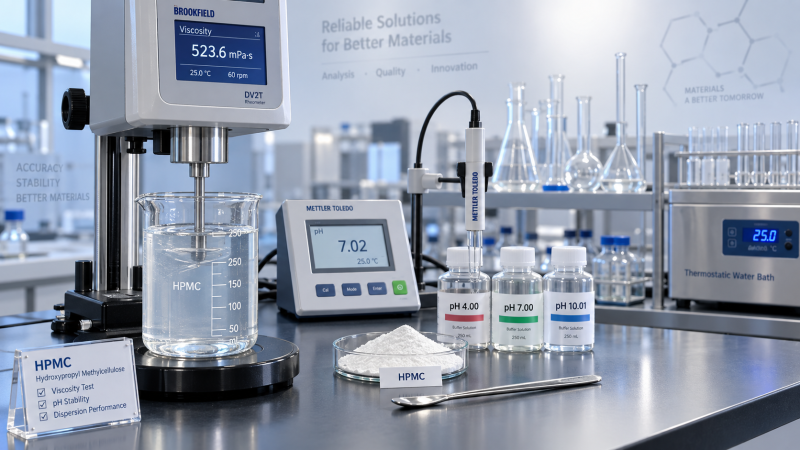
Reliable HPMC thickener testing is essential for quality control and safe formulation performance in construction and chemical applications. By evaluating viscosity, pH stability, and dispersion behavior, QC and safety teams can verify batch consistency, identify processing risks, and determine whether a material is suitable for its intended formulation. These tests are not isolated laboratory exercises: a small change in preparation conditions can change the apparent result enough to trigger an incorrect release decision.
Hydroxypropyl methylcellulose is commonly selected for water retention, rheology control, workability, suspension stability, and film-forming support. In dry-mix mortar, coatings, adhesives, detergents, and other chemical auxiliary systems, its performance depends not only on the nominal viscosity grade but also on how the powder hydrates and behaves in the actual formulation environment. A practical testing program therefore needs controlled sample preparation, repeatable instrument settings, and clear acceptance criteria tied to application requirements.
Start with a Representative Sample and Defined Test Conditions
Before testing an HPMC thickener, confirm that the sample represents the production batch. Powder can segregate during handling, particularly where particle-size distribution varies or bags have experienced repeated movement. Take portions from more than one point where practical, mix them carefully in a clean dry container, and protect the retained sample from moisture. Hygroscopic pickup may affect weighing accuracy and, in some formulations, hydration behavior.
The laboratory worksheet should record the lot number, sample date, water quality, solution concentration, mixing equipment, spindle or rotor, rotational speed, temperature, hydration time, and operator observations. This level of documentation is especially useful when a viscosity result is questioned later. “Viscosity below target” is not a meaningful conclusion unless the test conditions are known. Apparent viscosity is influenced by concentration, temperature, shear rate, and the degree of hydration.
For incoming inspection, the most useful approach is usually to compare each batch against the supplier’s agreed test method rather than comparing a single result with an unrelated market datasheet. A value expressed in CPS may look familiar, but it cannot be interpreted responsibly without the solution concentration, temperature, and measurement conditions behind it.
Measuring Viscosity Without Creating False Variation
Viscosity is often the first release parameter for an HPMC thickener because it is closely associated with body, sag resistance, workability, and water retention. Yet it is also the property most easily distorted by inconsistent preparation. HPMC solutions are not always perfectly Newtonian; the measured value can change as shear conditions change. For that reason, a rotational viscometer is useful only when the same instrument configuration and procedure are followed from batch to batch.
Prepare the solution with controlled hydration
A common laboratory route is to disperse the powder in hot water, then add cold water or cool the system to allow full hydration. The precise procedure should follow the product specification or internal method. Hot water can help prevent immediate surface hydration and lump formation, while cooling enables dissolution. Direct addition to room-temperature water may also work for some grades, but it demands controlled addition speed and adequate agitation.
Add powder gradually into a moving liquid vortex rather than dropping a large mass into still water. A dry outer shell may hydrate quickly around an un-wetted core, creating fish-eyes that remain invisible until the viscosity test gives an unexpectedly low or erratic result. Excessive high-shear mixing has its own risk: air entrainment can make readings unstable and complicate visual assessment. The goal is complete wetting and uniform hydration, not aggressive agitation for its own sake.
Once prepared, allow the solution to stand until hydration is complete and entrapped air has reduced. The required time varies by grade, concentration, particle size, and preparation method. A laboratory should establish this hold time during method validation and avoid shortening it just to accelerate release testing.
Control temperature, spindle, and speed
Measure the solution at the specified temperature, commonly using a controlled water bath or temperature-conditioned room where necessary. Temperature drift is a frequent source of disagreement between shifts and laboratories. The solution should be sufficiently uniform before measurement, but not stirred so vigorously that foam persists. Select a spindle and rotational speed that keep the instrument within its recommended torque range, and use the same arrangement for all comparable samples.
When reviewing results, distinguish between a real material change and a method change. If the same lot gives different values after a new spindle, new water source, revised solution concentration, or different temperature, the result may be technically correct but not comparable to previous records. This is why acceptance limits should always be connected to a defined method.
Checking pH Stability in the Intended Chemical Environment
A pH measurement of a standard HPMC solution is useful as a routine consistency check, but it does not by itself demonstrate compatibility with an alkaline mortar, acidic cleaner, pigment dispersion, or reactive additive package. The more valuable question is whether the HPMC retains acceptable viscosity and dispersion after exposure to the pH range and ingredients expected in use.
Begin with a calibrated pH meter. Calibration should be performed using suitable buffer solutions according to the instrument procedure, and the electrode should be appropriate for aqueous polymer solutions. Record the solution concentration and temperature because both can influence the observed pH. Do not interpret a minor pH difference as proof of polymer degradation without confirming the meter condition, water quality, and sample preparation.
For a stability evaluation, prepare a control solution and one or more challenged samples. Adjust pH only with reagents appropriate to the application and make adjustments gradually. Then observe viscosity, appearance, phase separation, odor changes, gel particles, and sediment over a defined time. The test duration should reflect the relevant process window: a freshly mixed cementitious system may require a different evaluation from a liquid coating stored for several days.
Particular caution is needed when other auxiliaries are present. Surfactants, salts, preservatives, defoamers, pigments, and polymer binders can alter solution behavior independently of pH. In waterborne formulations, compatibility screening may include materials such as Polyvinyl Alcohol, where the combined rheology and mixing sequence matter more than the individual viscosity figures. A stable HPMC solution in water may behave differently after contact with a complete formulation.
Dispersion Testing: Find Problems Before the Production Mixer Does
Dispersion testing assesses how readily the powder wets, distributes, and hydrates without persistent lumps. It is particularly relevant to safety and process control because poorly dispersed cellulose ether can lead to unplanned mixing time, dust exposure during corrective addition, blocked screens, inconsistent batch rheology, and manual rework.
A simple comparative test can be highly informative. Use identical water volume, water temperature, agitation speed, addition rate, and powder mass for each sample. Record the time to wet out, the presence of floating powder, visible agglomerates after a set mixing interval, and the time needed to achieve a uniform solution after hydration. Visual observations should be supported by a repeatable scoring system established internally; otherwise, one operator’s “slight lumping” may be another operator’s “acceptable dispersion.”
For dry-mix applications, the dispersion test should not stop with water alone. A small-scale blend containing the relevant mineral filler, cementitious component, and additives can reveal mixing-sequence issues that an aqueous beaker test misses. HPMC is often introduced into complex systems where particle density, moisture, mixer energy, and addition order influence final uniformity. If a material performs well in water but creates local gelled zones in a formulated product, the process should be reviewed before the raw material is rejected.
Interpreting Results as a Quality Decision
A sound release decision uses the three tests together. Viscosity confirms rheological consistency under defined conditions. pH stability indicates whether the material is likely to remain functional in the intended chemical range. Dispersion behavior exposes risks that may not appear in a fully hydrated laboratory solution. One acceptable number cannot compensate for a serious failure in another area.
When an out-of-specification result occurs, retain the original test solution and investigate in sequence: sample identity, weighing, water source, temperature, mixing history, hydration time, viscometer setup, and calibration status. Retesting is reasonable when a documented preparation or instrument issue is found. Retesting simply to obtain a preferred result is not. The investigation record should state whether the result reflects material variation, analytical variation, or an unresolved cause.
For suppliers with broad viscosity portfolios, grade identification also matters. Jinan Ludong Chemical Co., Ltd., established in 2020, produces and supplies cellulose ethers for construction and chemical applications, including HPMC, RDP, and HPS. Its HPMC type 75 and type 60 series cover construction and chemical grades, with stated controllable viscosity ranges from 400 to 200,000 CPS. Such a range makes method alignment essential: a low-viscosity grade and a high-viscosity grade cannot be evaluated meaningfully using one casual preparation routine.
Build a Method That Production Can Actually Use
The best HPMC thickener test method is not necessarily the most elaborate one. It is the method that is controlled, repeatable, relevant to the formulation, and understood by the people responsible for release and safe handling. Maintain reference samples where appropriate, trend results by lot, investigate meaningful shifts rather than isolated noise, and review the method whenever raw materials, water treatment, equipment, or product design changes.
Before approving a new grade or supplier batch, confirm the agreed viscosity procedure, target concentration, acceptable pH behavior, dispersion expectations, and any formulation-specific compatibility checks. That discipline gives QC teams a clearer basis for release and gives safety teams earlier warning of mixing, dust, and rework risks that may otherwise emerge only on the production floor.
Send Your Inquiry
We welcome your cooperation and we will develop with you.
