


When Does a Premium HPMC Thickener Reduce Total Formulation Cost?
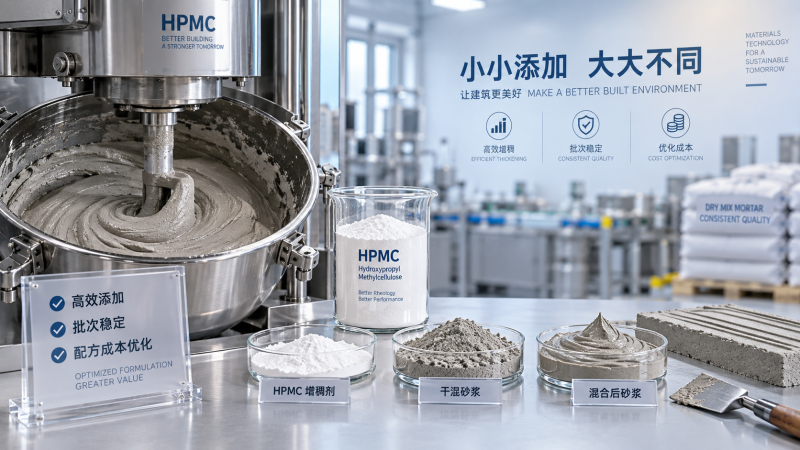
A premium HPMC thickener reduces total formulation cost only when its higher purchase price is offset by measurable savings elsewhere in the product and production process. The relevant comparison is not price per kilogram. It is the cost of producing a saleable, consistent batch that meets application requirements without excess additive use, rework, waste, or downstream complaints.
This distinction matters in dry-mix mortar, tile adhesive, wall putty, gypsum-based materials, cement renders, paints, and other systems where hydroxypropyl methylcellulose affects more than viscosity. A lower-cost grade may appear economical in a purchasing spreadsheet but require a higher dosage, wider process adjustments, or greater use of other ingredients to deliver acceptable workability and water retention. In those cases, a higher-performing HPMC thickener can be the lower-cost choice.
Start With Cost per Finished Batch, Not Cost per Ton
An HPMC quotation is easy to compare. A formulation is not. The approved cost model should calculate the cost of all materials required to make one compliant batch, then include the cost of variation. That means evaluating dosage, yield, production time, rejected material, cleaning, packaging losses, and the cost of handling quality issues after delivery.
A premium grade is worth considering when it allows the formulator to use less cellulose ether while preserving the target behavior. In cement-based systems, the useful properties are often linked: water retention helps prevent rapid moisture loss into the substrate; rheology affects spreading and sag resistance; open time affects application flexibility; and cohesive workability influences whether the material feels smooth or drags during use. A grade that performs these functions more efficiently can reduce the amount needed in the formulation.
That does not mean every high-priced grade is automatically economical. If two products achieve the same result at the same dosage and with the same batch consistency, the lower-priced material remains the rational selection. Premium pricing needs a clear operating benefit, not a technical label.
Where the Savings Usually Appear
The first source of savings is dosage efficiency. Viscosity alone is not enough to judge this. Two HPMC products with similar stated viscosity can behave differently in a mortar or coating because substitution level, particle characteristics, dissolution behavior, and compatibility with the rest of the formulation influence the final result. The appropriate comparison is the lowest dosage at which each option meets the same defined acceptance criteria.
The second source is reduced formulation compensation. When cellulose ether does not provide adequate water retention or workability, formulators may compensate by increasing dosage or adjusting other components. That can mean more polymer powder, starch ether, filler changes, or additional processing control. These adjustments may solve one problem while creating another, such as slower drying, altered strength development, poor mixing behavior, or higher total raw-material cost.
The third source is batch stability. In a commercial plant, small variation in thickening response or dispersion can create uneven batches even when the nominal recipe is unchanged. Operators then spend time correcting water addition, mixing duration, or ingredient balance. This is often treated as a production issue rather than a raw-material cost, but it is directly related to procurement quality. A more consistent HPMC grade can reduce corrective work and make output more predictable.
The fourth source is avoidance of field failures. Materials that spread poorly, lose water too quickly, slip on vertical surfaces, or show inconsistent application behavior can generate claims, returns, and technical support costs. Not every application issue is caused by HPMC, but cellulose ether performance is important enough that a weak or inconsistent grade may expose a formulation to avoidable risk.
Applications Where Premium Performance Has a Better Chance of Paying Back
The economic case is strongest when the formulation has a narrow performance window. Tile adhesives are a common example. The material must remain workable, retain sufficient water for cement hydration, adhere properly, and resist slip where applicable. A small loss in performance can make the product difficult to apply or unreliable on site. If a higher-grade thickener protects these requirements at a lower dosage or with less formulation complexity, its price premium may be justified.
Thin-bed mortars, repair mortars, skim coats, and gypsum-based plasters can show a similar pattern. These products are sensitive to spreadability, water demand, open time, and surface finish. A raw material that provides stable behavior can reduce the need for operators to chase changes from batch to batch.
The case is weaker in formulations with broad tolerances, low performance expectations, or a large dosage margin. If the product is not sensitive to application feel, water retention, or consistency, an economical standard grade may be sufficient. Paying for capabilities the formula does not use is still over-specification.
Do Not Approve a Premium Grade on Viscosity Alone
A common purchasing error is to treat viscosity as a complete proxy for HPMC performance. It is an important specification, but it does not answer all commercial questions. The relevant issue is whether the material reaches the required rheology, water retention, application behavior, and stability in the actual formula.
Another mistake is comparing products at equal dosage. Equal dosage testing is useful as an initial screen, but it can mislead a cost decision. A premium product should also be tested at optimized dosage. If it meets the target at a lower addition level, that is where its value may appear. Conversely, if dosage cannot be reduced and no process or quality improvement is observed, the premium is difficult to defend.
It is also risky to compare only a laboratory trial with no attention to manufacturing conditions. Raw-material quality, moisture variation, mixing sequence, water temperature, mixing energy, and storage conditions can affect the result. A trial should reflect the commercial production route as closely as practical.
A Practical Approval Method
The most useful approach is to define the performance threshold before discussing price. The formulation team should state what “acceptable” means for the specific product: target workability, water retention, sag control, setting behavior, appearance, adhesion-related requirements, and tolerance to normal process variation. Procurement can then request samples and technical data against a clear decision standard.
- Set a baseline. Record the current formula, dosage, total ingredient cost, mixing conditions, quality results, and known production losses.
- Test at equal performance, not just equal addition rate. Adjust each candidate to the minimum dosage that meets the same acceptance criteria.
- Track compensation effects. Note whether the new grade changes the need for polymer powder, starch ether, water adjustment, or process changes.
- Run repeat batches. One successful trial may show potential; repeatability reveals whether the result can support purchasing approval.
- Calculate the complete cost. Include material cost, production time, rejected batches, corrective additions, and expected quality risk.
This process gives finance a defensible basis for approval. It moves the discussion from “premium versus standard” to a testable question: which option produces the required product at the lowest stable total cost?
Supply Consistency Is Part of the Cost Calculation
For high-volume formulations, supply reliability and grade consistency deserve the same attention as quoted price. A low-cost source that requires frequent reformulation, unpredictable lead times, or lot-by-lot adjustments can erode any initial savings. Procurement specifications should therefore cover the properties that matter to the formula, not only a broad viscosity range.
Jinan Ludong Chemical Co., Ltd. produces cellulose ethers for construction and chemical applications, including HPMC grades across a broad viscosity range. For a buyer, the useful point is not the breadth of the catalogue by itself; it is the ability to align the selected grade with the formulation’s actual requirements and maintain a defined supply specification over time.
Alternative cellulose ethers may also deserve consideration when the formula and application call for a different performance balance. For example, Methyl Hydroxyethyl Cellulose (HEMC) can be evaluated alongside HPMC where the formulator is comparing water retention, workability, setting response, and compatibility within a particular dry-mix system. It should be treated as a formulation comparison, not as a direct assumption that one chemistry is universally less expensive.
Questions That Reveal Whether the Premium Is Real
Before approving a higher-priced HPMC thickener, ask a short set of commercial questions:
- Can the dosage be reduced while the finished product still meets the same specification?
- Does the change eliminate or reduce another costly additive?
- Will the new grade reduce batch corrections, rework, or operator intervention?
- Are the benefits visible under normal production conditions rather than only in a controlled trial?
- Is the product sensitive enough that improved application consistency reduces complaint risk?
- Can the supplier maintain the agreed performance profile across routine deliveries?
If the answer to several of these questions is yes, a higher unit price may lower total formulation cost. If the benefit is limited to a better-looking technical data sheet, while dosage, process behavior, and finished-product quality remain unchanged, the premium does not have an economic basis.
The approval decision should therefore be tied to a defined finished-product cost and a defined performance threshold. That is the point at which an HPMC purchase becomes a formulation investment rather than a simple commodity transaction.
Send Your Inquiry
We welcome your cooperation and we will develop with you.
