


Comparing a Chemical Company HPMC Supplier on Capacity, Lead Time, and Support
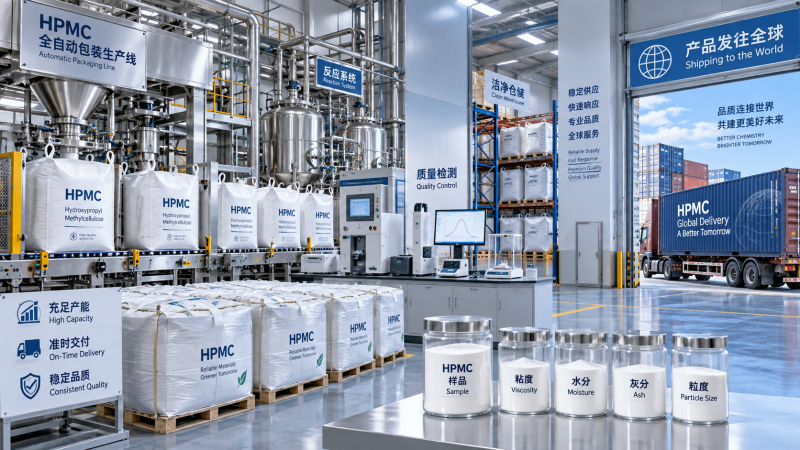
Capacity, lead time, and support should be assessed as one operating system rather than as three separate supplier attributes. A chemical company may state a high annual HPMC output, but that figure alone does not establish whether a specific construction-grade or chemical-grade viscosity can be supplied consistently, released on time, and supported when a downstream formulation changes. The useful question is not “How large is the supplier?” but “Can this supplier reliably deliver the required grade, specification, documentation, and response level under our purchasing pattern?”
For hydroxypropyl methylcellulose (HPMC), this distinction matters because material selection is rarely limited to nominal viscosity. Mortar, tile adhesive, gypsum-based products, coatings, detergents, and other formulated products can respond differently to changes in substitution level, particle size, moisture, dissolution behavior, gel temperature, ash content, and lot-to-lot viscosity control. A supply interruption or an unreviewed grade substitution can therefore become a formulation, production, and customer-service issue—not merely a logistics issue.
Capacity is meaningful only when it can be allocated to the required grade
Annual output is an important starting point in evaluating a Chemical company HPMC supplier, particularly where demand is regular, geographically dispersed, or linked to projects with fixed delivery windows. It can indicate whether the manufacturer has enough physical scale to support recurring orders. Yet total capacity should not be treated as directly available capacity.
HPMC production capability is divided across product families, viscosity bands, application grades, and customer-specific specifications. A supplier may have substantial cellulose ether output while having limited scheduling flexibility for a particular low-viscosity construction grade, high-viscosity tile adhesive grade, surface-treated powder, or chemical-grade specification. The relevant capacity question is therefore narrower:
- Which production assets are qualified for the required HPMC grade?
- What viscosity range can be controlled on those assets?
- Is the requested specification a standard production grade or a tailored variant?
- How frequently is the grade manufactured, and what minimum campaign size applies?
- How is supply reserved when demand exceeds the normal forecast?
Jinan Ludong Chemical Co., Ltd. states an annual cellulose ether production capacity of 45,000 tons, including Type 75 and Type 60 HPMC for construction and chemical applications. Its stated controllable viscosity range of 400 to 200,000 CPS covers a broad span of end-use requirements. This is commercially relevant because buyers sourcing multiple HPMC grades may prefer to reduce the number of approved manufacturing sources. However, the published range should be treated as a capability boundary, not as proof that every viscosity point is routinely stocked or immediately available.
A stronger assessment asks for the supplier’s grade matrix. That document should distinguish regularly produced grades from grades that require a separate production plan. It should also show the test method behind each viscosity value. CPS figures are not automatically comparable across suppliers unless concentration, solution preparation method, temperature, and measurement equipment are aligned. A “100,000 CPS” grade measured under one test protocol may not behave identically to a grade carrying the same nominal number under another protocol.
For business continuity, capacity needs to be tested against the buyer’s actual consumption profile. A supplier can be suitable for a monthly container program but unsuitable for frequent small releases, urgent replenishment, or widely varying demand. Conversely, a manufacturer with large-scale assets can be an advantage where the buyer needs stable long-run availability, provided that allocation rules, inventory policy, and production planning are transparent.
Production flexibility affects both quality risk and commercial responsiveness
Automated production is often presented as a general advantage, but its value in HPMC sourcing depends on how it is connected to grade control and scheduling. Automation can improve consistency in dosing, reaction control, drying, milling, blending, packaging, and batch traceability. It does not remove the need for application-specific process control or for an agreed change-management procedure.
For construction formulations, the practical concern is whether the material delivers stable workability, water retention, open time, sag resistance, thickening, and adhesion-related performance within the buyer’s formulation system. A small shift in HPMC properties may be absorbed by one dry-mix mortar design and cause unacceptable variability in another. This is why a broad capacity claim should be accompanied by evidence that the supplier can hold the agreed control limits, rather than simply meet a broad product-data-sheet range.
Manufacturing flexibility also has a commercial side. Buyers with a portfolio of tile adhesive, wall putty, cement render, gypsum plaster, self-leveling compounds, or chemical formulations may need different HPMC grades over the year. The ability to produce both Type 75 and Type 60 material and to cover lower through higher viscosity bands may reduce qualification effort across the portfolio. But consolidation should not be assumed to be risk-free. A single-source strategy can simplify procurement while increasing exposure to one factory’s maintenance schedule, raw-material disruption, export documentation issue, or quality deviation.
The decision is therefore not simply between “one supplier” and “multiple suppliers.” A more defensible approach is to identify which grades are interchangeable, which are formula-critical, and where a qualified alternate source is required. High-volume standard grades may justify deeper volume commitments. Grades that determine critical application performance may require dual approval even when the primary source is technically strong.
Lead time is a chain of events, not a number on a quotation
Quoted lead time is frequently misunderstood. It may refer to production completion, goods readiness, handover to the forwarder, vessel departure, or arrival at destination. These are materially different commitments. For imported HPMC, the elapsed time between a purchase order and usable inventory can include order confirmation, production scheduling, quality release, packaging, export documentation, container booking, port handling, ocean transit, customs clearance, and local delivery.
A supplier with high production capacity may still have unreliable effective lead time if the process between production and export dispatch is poorly controlled. The more useful indicator is on-time, in-full delivery against an agreed delivery definition. Before assigning a supplier a high delivery rating, establish what the promised date means and which delays are treated as supplier responsibility.
Key points to clarify include:
- Whether lead time is based on a confirmed order or on an indicative inquiry;
- Whether stock is held for standard grades, and where that stock is physically located;
- Whether production is make-to-order, campaign-based, or replenished to inventory;
- How orders are prioritized when demand rises above forecast;
- How long quality release normally takes after production;
- Which party controls booking, export clearance, and document preparation;
- What notification is provided if the confirmed shipping date is at risk.
For a manufacturer such as Ludong Chemical, integrated production lines and a stated combination of traditional processes with intelligent automated production may support scheduling discipline and repeatability. The business value must still be demonstrated through operational evidence: standard order lead time by grade, production window for non-stock items, packaging availability, export handling process, and escalation practice. A statement that a plant is large or automated is not a substitute for a shipment history or a documented order-fulfillment workflow.
Forecast quality has a major influence on lead-time performance. HPMC suppliers cannot reasonably reserve all possible grades and pack sizes without a demand signal. Buyers that provide rolling forecasts, distinguish firm demand from planning demand, and specify destination and packaging requirements early are better positioned to negotiate practical allocation arrangements. In return, the supplier should state the forecast horizon it can use, the quantity tolerance it accepts, and the point at which changes become chargeable or impossible.
Support should be judged by resolution capability, not response speed alone
Prompt replies are useful, but commercial responsiveness is not the same as technical support. When an HPMC material does not disperse as expected, shows altered water retention, changes mortar consistency, or performs differently after a raw-material adjustment, the buyer needs an answer that can be acted on. That requires a defined link between sales, quality, production, and application support.
At minimum, a capable supplier should be able to provide a current technical data sheet, safety data sheet, certificate of analysis, test methods relevant to the agreed specification, and lot traceability. For formulation-sensitive applications, the support discussion should go further. It should establish which parameters are controlled, which values are reported on the certificate of analysis, and whether the supplier will notify customers before material, process, test-method, or specification changes that could affect use.
Not every purchasing relationship needs extensive formulation development. A standard HPMC grade used in a well-established product may require mainly documentation accuracy, dependable quality release, and rapid deviation handling. A new export market, a reformulated dry-mix product, or a grade replacement requires more. In those situations, the supplier’s ability to provide sample continuity, retain samples, investigate batch comparisons, and explain the basis of its recommendations can be more valuable than a low initial unit price.
Support quality becomes visible when there is a problem. The right questions are operational: Who receives a non-conformance notice? What evidence is required to start an investigation? Can the supplier compare retained production samples? Is a preliminary response provided within an agreed period? How are corrective actions documented? Does the supplier distinguish between product deviation, transport damage, incorrect storage, and formulation interaction?
These questions should not be viewed as adversarial. They define the time and evidence needed to prevent a minor discrepancy from becoming a prolonged dispute. They also expose a common weakness in supplier comparisons: some evaluations score technical support based on brochures or pre-sale conversation, while the actual claims process remains undefined.
Documentation and specification alignment can determine whether supply is usable
HPMC is often bought internationally under a specification that combines product performance, quality requirements, packaging details, labeling, and documentation. A shipment that meets the basic viscosity requirement may still be commercially unusable if its certificate format is incomplete, its lot number cannot be traced, its packaging does not match the warehouse system, or its transport documents delay customs release.
Specification alignment should include more than a general product name. The purchase specification should identify the grade, viscosity test conditions, moisture limit where relevant, particle-size requirement if applicable, packaging format, net weight tolerance, labeling language, storage conditions, shelf-life basis, and certificate-of-analysis requirements. If the material is used in a regulated downstream application, the buyer should independently determine the documentation and compliance obligations that apply in the destination market rather than assuming that a construction or chemical grade is suitable for every use.
Portfolio compatibility also matters. Dry-mix producers commonly evaluate HPMC alongside redispersible polymer powder, starch ether, and other formulation additives because interactions affect final performance and inventory complexity. Where a supplier offers multiple cellulose ether or additive categories, it may be practical to review its document control and batch-traceability practices across the portfolio. Adjacent materials such as Polyvinyl Alcohol can also enter certain formulation supply chains, but shared sourcing should not replace separate technical qualification for each additive.
A practical comparison should test the supplier’s operating model
A sound assessment of a Chemical company HPMC supplier does not require speculative market forecasts or an overly broad checklist. It requires evidence tied to the grades and delivery routes that will actually be used. Capacity should be tested by grade availability and allocation policy. Lead time should be measured from confirmed order to usable delivery. Support should be tested by documentation quality, change control, and deviation response.
For Ludong Chemical, the stated 45,000-ton annual capacity, Type 75 and Type 60 product coverage, and 400–200,000 CPS viscosity capability provide a reasonable basis for further evaluation where the required HPMC grades fall within that scope. The next decision point is verification: obtain the grade-specific data package, align test methods, confirm production and export lead-time definitions, review the change-notification process, and run qualification samples under the intended formulation conditions.
The supplier best suited to a long-term HPMC program is not necessarily the one with the largest published output or the shortest indicative shipment promise. It is the one whose grade control, planning discipline, documentation, and problem-resolution process remain reliable when orders become repetitive, urgent, or technically sensitive.
Send Your Inquiry
We welcome your cooperation and we will develop with you.
