


HPMC 200000 Explained: When Is This High-Viscosity Grade the Right Choice?
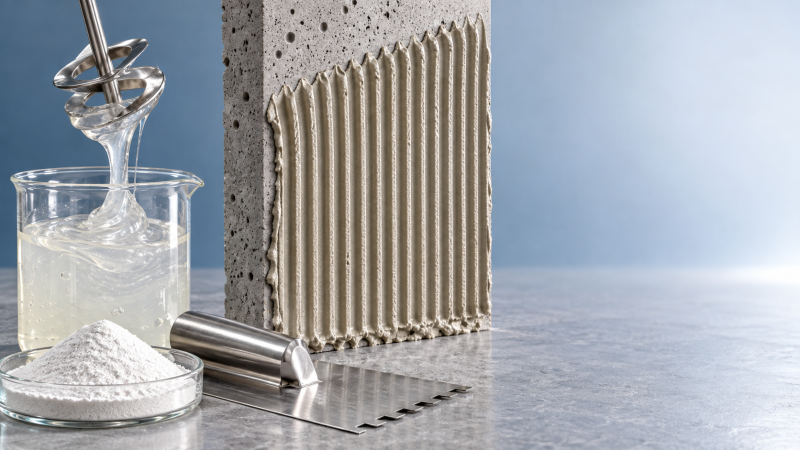
When a dry-mix mortar feels too loose on the trowel, loses water quickly into an absorbent substrate, or sags after application, formulators often look for a stronger cellulose ether. HPMC 200000 can be the right direction when the system needs high thickening efficiency, robust water retention, and better resistance to slump. It is not automatically the best grade simply because its viscosity number is high, however. In some mixes, it can make stirring more difficult, increase the perception of stickiness, or produce a texture that is harder to spread.
The practical answer is straightforward: choose HPMC 200000 when the formulation needs a pronounced rheology-building effect and sufficient water control under demanding application conditions, especially in cement- or gypsum-based systems that must remain workable on the wall or substrate. Choose a lower-viscosity grade when rapid dispersion, lighter handling, high flow, or easier pumping matters more than maximum body and water retention.
What the “200000” designation usually means
HPMC, or hydroxypropyl methylcellulose, is a nonionic cellulose ether used to modify the behavior of water-based formulations. After hydration, it can thicken the liquid phase, retain water, improve consistency, and help create a more stable application texture. The number in HPMC 200000 generally refers to a nominal viscosity class, commonly expressed in centipoise (cP or CPS) under a specified test method.
This point matters because viscosity values are not fully comparable unless the test conditions match. A quoted value can depend on polymer concentration, water temperature, measuring equipment, spindle selection, rotation speed, and dissolution procedure. A product described as 200,000 CPS should therefore be treated as a high-viscosity grade category, not as a complete performance specification by itself.
In actual formulation work, the final viscosity of a mortar, coating, paste, or cleaner is also affected by cement, fillers, starch ethers, polymers, surfactants, pH, salts, pigments, and mixing energy. The grade tells you the likely direction of performance; a small application test tells you whether that direction is correct for the full system.
The situations where a high-viscosity grade earns its place
High-viscosity HPMC is most useful when the formulation has a clear need to hold water and maintain structure after mixing. A tile adhesive, skim coat, wall putty, repair mortar, or gypsum compound may contain fine mineral powders that quickly absorb or release water during application. If water leaves the material too quickly, cement hydration can be affected, open time may become too short, and the applicator may find the material difficult to comb, level, or rework.
In these situations, HPMC 200000 can help by increasing the viscosity of the aqueous phase around the solid particles. That can reduce rapid water migration into porous substrates and support more stable handling. The benefit is not merely “thicker mortar.” A well-matched high-viscosity grade can help the material stay coherent while being spread, combed, or built up on vertical surfaces.
It is often worth considering when a formulation shows one or more of the following signs:
- The material drops or slumps after being applied to a wall.
- Water is absorbed rapidly by masonry, concrete, board, or another porous base.
- The mixture becomes dry or difficult to rework before application is complete.
- Tile adhesive ridges lose definition too quickly after combing.
- A wall compound lacks body and feels too fluid despite an acceptable powder-to-water ratio.
- A water-based product needs more suspension stability without relying only on mineral thickeners.
These signs do not prove that the viscosity grade alone is the problem. Excessive sand particle size, filler balance, inadequate polymer content, inappropriate water demand, or poor mixing can cause similar effects. Still, they are good reasons to investigate whether a higher-viscosity cellulose ether grade is needed.
Why high viscosity changes application behavior
The main advantage of a 200000 CPS class HPMC is its ability to build structure at relatively low addition levels. In a wet formulation, the hydrated polymer increases resistance to flow. Under the shear created by mixing, troweling, rolling, or pumping, the material may become easier to move; once the shear decreases, it regains body. This balance is valuable in vertical applications, where a material needs to spread under tool pressure but should not run after placement.
Water retention is another important reason to use a high-viscosity grade. Cement-based formulations need water for hydration, while gypsum and mineral-filled products require stable moisture distribution for workable application. Where the substrate is dry, warm, or highly absorbent, a cellulose ether that retains water more effectively can reduce sudden moisture loss. This may support open time and improve the consistency of the working window.
High-viscosity HPMC can also influence air entrainment, lubricity, and surface feel. These effects are formulation-dependent. A mortar may feel creamier and easier to spread after optimization, but an excessive dosage can also make it feel overly sticky or heavy. The correct objective is not to maximize viscosity. It is to reach the handling profile required by the application.
Do not select by viscosity number alone
A common purchasing mistake is to compare cellulose ether grades only by their nominal CPS value. Two products in the same viscosity range can still perform differently because substitution levels, particle size, surface treatment, gel temperature, dissolution behavior, moisture level, and production consistency may differ. For construction use, the distinction between cold-water soluble and delayed-dissolution surface-treated material can also affect the mixing process.
Substitution chemistry affects how the polymer hydrates and behaves in water. Hydroxypropyl and methoxy substitution can influence thermal gelation, water solubility, and compatibility with a formulation. A grade with a suitable viscosity but unsuitable substitution balance may not give the expected open time, texture, or stability.
It can be useful to compare HPMC with another cellulose ether when a formulation needs a different rheology profile. For example, Methyl Hydroxyethyl Cellulose (HEMC) may be evaluated where the desired hydration behavior or mortar feel differs from that of an HPMC-based system. This is not a universal replacement decision; the relevant question is how each material performs with the selected cement, filler, polymer powder, and application method.
A practical way to judge whether HPMC 200000 is too high, too low, or appropriate
Start with the application failure rather than the polymer grade. A product that seems thin, dries quickly, and sags has a different problem profile from a product that is already stiff but has poor adhesion. The first may benefit from increased viscosity or water retention. The second may need changes elsewhere in the formulation before more cellulose ether is added.
When the grade may be too low
A lower-viscosity HPMC grade may be insufficient when the wet mix separates, loses water rapidly, or cannot maintain a stable layer on a vertical surface. In tile adhesive, weak ridge stability can be a useful observation. In wall putty, the material may feel watery at first and then drag as water is pulled into the substrate. In a repair mortar, the mix may not stay where it is placed.
Before moving directly to HPMC 200000, verify the actual water addition and mixing sequence. Too much water can create apparent low viscosity regardless of the grade selected. Poor dispersion can create the opposite impression: localized gel particles may coexist with an otherwise thin mixture.
When the grade may be too high
Excessive polymer viscosity or dosage can create a paste that feels elastic, sticky, or difficult to spread smoothly. The material may cling strongly to the mixing tool or trowel, making it harder to achieve a thin and even layer. Some formulations may show reduced flow, slower wetting of powders, or a texture that feels “long” rather than clean-cut.
High viscosity can also complicate processing where rapid dissolution and easy pumping are important. In liquid products, the polymer must be dispersed carefully to avoid lump formation. In dry-mix systems, hydration time should be evaluated after mixing because the full rheological profile may not appear immediately.
Application-by-application selection logic
How to run a meaningful comparison trial
A useful comparison does not need to be complicated, but it should control the variables that change performance. Prepare a reference formula using the current cellulose ether grade, then compare it with HPMC 200000 at a carefully selected starting dosage. Do not change water content, filler ratio, polymer powder level, and mixing time all at once. Otherwise, it becomes impossible to identify the source of any improvement or problem.
- Use the same batch size, powder blend, water temperature, and mixing equipment for each sample.
- Allow the material to hydrate for the same period before judging consistency.
- Assess wet density, mixing feel, trowel drag, spreadability, and vertical stability.
- Apply samples to the intended substrate, especially if the substrate is highly absorbent.
- Observe working time, reworkability, ridge retention, surface finish, and any visible lumping or air-related defects.
- Adjust dosage in small increments only after the initial comparison identifies the direction of change.
For dry-mix mortar, measuring only the initial viscosity in a cup or beaker is not enough. The product is used under shear and against a substrate, so trowel behavior and water loss matter as much as a laboratory viscosity reading. For liquid systems, visual homogeneity and storage behavior may be equally important.
Mixing and handling details that can distort the result
High-viscosity cellulose ethers need proper dispersion. If powder is added too quickly to water, the outer surface of particles can hydrate before the center wets, forming agglomerates that resemble gel lumps. Those lumps can be mistaken for high viscosity, even though the polymer is not uniformly dissolved.
One approach is to disperse the powder under sufficient agitation before full hydration occurs, then allow time for the polymer to dissolve. The exact sequence depends on whether the grade is surface treated, whether the product is supplied in dry-mix form, and whether other powders are present. In a dry mortar factory, uniform premixing with mineral components is critical. In a liquid chemical formulation, the addition order of surfactants, salts, and alkaline materials may influence hydration and final texture.
Temperature deserves attention as well. Water temperature can change hydration speed and measured viscosity. A sample mixed in cool water may not behave exactly like one mixed under warmer site conditions. When comparing grades, keep the test temperature consistent rather than interpreting every difference as a polymer-quality issue.
The decision boundary: strong performance without unnecessary heaviness
HPMC 200000 is a sensible candidate when the formulation needs substantial water retention, thicker rheology, and stronger anti-sag support. It is particularly relevant where vertical application, porous substrates, or a longer workable period place pressure on the wet mortar structure.
It is less suitable as a default answer to every workability problem. When the main requirement is easy flow, rapid wetting, low mixing resistance, or a light application feel, a medium- or lower-viscosity grade may provide a better balance. The most reliable selection comes from matching the grade to the failure mode, confirming the test method behind the viscosity value, and checking performance in the complete formulation rather than in water alone.
Send Your Inquiry
We welcome your cooperation and we will develop with you.
