


HPMC 200000 vs Lower Viscosity Grades for Cement-Based Tile Adhesives
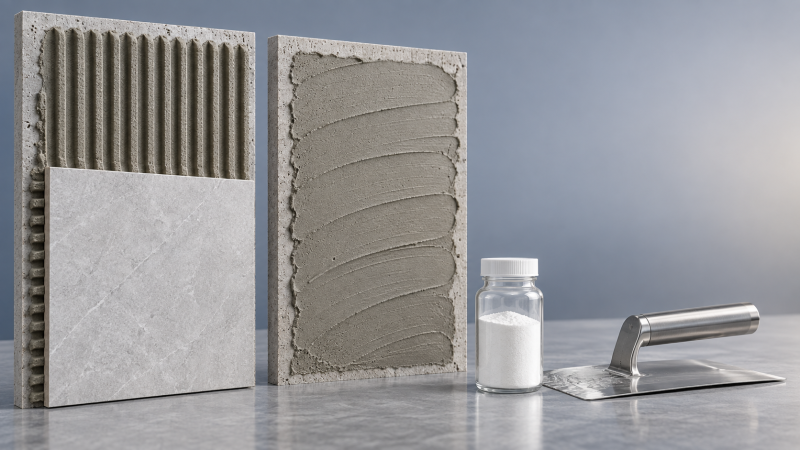
For cement-based tile adhesives, HPMC 200000 is usually selected when the formulation needs strong water retention, higher body, and reliable resistance to tile slip on vertical surfaces. Lower-viscosity grades are more suitable when easier mixing, smoother spreading, faster wetting, or a less viscous mortar profile is the priority. Neither option is inherently superior; the correct grade follows the tile format, bed thickness, substrate absorption, polymer level, filler grading, and required application behavior.
A viscosity figure alone should not be treated as a complete performance specification. HPMC viscosity is measured under defined laboratory conditions, while adhesive behavior is created by the full dry-mix system after water addition. Cement type, calcium content, sand particle size distribution, redispersible polymer powder, starch ether, hydrophobic additives, and mixing water all change the apparent consistency seen on site. Still, comparing high- and lower-viscosity cellulose ethers provides a useful starting point for formulation screening.
Where HPMC 200000 changes adhesive behavior
HPMC 200000 has a relatively high thickening effect in water. In a tile adhesive, this generally produces a more cohesive mortar with a stronger internal structure. The mortar tends to hold its shape after combing, which is valuable where tiles are installed on walls, where large-format tiles create downward stress, or where the adhesive must retain pronounced trowel ridges for a longer period.
Its water-retention contribution is often the main reason for considering this grade. Cement hydration requires water to remain available in the adhesive layer. On porous substrates or in warm, dry, or moving-air conditions, water can be drawn from the mortar before the cement has developed adequate bonding strength. A high-viscosity HPMC creates a more effective water-holding network, reducing rapid moisture loss at the substrate interface and supporting cement hydration during the working period.
This benefit has a practical limit. Excessive water retention and viscosity can make the adhesive feel heavy during spreading. The trowel may drag, and a formulation that appears stable in a laboratory cup can become difficult to work over a large wall area. If the adhesive is too structured, the installer may apply an uneven bed or fail to achieve adequate contact at the back of the tile. Higher viscosity should therefore be evaluated together with spreadability and transfer, rather than judged from sag resistance alone.
HPMC 200000 is often useful where a formulation needs more open time without relying entirely on a higher polymer dosage. Open time is not simply the length of time before the mortar surface looks dry. It is the period during which a freshly combed adhesive can still wet the tile back sufficiently to form effective contact. A surface skin may develop even when the mortar beneath remains soft. High-viscosity cellulose ether can delay this loss of surface workability, but the result must be tested under the intended substrate and ambient conditions.
What lower-viscosity grades do differently
Lower-viscosity HPMC grades generally dissolve and disperse more readily during mixing, particularly in dry-mix products mixed with a hand-held paddle under field conditions. They can produce a mortar that feels lighter and more fluid at the same water addition. This may improve wetting of sand and cement particles, reduce mixing time, and give a smoother draw under the trowel.
That smoother feel is useful for thin-bed adhesives used on reasonably flat floors or for installations involving smaller tiles. When vertical holding demand is modest, an overly high-viscosity system can add resistance without delivering a proportional installation benefit. A lower-viscosity grade can allow the formulation to reach a more workable consistency while retaining enough cohesion for normal combing and tile placement.
The trade-off is reduced resistance to water loss and deformation when the formula is otherwise unchanged. On an absorbent concrete block, lightweight substrate, aged screed, or poorly prepared cementitious wall, a lower-viscosity grade may allow the adhesive to lose water more quickly. The mortar can then become shorter, ridges can dry at their edges, and tile adjustment becomes less forgiving. Increasing water addition may improve the initial feel but does not necessarily restore open time or bond development; it can also reduce slump resistance and alter curing behavior.
Lower viscosity is not synonymous with poor water retention. The substitution type, particle treatment, dosage, and interaction with other rheology modifiers all matter. A well-designed lower-viscosity system can meet demanding workability targets. The important point is that it should not be assumed to behave like HPMC 200000 merely because both materials are labeled as construction-grade cellulose ethers.
Water retention, open time, and sag are related but separate
These properties are frequently grouped together during grade selection, yet they do not move in perfect alignment. A mortar with high water retention can still have inadequate anti-sag performance if its particle packing and polymer balance are weak. Conversely, a stiff mortar can resist sliding while offering poor tile wetting because it does not transfer well from the ridges to the tile back.
Open time also has more than one failure mode. If water is absorbed quickly into the substrate, the adhesive loses workability from below. If hot air or direct sun dries the ridge surface, skin formation begins from above. A high-viscosity HPMC may improve both conditions to a degree, but it cannot fully compensate for an unprimed, highly absorbent substrate or application in unsuitable weather. The evaluation method should distinguish between moisture loss, surface skinning, and insufficient initial transfer.
Ridge shape is a useful field observation. With HPMC 200000, ridges often remain taller and more defined after combing. That appearance is positive only if the ridges collapse properly during tile bedding. If they remain rigid, contact coverage may be lower than expected. A lower-viscosity adhesive can show faster ridge relaxation, which may improve bedding on a flat substrate but may also reduce the ability to support a tile before cement hydration begins. Assessment should include both the combed profile and the contact pattern after tile removal.
Tile size and installation direction change the decision
Large-format porcelain tiles commonly increase the demand for cohesive mortar. Their larger surface area and weight make downward movement more visible on walls, while their low absorption provides little assistance in drawing moisture from the adhesive. HPMC 200000 is often a logical starting point for such work, particularly where the adhesive is expected to retain a stable combed bed during adjustment.
For floor installations, gravity does not create the same slipping problem, but high viscosity is still not automatically unnecessary. Large tiles may require a workable adhesive with sufficient body to maintain bed thickness and prevent local collapse when tiles are pressed into place. The appropriate balance is often a moderately structured mortar rather than the highest possible viscosity. Lower-viscosity grades can be attractive where rapid spreading and complete tile wetting are more difficult to achieve with a high-body formulation.
Small ceramic tiles on stable, low-absorption floors present a different balance. If long open time and anti-sag performance are not demanding, a lower-viscosity cellulose ether may offer a more efficient rheological profile. A grade should not be selected solely from the tile size, however. A small tile installed over a thirsty cement render may impose a greater water-retention demand than a larger tile installed over a dense, properly prepared concrete surface.
Mixing behavior can hide a wrong comparison
When comparing viscosity grades, each trial batch needs the same mixing sequence, water temperature, rest period, and remix procedure. High-viscosity grades may build body progressively after hydration. Reading the consistency immediately after mixing can therefore underestimate the final resistance and encourage unnecessary water addition. That extra water may later produce excessive slump or reduced ridge stability after the mortar has fully matured.
Dry addition rate also matters. If powder is dumped rapidly into water, agglomerates can form. Their outer surface hydrates first, trapping dry material inside. The resulting mortar may contain small gel particles that are mistaken for incomplete dispersion, poor raw material quality, or sand contamination. A controlled powder addition, adequate mixing shear, and a defined maturation period are needed before comparing HPMC 200000 with a lower-viscosity alternative.
Water demand should be recorded rather than adjusted by feel alone. Two grades may reach similar apparent consistency at different water additions, but their application behavior can diverge after combing. Compare water-to-powder ratio, density, trowel drag, ridge stability, tile transfer, vertical movement, and open-time performance as a set. A single flow or slump observation is too narrow for selecting a cellulose ether for tile adhesive.
Formulation interactions that alter the viscosity choice
Redispersible polymer powder affects adhesion, flexibility, wetting, and cohesion. In a polymer-rich adhesive, the polymer may contribute enough internal binding that a lower-viscosity HPMC produces acceptable tile slip and transfer. In a leaner formulation, HPMC 200000 may carry more of the burden for water retention and structure. These interactions should be checked after curing as well as during fresh-mortar testing, since improved handling does not guarantee the intended bond performance.
Hydroxypropyl starch ether is often used in small amounts to modify anti-sag behavior and trowel response. When it is present, moving from a lower-viscosity HPMC to HPMC 200000 without revisiting the starch ether level can create an adhesive that is overly thick or difficult to comb. The same principle applies to fine fillers. A higher proportion of very fine mineral filler increases surface area and can amplify the body contributed by cellulose ether.
Where an alternative cellulose ether chemistry is under review, such as Methyl Hydroxyethyl Cellulose (HEMC), the comparison should extend beyond nominal viscosity. Thermal gel behavior, hydration profile, water retention, and interaction with cement vary by chemistry and substitution pattern. A direct viscosity-for-viscosity substitution is not a reliable evaluation method.
A practical selection sequence
Begin with the required installation behavior rather than a target viscosity number. If the adhesive must hold large tiles on a wall, retain water on absorbent substrates, and preserve ridges during adjustment, start the screening around HPMC 200000 or a grade with comparable fresh-mortar structure. If fast mixing, smooth spreading, and floor workability are dominant, begin with lower-viscosity grades and determine whether water retention remains sufficient under drying conditions.
- Prepare matched trial formulas, changing only the cellulose ether grade and adjusting water only after a defined rest period.
- Comb the mortar with the intended notch size, then assess ridge definition, collapse under tile pressure, and transfer to the tile back.
- Test vertical movement after placement when wall use is relevant; do not infer anti-sag behavior from mortar stiffness in the bucket.
- Expose combed adhesive to representative substrate absorption and ambient drying conditions before judging open time.
- Review the result after any change in cement source, sand grading, polymer level, or auxiliary thickener, because the earlier viscosity ranking may shift.
HPMC 200000 is most effective when its higher water retention and structural contribution solve a specific installation need. Lower-viscosity grades remain valuable where the adhesive must spread easily, wet tile backs readily, and avoid excessive body. The selection becomes defensible when the grade is judged through the full mortar response: mixing development, combing, ridge behavior, tile transfer, movement after placement, and moisture retention under the intended substrate conditions.
Send Your Inquiry
We welcome your cooperation and we will develop with you.
