


Using HPMC 200000 to Improve Water Retention in Machine-Applied Plaster
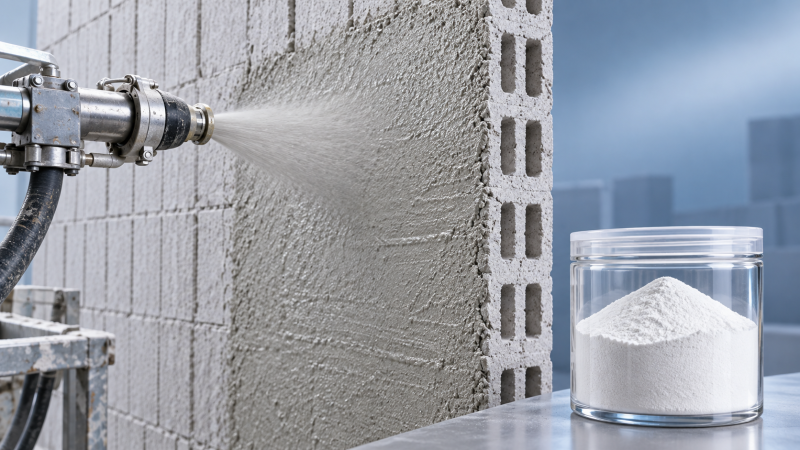
Machine-applied plaster loses water from several directions at once: suction into the substrate, evaporation from the exposed surface, and water demand from cement hydration. When that loss becomes too fast, the material may still pass through the pump but arrive at the wall with reduced open time, weak contact, or an unstable spray pattern. A high-viscosity cellulose ether such as HPMC 200000 is used to hold mixing water within the fresh plaster film long enough for placement, leveling, and early curing to proceed more consistently.
The result should not be judged only by whether the mortar feels thicker in the mixer. The useful effect is a workable balance between water retention, pumpability, spray cohesion, and finishing response. If the formulation retains water but becomes difficult to convey through hoses, the high retention grade has not been matched correctly to the complete plaster system. If the mortar sprays easily but pulls dry immediately on an absorbent wall, the dosage, grade selection, or substrate preparation needs attention.
What HPMC 200000 Changes in Fresh Plaster
HPMC 200000 refers to a high-viscosity grade, commonly identified by a viscosity level around 200,000 CPS under specified test conditions. That viscosity value is useful for product selection, but it is not a direct prediction of mortar consistency. Test concentration, solution temperature, measurement method, substitution level, particle treatment, and the rest of the dry mix all influence how the grade performs after water is added.
In a machine-applied plaster, hydrated HPMC forms a polymer network in the aqueous phase. This network increases the ability of the mortar to resist rapid water separation and slows water migration into porous masonry or concrete. The fresh mix stays more coherent at the nozzle and remains more receptive to troweling after it reaches the wall. Water retention also supports cement hydration near the interface, where premature drying can otherwise weaken adhesion and cause a dusty or friable surface.
High viscosity is especially relevant when the plaster contains fine mineral fillers, lightweight aggregates, or a binder system that tends to release water under shear. The cellulose ether helps suspend solids and reduces bleeding. On vertical surfaces, this added cohesion may also improve resistance to localized slump. Yet high viscosity alone cannot correct an unsuitable aggregate grading, excessive water addition, poor cement quality, or a damaged pump configuration.
Start with the Symptoms, Not the Viscosity Number
Several visible defects can be described as “drying too fast,” although their causes differ. Separating these conditions before changing the HPMC 200000 level prevents unnecessary reformulation.
Absorbent substrates deserve particular attention. A formulation that remains workable on dense concrete can seem under-retentive on dry autoclaved block, clay brick, or aged porous render. Raising the polymer dose may improve the result, but substrate conditioning should be examined first. Uneven pre-wetting creates uneven suction, so a wall may show dry patches beside areas that remain overly soft. The apparent inconsistency then comes from the background, not necessarily from the plaster batch.
Balancing Water Retention with Machine Delivery
Machine application subjects fresh plaster to mixing, pumping, hose transport, acceleration at the spray gun, and impact on the wall. These stages do not impose the same shear conditions. A mix that looks acceptable in a bucket test may behave differently after recirculation or after a pause in the hose. HPMC 200000 should therefore be evaluated through the actual application route, rather than by static consistency alone.
At a suitable level, the grade contributes body and lubricity without causing the hose to feel blocked or overly elastic. The material should form a continuous, controlled spray pattern and build evenly on the wall. At an excessive level, operators may compensate by adding water. That can restore apparent fluidity at the mixer, while reducing green strength, increasing shrinkage sensitivity, and extending the time before the plaster can be ruled or finished. Adding water during application also makes comparison between batches unreliable.
Water demand is not fixed by HPMC alone. Fine sand content, calcium sulfate or cement binder type, lime content, fly ash or other mineral additions, air-entraining agents, starch ether, and redispersible polymer powder all shift the response. A mix with more fine particles may need more water to reach the same flow, while a mix with poor grading may feel harsh despite a higher water addition. Treating every flow problem as a cellulose ether problem often leads to an unnecessarily high dosage.
The addition process matters as much as the selected grade. HPMC must be evenly distributed through the dry blend before water reaches it. Localized polymer-rich agglomerates hydrate slowly and create gel particles that resemble undispersed lumps or foreign contamination. Longer wet mixing does not always solve this; it can introduce excess air and alter the mortar structure. A consistent dry blending sequence, controlled feed rate, and stable mixing time produce more meaningful performance comparisons.
Practical Trial Sequence
- Establish a reference mix using fixed raw materials, dry mixing conditions, water ratio, and machine settings. Record the water addition instead of adjusting it by appearance alone.
- Apply the reference to representative substrates, including the most absorbent surface expected on site. Observe spray fan stability, wall build, leveling window, and condition of the surface after initial set.
- Adjust the HPMC 200000 dosage in controlled increments while keeping other ingredients unchanged. A single change makes it possible to distinguish improved retention from a change caused by water or filler variation.
- Run the selected variants through normal hose length and normal stoppage intervals. A plaster that performs after immediate discharge may respond differently after a short interruption.
- Only after the cellulose ether range is established should related modifiers be adjusted. Starch ether, air management additives, retarders, and polymer powder can refine workability, but they should not obscure the initial water-retention assessment.
Finishing Behavior Is a Useful Secondary Indicator
Water retention is often discussed in terms of open time, but the finishing stage reveals whether retained water is being released in a useful way. A balanced plaster remains workable beneath the surface during scraping, straightening, or troweling. It should not tear away in dry crumbs, yet it should not smear excessively or drag as though the surface has no structure.
A sticky finish does not automatically mean that HPMC 200000 is too high. High binder content, overly fine filler, excess mixing water, delayed setting, or too much air can create a similar sensation. Conversely, a coarse, tearing finish may result from insufficient water retention, but also from a dry substrate, inadequate paste volume, or application after the workable window has already passed. The timing of the symptom matters. If dragging begins immediately after spraying, inspect pumping and water setting. If it begins only after the wall has stood briefly, examine moisture loss and setting behavior.
Layer thickness changes the interpretation as well. A thin coat has less internal water reserve and is more exposed to rapid surface loss. A thicker projection may remain wet internally while the outer skin dries. Increasing cellulose ether solely to correct the surface of a thick application can delay drying deeper in the layer. Where thickness varies substantially across a wall, leveling technique and substrate flatness should be addressed alongside formulation changes.
Interaction with Other Dry-Mix Additives
HPMC 200000 is commonly part of a wider rheology and adhesion package. Hydroxypropyl starch ether may be used at low levels to modify anti-sag behavior, workability, and the feel of the mortar during troweling. Its effect should be distinguished from that of a high-viscosity cellulose ether: starch ether often changes the short-term structure and slip, whereas HPMC has a central role in water retention and film-forming behavior in the fresh mineral matrix.
Redispersible polymer powder can improve flexibility, adhesion, and cohesion after drying, but it does not replace proper water retention. A polymer-modified plaster applied to a strongly absorbent wall still needs enough moisture at the interface for reliable hydration and contact. In formulations where adhesion or surface toughness needs further adjustment, a compatible binder such as Polyvinyl Alcohol may be considered within the broader formulation design. Its effect should be tested against set time, re-dispersibility, water demand, and the intended plaster system rather than assumed from its performance in another mortar product.
Retarders require care during trials. A longer setting time can look like improved open time, while the wall surface still dries too quickly. HPMC 200000 addresses moisture management; a retarder primarily changes the setting profile. Combining both without separating their effects can produce a plaster that stays chemically unset for too long but still lacks workable moisture near the exposed surface.
Conditions That Can Override a Good Formula
Hot substrates, direct sun, wind, and very low ambient humidity accelerate surface drying. Under those conditions, even a well-balanced high-retention plaster may require shorter working sections or more disciplined timing between spraying and leveling. Cold conditions present a different issue: evaporation slows, and set development may be delayed. Increasing HPMC because the plaster remains soft in cold weather can make later performance less satisfactory when temperatures return to normal.
Water quality and temperature can also alter day-to-day behavior. A substantial temperature shift changes the apparent viscosity of the aqueous phase and influences hydration speed. Hard water, contaminants, or residual material in the mixing vessel may affect consistency or setting. Before changing the dry formula after a single poor shift, confirm the actual water ratio, machine calibration, material storage condition, and cleanliness of the wet equipment.
Storage deserves a simple but disciplined approach. Cellulose ether powder should remain protected from moisture and contamination. Partially wetted material can form compacted fragments that disperse poorly in the dry mix. A fresh bag and a previously opened bag may therefore give different results even when the nominal grade is identical. Maintaining sealed packaging after opening and preventing contact with wet tools preserves more consistent incorporation.
Choosing the Right Level of HPMC 200000
The correct dosage is the lowest level that achieves stable water retention and workable wall behavior within the intended application window. A higher dose is not automatically a safer choice. Beyond the useful range, the mortar may become overly cohesive, slow to set, difficult to level, or sensitive to water adjustments. Below that range, the mix can lose water too quickly, show poor transfer to the substrate, or develop variable surface quality across different wall materials.
Selection should be based on the complete mortar recipe and the practical conditions of spraying, not on viscosity alone. Evaluate the same batch from mixer discharge through hose delivery, wall build, leveling, and early hardening. When HPMC 200000 is matched to aggregate grading, binder system, water ratio, and substrate suction, it creates a more forgiving moisture profile without sacrificing the machine-applied character of the plaster.
Send Your Inquiry
We welcome your cooperation and we will develop with you.
