


Why HPMC 200000 May Dissolve Slowly and How to Improve Hydration Time
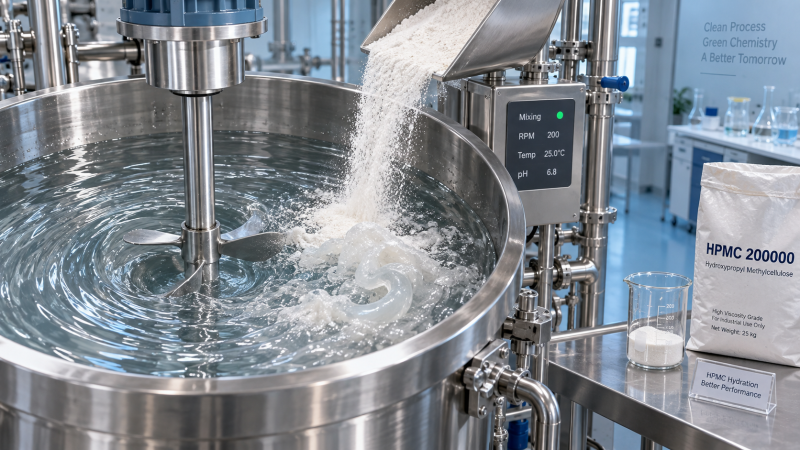
Slow dissolution of HPMC 200000 is usually a hydration-control problem, not immediate evidence of an off-specification material. At this viscosity level, the polymer can form a hydrated outer layer very quickly when it contacts water. If that layer develops around a poorly dispersed particle cluster, water penetration into the core becomes restricted. The visible result is familiar: transparent or semi-transparent “fish eyes,” soft gel particles, long mixing time, inconsistent viscosity, or a batch that appears smooth but continues to thicken later.
The practical objective is not simply to stir harder or add more water. It is to keep individual particles separated long enough for wetting and hydration to occur uniformly. For HPMC 200000, dispersion quality during the first minutes of addition has a greater effect on preparation time than prolonged agitation after lumps have already formed.
Why high-viscosity HPMC hydrates more slowly
HPMC is water-soluble, but solubility should not be confused with instant dissolution. A dry polymer particle passes through several stages: wetting at the surface, dispersion into the liquid, water diffusion into the particle, chain swelling, and finally molecular dissolution. A 200000 CPS grade produces a much more viscous hydrated phase than a low-viscosity grade. Once the particle surface swells, it can create a gel-like barrier that delays further water entry.
This effect becomes more severe when powder is dumped into water in one portion. The outer particles hydrate immediately, while the interior remains dry. Agitation may break some clusters apart, but it can also fold air into the system or generate a vortex that pulls dry powder below the surface before it is properly wetted. The apparent lump can then survive for a long time, even though the surrounding liquid is already viscous.
The “200000” designation also requires careful interpretation. It generally refers to an apparent viscosity measured under a supplier-defined test condition, commonly at a specified solution concentration, temperature, and measurement method. It is not a universal prediction of the viscosity of every finished formulation. A coating, detergent, putty, adhesive, or cementitious system can show very different hydration behavior because solids, salts, pH, pigments, latex, and shear conditions all alter the available water and polymer environment.
Temperature can either help dispersion or create a false expectation
Water temperature is one of the most frequently misunderstood variables. HPMC does not behave like a simple material that always dissolves faster in hotter water. Many grades are commonly prepared through a hot-water dispersion followed by cooling method: the powder is dispersed in hot water, where it does not fully dissolve, then cold water is added and the system is stirred during cooling until hydration is completed.
This method works because the initial hot phase can reduce premature hydration and allow better dispersion, provided the material is added gradually and the temperature is maintained sufficiently high for the selected grade. It is not a shortcut in which hot water alone creates a finished clear solution. If the batch remains warm, the operator may incorrectly conclude that the polymer is insoluble or defective when the necessary cooling stage has not occurred.
Cold-water addition is also effective, but it demands controlled feeding. In cold water, HPMC can begin hydrating quickly. The powder must therefore be introduced as a thin, steady stream into well-agitated water, not poured in as a heap. The appropriate water temperature depends on the grade, formulation and process sequence. A maintenance response should avoid prescribing one universal temperature range without checking the supplier’s technical data and the actual product type.
Very cold water can lengthen the time required for complete hydration. Excessively warm processing water can complicate the behavior of certain grades, particularly where the process relies on immediate solution development. Temperature should therefore be recorded during troubleshooting rather than described only as “cold” or “hot.”
The addition method usually determines whether lumps appear
A batch can fail before meaningful dissolution has begun. The highest-risk practices are pouring the entire bag into a tank, adding powder into a weak surface swirl, feeding HPMC after the liquid has already become highly viscous, or allowing powder to accumulate on tank walls and then wash down as a large mass.
Better handling starts with a clean vessel containing sufficient free water. The liquid should be moving throughout the tank rather than only rotating at the center. A deep vortex is not proof of effective mixing; it often draws air into the liquid and can carry powder below the surface in agglomerates. The useful condition is broad circulation that continuously refreshes the wetting zone.
Feed rate must match the mixer’s ability to disperse the incoming powder. If a single feed point is used, adding HPMC through a sieve, eductor, powder induction system, or controlled screw feeder can improve distribution. For manual addition, a narrow and continuous stream is more reliable than repeated shovel-sized charges. Powder should not be allowed to float as a dry blanket because the blanket will hydrate from below and form large gel fragments.
Where production equipment permits, an initial low-to-moderate shear dispersion stage followed by a holding period is often more effective than continuous high shear from the start. Excessive shear is not a cure for poor addition. Once a swollen surface layer has formed, violent mixing may reduce visible particle size without fully hydrating the polymer core. It can also entrain foam, raise product temperature, and complicate viscosity measurement.
Mixing speed matters, but impeller design matters more
“Increase the RPM” is an incomplete corrective action. The same rotational speed can produce very different flow patterns in tanks of different diameter, liquid height, impeller type, and fill level. A small high-speed propeller may create a strong local vortex while leaving dead zones near the wall or bottom. A poorly positioned impeller can permit dry material to settle or collect under the liquid surface.
For hydration problems, inspect whether the tank provides:
- circulation through the full liquid volume rather than surface-only rotation;
- adequate movement at the powder entry point;
- no persistent powder deposits on the wall, shaft, lid, or bottom;
- enough clearance to prevent stagnant areas;
- mixing intensity appropriate for the batch volume as viscosity rises.
The required agitation changes during the batch. At the beginning, enough energy is needed to disperse dry powder. As hydration proceeds and viscosity rises, the system requires effective bulk turnover rather than a sharp vortex. Equipment that performs adequately with water may become ineffective after only part of the HPMC has hydrated. This is why a trial conducted in a beaker or laboratory mixer may not predict full-scale tank performance.
Water quality and formulation sequence can delay hydration
Even a sound addition procedure can produce slow or uneven hydration when the water phase is not controlled. Hardness minerals, dissolved salts, high electrolyte content, pH adjusters, solvents, surfactants, preservatives, and other soluble ingredients can alter wetting behavior or compete for available water. Their impact depends on concentration and on when they enter the process.
In a simple aqueous solution, the most reliable diagnostic is to prepare the HPMC in water before introducing other ingredients. If hydration is normal in clean water but slow in the production formula, the issue is likely formulation compatibility or sequence rather than the polymer itself.
High-solids systems deserve particular attention. Pigments, fillers, cement, gypsum, starches, and redispersible polymer powders change water demand and mixing load. In dry-mix mortar, HPMC is usually blended as a dry component and hydrates only after water is added on site. Slow viscosity development in this situation may be caused by insufficient mixing water, poor wetting of the dry blend, very short mixing time, temperature effects, or the interaction of other components. It should not be assessed by treating the dry mortar behavior as identical to a pure HPMC solution.
For liquid formulations, a useful process principle is to avoid adding HPMC into an already concentrated salt solution or into a phase made viscous by other thickeners unless the formulation has specifically been designed for that sequence. Pre-dispersing the cellulose ether in water frequently gives a clearer basis for controlling the batch.
Distinguish slow hydration from an actual product-quality issue
Hydration complaints should be investigated with a controlled comparison rather than visual judgment alone. A product can appear to dissolve slowly because the sample was taken before full maturation. HPMC solutions may continue to develop viscosity after the visible powder has disappeared. Conversely, a batch that looks smooth may contain unhydrated microgels that affect coating uniformity, open time, water retention, or pumping behavior.
A practical check is to compare the suspect material and a retained or reference sample under the same conditions: identical water source, temperature, concentration, addition rate, vessel geometry, impeller setting, and hydration time. Measure viscosity only after the specified resting or maturation period. If the reference and suspect materials behave similarly under controlled preparation, the original complaint is likely process-related.
If a significant difference remains, review the material identity before drawing a conclusion. Confirm grade, lot number, packaging integrity, storage duration, and whether the correct product was used. HPMC grades with different methoxy or hydroxypropyl substitution, particle-size distribution, surface treatment, or target viscosity may not hydrate at the same rate. A label that merely states “HPMC 200000” does not establish that two products are interchangeable.
Moisture exposure during storage may also affect powder flow and dispersion. Caked material, damaged bags, or powder that has been repeatedly exposed to humid air can feed unevenly and form dense agglomerates. This does not automatically mean that chemical performance has changed, but it is a relevant cause of poor batch handling and should be recorded.
A focused troubleshooting sequence
When a complaint involves lumps or unexpectedly long hydration time, begin by identifying when the defect became visible. Lumps present immediately after feeding point to poor wetting and dispersion. Lumps appearing after other raw materials are added suggest formulation sequence or incompatibility. A smooth batch that thickens much later indicates incomplete hydration, temperature change, or an insufficient holding period before viscosity adjustment.
Then check the process record in the order the batch was made. The most valuable details are water quantity, water temperature, tank fill level, mixer type, mixing speed, powder feed duration, ingredient order, and time between addition and final evaluation. “Mixed for 30 minutes” has limited diagnostic value if the HPMC was added in 30 seconds into a tank with poor circulation.
Corrective trials should change one variable at a time. Reduce the feed rate without changing chemistry; use clean water before adding salts; improve tank circulation; test a hot-dispersion/cooling procedure where appropriate; or extend the maturation period before final viscosity adjustment. Changing water temperature, mixer speed, addition sequence, and formulation simultaneously may produce a successful batch but does not identify the real cause.
When an application requires predictable hydration and rheology, the relevant technical reference is not viscosity alone. Product selection should consider the intended formulation, dissolution method, particle form, water quality, equipment capability, and the time available before use. A suitable Hydroxypropyl Methyl Cellulose grade should be evaluated under conditions that resemble the actual process rather than only by a nominal viscosity value.
The most dependable improvement is therefore procedural: disperse before full hydration, control temperature deliberately, maintain effective whole-tank circulation, and allow adequate time for polymer chains to hydrate before judging the result. These controls reduce lumping more reliably than attempting to rescue an already gelled HPMC 200000 batch with additional shear or dilution.
Send Your Inquiry
We welcome your cooperation and we will develop with you.
