


How a Lubricants Manufacturer Supports Custom Formulation Needs
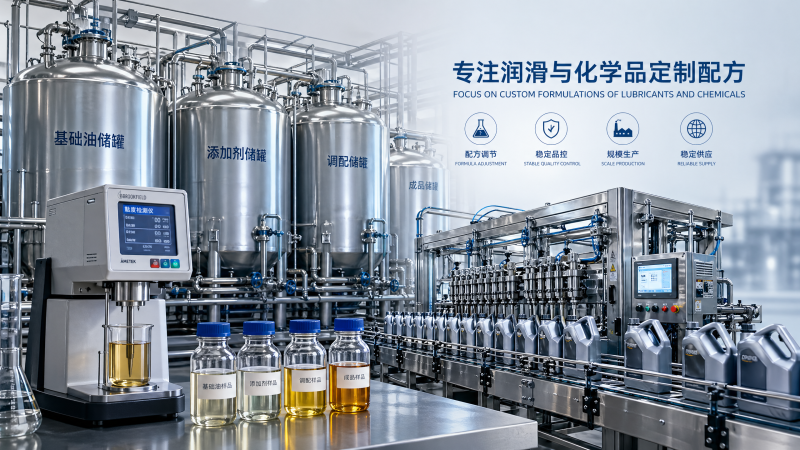
Choosing the right lubricants manufacturer can make a critical difference when your business needs custom formulation support, stable quality, and scalable supply. For decision-makers in industrial and chemical sectors, a partner with advanced production systems, flexible process control, and global service capability is essential to meeting specialized performance requirements while improving efficiency, consistency, and long-term competitiveness.
Why Scenario-Based Formulation Support Matters in Lubricants Procurement
For industrial buyers, selecting a lubricants manufacturer is rarely just about price per drum or standard catalog availability. In practice, lubrication requirements vary significantly across metalworking, construction chemicals, process industries, heavy equipment maintenance, and cleaning-related formulations. A product that performs well in one application may create stability, compatibility, or handling issues in another within 3 to 6 months of use.
This is why scenario-based evaluation is important. Decision-makers need to assess not only whether a supplier can make a lubricant, but whether that supplier can support viscosity control, additive compatibility, batch consistency, and scale-up under real production conditions. In many projects, custom formulation work involves 4 key checkpoints: raw material matching, pilot verification, process adjustment, and commercial delivery planning.
A capable lubricants manufacturer should also understand adjacent chemical systems. Companies operating in broader chemical segments often need formulation support that crosses application boundaries, such as rheology modification, water retention, film formation, or suspension stability. For that reason, manufacturers with integrated production and materials experience often provide stronger technical alignment than traders with limited process control.
What decision-makers usually need to verify early
Before moving into sampling or negotiation, buyers should confirm whether the supplier can adapt to target performance ranges instead of offering only fixed specifications. In the chemical industry, this often means checking viscosity windows, solids behavior, thermal stability ranges, and packaging flexibility. If the required viscosity target spans from low-flow process aids to highly controlled systems, the manufacturer’s process precision becomes a major differentiator.
- Can the supplier adjust formulation parameters within defined performance ranges rather than only offering standard grades?
- Is there internal production control to maintain consistency across repeat orders over 6 to 12 months?
- Does the supplier support pilot samples, application feedback loops, and technical review before full-volume commitment?
- Can production scale from trial quantities to container-level shipments without changing core product behavior?
For example, Jinan Ludong Chemical Co., Ltd. operates large-scale production focused on cellulose ethers and integrated chemical services, with annual capacity reaching 45,000 tons. Its HPMC product range covers controllable viscosities from 400 to 200,000 CPS, which reflects the type of process flexibility many buyers value when evaluating a lubricants manufacturer for custom formulation support in related chemical applications.
Typical Application Scenarios Where Custom Lubricant Formulation Is Needed
Not every business needs a fully custom lubricant, but several common scenarios make formulation support commercially worthwhile. These scenarios usually involve either unusual operating conditions, compatibility requirements with existing process chemicals, or the need to improve efficiency across large-volume usage. A structured comparison helps procurement and technical teams align supplier evaluation criteria with business risk.
The table below compares several common use cases where a lubricants manufacturer is expected to do more than deliver a standard product. It highlights how technical priorities shift depending on operating environment, product function, and supply-chain expectations.
This comparison shows that the best lubricants manufacturer is often the one that can adapt process logic to the customer’s actual application rather than supplying a generic specification sheet. In some cases, lubrication performance is directly tied to formulation behavior elsewhere in the system, especially when the buyer works across chemical processing, coatings, mortar additives, or detergent-related products.
Scenario 1: Industrial processing lines with repeat-use consumption
In continuous industrial lines, the purchasing priority is rarely a one-time performance test. What matters is whether the lubricant behaves consistently over 20, 50, or 100 production cycles under stable operating conditions. Small formulation drift can affect machine cleanliness, wear behavior, downtime frequency, or finishing quality. In these settings, a lubricants manufacturer must show disciplined process control and repeat-batch consistency.
Decision-makers in this scenario should ask for controlled parameter ranges, not just nominal values. For example, if a plant needs a stable flow and lubrication effect in a narrow temperature band, the acceptable tolerance may be much tighter than in general-purpose maintenance use. This often requires internal quality checkpoints from raw material intake to final packaging.
A supplier with modern and integrated production systems is often better equipped for this. Ludong Chemical, for instance, combines traditional production knowledge with intelligent automated production to support diverse global customer requirements. That kind of manufacturing structure is valuable when buyers need scale plus process discipline rather than only small-lot flexibility.
Scenario 2: Formulations that depend on rheology and compatibility
Some buyers do not purchase a lubricant as a stand-alone maintenance product. Instead, they need formulation components that influence flow, application feel, retention, dispersion, or controlled movement within a larger chemical system. In these cases, compatibility with surfactants, polymers, fillers, or binders may matter as much as lubricity itself.
This is especially relevant in detergent and construction-related systems, where thickening, suspension, and handling performance affect end-use quality. Depending on the formula architecture, a material such as Detergent-grade HPMC may be considered as part of the performance optimization strategy when controlled viscosity and formulation stability are required. For a lubricants manufacturer serving these markets, understanding such cross-functional behavior is a commercial advantage.
Here, the buyer should focus on whether the supplier can support lab-side dialogue. Typical review points include viscosity target windows, dissolution behavior, interaction with alkaline systems, and storage stability over 30 to 90 days. A supplier that can discuss these factors in application terms is usually more useful than one offering only commodity transactions.
Scenario 3: Global procurement with scaling and delivery risk
A third common scenario involves companies that have validated a product technically but need confidence in long-term supply. For global or regional manufacturers, the main concern is whether a lubricants manufacturer can maintain supply continuity when demand increases from pilot stage to regular bulk orders. A trial that begins with sample kilograms may quickly move to ton-scale requirements within one or two quarters.
In this situation, production capacity, grade management, and communication discipline become central. Ludong Chemical’s annual output of 45,000 tons illustrates the type of manufacturing scale that can support broader delivery planning. Capacity alone does not solve every issue, but it reduces the risk that a promising formulation becomes commercially difficult to source.
Buyers should also verify lead-time expectations, packaging options, and process for handling specification adjustments. A supplier that can manage standard products and controlled customization within predictable windows of 2 to 6 weeks is often more practical than one that offers customization but struggles with execution.
How Requirements Change Across Business Types and Project Stages
The same lubricants manufacturer may be suitable for one buyer and not for another, simply because purchasing logic changes across company size, technical maturity, and project stage. A contract manufacturer, an industrial end user, and a chemical formulator can all ask for custom support, but they evaluate success through different metrics. Understanding these differences helps avoid mismatched supplier selection.
Early-stage development versus mature-volume supply
At the development stage, speed of technical iteration matters most. The buyer may need 2 or 3 sample variants, preliminary compatibility feedback, and a clear path to optimization. At the mature stage, however, procurement priorities shift toward lot stability, documentation consistency, and predictable delivery cadence. The supplier must be able to support both phases without changing the commercial relationship structure too abruptly.
This is where integrated manufacturing can create value. If the supplier has both production capability and trading-service experience, communication tends to be smoother between technical discussion and commercial execution. That matters when formulation revisions must be translated into production instructions with limited error tolerance.
The table below outlines how expectations typically differ by business type and project stage when evaluating a lubricants manufacturer.
The core takeaway is that supplier suitability should be judged against the buyer’s operating reality. A technically strong supplier with limited scale may be ideal for niche development work, while a high-capacity lubricants manufacturer with disciplined process systems may be the better fit for repeat industrial programs and international distribution.
What medium and large buyers should prioritize
For business decision-makers, the most practical evaluation framework usually combines technical fit, production reliability, and supply-chain resilience. Price remains important, but an apparent unit cost advantage can disappear quickly if the supplier cannot maintain target performance or accommodate normal process adjustments over time.
- Prioritize suppliers that can discuss specification ranges and application outcomes in the same conversation.
- Request a clear sample-to-order process, including expected review cycles and feedback timing.
- Check whether capacity and product portfolio are broad enough to support future formulation changes.
- Confirm whether the supplier can support multiple application environments rather than a single narrow use case.
This approach is particularly useful when procurement teams must justify supplier selection not only to technical staff but also to operations and finance. A lubricants manufacturer that supports both performance and delivery stability reduces the hidden costs of reformulation, downtime, and supplier replacement.
Common Misjudgments When Evaluating a Lubricants Manufacturer
One frequent mistake is treating custom formulation as a simple variant of standard purchasing. In reality, customization introduces process risk, validation time, and communication complexity. If buyers focus only on initial sample success and ignore scale-up conditions, they may face unexpected variation during the first commercial shipments.
Another common issue is overemphasizing one parameter while neglecting full-system behavior. For example, a formulation may hit a target viscosity value but still underperform in mixing, storage, temperature response, or downstream compatibility. In chemical applications, performance usually depends on multiple interacting variables rather than one isolated number.
A third misjudgment is assuming that all large suppliers are equally flexible. Capacity matters, but so does process adaptability. Buyers should verify whether the manufacturer can support controlled customization without disrupting consistency. In adjacent formulation areas, even products like Detergent-grade HPMC require attention to grade selection and application context, which shows why material knowledge and process control must go together.
A practical checklist before final supplier selection
To reduce risk, procurement and technical teams should align on a short but disciplined review list before confirming a lubricants manufacturer. This helps ensure that formulation support is commercially workable, not just technically promising in the lab.
- Define the target application scenario clearly, including operating temperature, expected use frequency, and compatibility concerns.
- Set acceptable performance ranges for at least 3 core indicators such as viscosity, stability, or handling behavior.
- Request sample validation with documented feedback, especially if scale-up is expected within 30 to 90 days.
- Confirm production capacity, lead-time window, and packaging flexibility for both pilot and bulk orders.
- Clarify how formulation changes will be reviewed, approved, and reflected in order execution.
This checklist may look simple, but it often prevents the most expensive sourcing errors. It also gives decision-makers a stronger internal basis for comparing suppliers on total business suitability rather than on unit price alone.
Why Choose Us for Custom Formulation Support
If your business is evaluating a lubricants manufacturer for custom formulation needs, the right partner should offer more than product supply. It should combine manufacturing strength, parameter flexibility, application understanding, and responsive service. Jinan Ludong Chemical Co., Ltd. brings these advantages through large-scale production, integrated chemical services, and experience supporting diverse global customer requirements in cellulose ether and related formulation environments.
Our production system combines traditional process expertise with intelligent automation, helping customers manage both consistency and flexibility. With annual capacity of 45,000 tons and controllable HPMC viscosities from 400 to 200,000 CPS, we are positioned to support applications where formulation precision, scale, and supply continuity all matter. For decision-makers, that means a stronger basis for balancing performance demands with practical delivery planning.
Whether you are working on industrial processing, construction-related formulations, detergent systems, or broader chemical product development, we can discuss your specific scenario in business terms. Contact us to review parameter confirmation, product selection, delivery timelines, custom solution options, sample support, packaging needs, and quotation planning. A focused technical and commercial conversation at the start can shorten evaluation cycles and improve the quality of your final sourcing decision.
Send Your Inquiry
We welcome your cooperation and we will develop with you.
