


How an HPMC Thickener Controls Viscosity in Water-Based Coatings and Adhesives
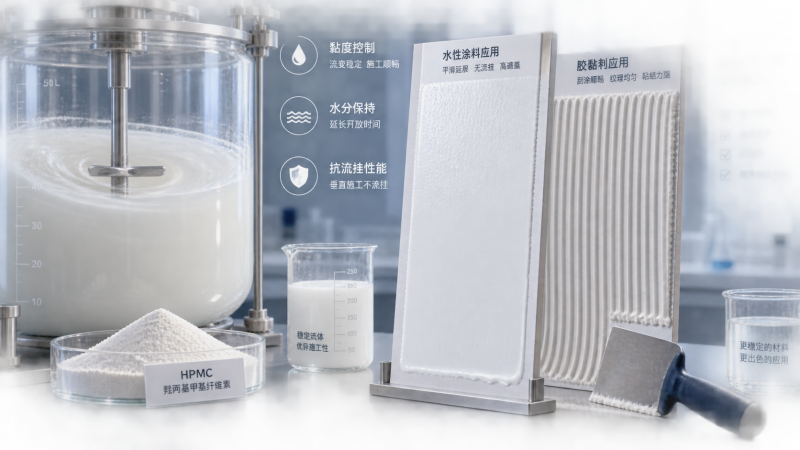
An HPMC thickener controls viscosity in water-based coatings and adhesives by hydrating in the water phase and creating a polymer network that resists flow. That resistance is not constant under every condition. A properly selected grade can give a formulation enough body at rest to prevent settling or sagging, then allow it to spread, brush, roll, spray, or trowel under shear. The same material also retains water, which changes open time, film formation, substrate wetting, and the working consistency of cementitious or polymer-modified adhesive systems.
Hydroxypropyl methylcellulose (HPMC) is a nonionic cellulose ether. Its polymer chains contain hydrophilic groups that interact with water after adequate wetting and dissolution. Once hydrated, the chains occupy volume and entangle with one another. Water becomes less free to move, so the apparent viscosity rises. In a coating or adhesive, this effect is influenced by the HPMC grade, concentration, mixing history, water quality, temperature, and the rest of the formulation.
Viscosity Is a Flow Profile, Not a Single Number
A viscosity value measured in centipoise is useful only when the test conditions are known. Spindle type, rotational speed, temperature, solids level, hydration time, and sample preparation can all change the reported result. Two formulations with the same apparent viscosity at one test speed may behave very differently during application.
Water-based coatings and adhesives are commonly exposed to different shear conditions. During storage, the material experiences very little movement. During pumping, mixing, rolling, brushing, spraying, or extrusion, shear rises sharply. An HPMC thickener often produces shear-thinning behavior: the formulation becomes easier to move when force is applied and rebuilds structure after that force is removed. This is why a material can appear smooth during application yet remain on a vertical surface without running excessively.
For coatings, low-shear viscosity is closely associated with sedimentation control, anti-sag behavior, and resistance to pigment separation. Mid-shear behavior influences brush drag, roller pickup, leveling, and the perceived body of the wet film. High-shear response matters during pumping, spraying, and high-speed dispersion. In adhesives, the balance shifts toward extrusion force, trowelability, wet grab, slip resistance, and the ability to maintain a uniform bond-line thickness.
Increasing polymer dosage may raise the viscosity reading, but it does not automatically improve all parts of this flow profile. A formulation can become too elastic, stringy, difficult to pump, or resistant to leveling. Viscosity control therefore begins with the application behavior that needs correction, rather than with a target number alone.
What Happens During Hydration
HPMC must be dispersed and hydrated correctly before its full thickening effect can be evaluated. If dry powder contacts water under unsuitable conditions, the outer surface may hydrate rapidly and form a gel-like layer around an unhydrated core. These agglomerates are often described as fish eyes. They can remain as soft lumps, dissolve slowly, or produce an uneven viscosity result that is mistaken for poor product consistency.
A common preparation approach is to disperse HPMC in water while maintaining sufficient agitation, then allow time for hydration before final viscosity adjustment. Some grades are designed for delayed dissolution in cold water; others are more readily handled through a hot-water dispersion followed by cooling. The suitable method depends on the product grade and the process sequence. Adding the thickener after a high-solids pigment grind, for example, creates different wetting conditions than hydrating it in part of the water before the grind.
The hydration stage should not be judged only by visible lump removal. An apparently smooth batch can continue building viscosity as polymer chains fully uncoil and distribute through the aqueous phase. Final adjustment made too early can lead to overshooting the intended viscosity after the batch rests. This is particularly relevant where water is added gradually to reach a finished application consistency.
Why Addition Order Changes Results
In a paint formulation, surfactants, defoamers, pigments, dispersants, latex binders, coalescents, and fillers may already be present when HPMC is introduced. These materials alter wetting, foam generation, ionic strength, and the available water phase. In an adhesive, cement, mineral fillers, redispersible polymers, and other rheology modifiers create an even more complex environment.
Prehydrating HPMC in a controlled water portion tends to make its contribution easier to interpret. Adding it directly into a partly finished batch may still be appropriate, but the mixing energy and hold time must be sufficient. Strong agitation helps disperse powder, yet excessive air incorporation can obscure the true viscosity and create application defects. The practical target is complete, uniform hydration with the least avoidable foam.
Water Retention Extends Beyond Thickness
HPMC holds water within the formulation and slows its movement into absorbent substrates or porous mineral components. This behavior is especially visible in tile adhesives, wall putties, skim coats, and other cement-based systems, but it also matters in aqueous coatings applied to porous surfaces.
In a coating, rapid water loss may cause poor flow, premature dry edges, uneven film formation, or insufficient time for particles to arrange into a continuous film. In an adhesive, rapid suction of water into the substrate can shorten workable time and reduce the opportunity for proper contact between the adhesive and the surface. HPMC moderates this water transfer, helping the material retain a usable consistency while it is spread or positioned.
Water retention and viscosity are related but are not interchangeable properties. A higher-viscosity grade does not always produce the preferred balance of open time, spreadability, and sag resistance. Substitution based only on a nominal viscosity range can therefore change field behavior even when the laboratory sample seems similar. Polymer substitution level, molecular-weight distribution, particle form, and the rest of the formula affect hydration and water management.
Coating Behavior: Leveling Versus Sag Resistance
A water-based coating must retain enough structure to stay where it is applied while still flowing enough to hide brush marks, roller texture, or overlap boundaries. These requirements naturally compete. A low-viscosity coating may level well but run on vertical surfaces, permit pigment settling, or feel watery during application. A highly structured coating may resist sag but leave poor leveling, excessive roller texture, or a heavy application feel.
HPMC contributes most strongly to the aqueous phase, so its effect should be considered alongside associative thickeners, latex type, pigment volume concentration, and solvent or coalescent package. Associative thickeners often respond differently to shear and can interact with binder particles or surfactants. Combining rheology modifiers may be necessary when low-shear sag control and high-shear application flow must be tuned separately. Replacing one material with another solely because the final viscosity is similar can disturb this balance.
Temperature also affects perceived consistency. Warm storage and application conditions generally lower the viscosity of aqueous systems, while lower temperatures can make a batch feel substantially heavier. A coating designed only around a room-temperature measurement may behave unexpectedly during seasonal changes. Measuring both after preparation and after a defined rest period at relevant temperatures gives a more useful picture than a single immediate reading.
Adhesive Behavior: Holding Water While Maintaining Contact
In water-based adhesives, the useful question is often whether the material maintains contact under its actual application method. A thin adhesive applied by roller requires controlled flow and wetting. A bead-applied product needs stable extrusion and minimal slump. A troweled construction adhesive or tile adhesive needs smooth spread, ridge definition, and resistance to tile slip after placement.
HPMC can improve body and water retention, but excessive thickening can reduce wet-out on the substrate or make the adhesive difficult to spread into a uniform layer. High viscosity can also increase mixing torque and pumping load. Conversely, inadequate structure may allow a bead to flatten, a vertical layer to slide, or filler particles to settle during storage.
Where a dry-mix adhesive contains polymer modification, HPMC is assessed together with the binder contribution of Redispersible Polymer Powder. The polymer powder mainly supports adhesion, flexibility, and film formation after redispersion, while HPMC primarily manages water and rheology. Their effects overlap in the finished material because improved water retention can support polymer-film development, but one should not be selected as a direct substitute for the other.
Parameters That Are Commonly Misread
pH deserves attention even though HPMC is nonionic and is generally less sensitive to electrolytes than many ionic thickeners. Extreme pH conditions, other rheology modifiers, dispersants, salts, and preservative systems can still change the broader formulation environment. Water hardness and dissolved salts may affect dispersant performance, pigment stabilization, or polymer interactions, causing a viscosity shift that is incorrectly attributed to HPMC.
Selecting a Grade Around the Actual Process
Grade selection starts with the required application method and the expected solids content. A lower-viscosity HPMC grade may be appropriate where easy mixing, pumpability, sprayability, or rapid wetting is the priority. A higher-viscosity grade is more likely to be considered where pronounced water retention, anti-sag behavior, or structural body is needed. The final choice still depends on dosage, because a small amount of a high-viscosity grade and a larger amount of a lower-viscosity grade do not always produce the same rheology.
Particle size and surface treatment influence how easily the material disperses. A grade that hydrates too rapidly for available mixing equipment can create lumps even if its final rheological properties are otherwise suitable. Batch process design should account for powder feed rate, vortex control, liquid temperature, agitation pattern, and the time available before downstream filling or application.
For laboratory comparison, keep water source, temperature, mixing speed, addition order, rest time, solids level, and measurement method consistent. Compare not only the final viscosity but also the time needed to reach it, the appearance of the hydrated solution, flow under different shear conditions, and the formulation's behavior after standing. In coating systems, drawdown leveling and vertical sag observations add context to instrument readings. In adhesives, evaluate spread, bead stability, open-time behavior, and contact with the intended substrate.
When Viscosity Shifts After Storage
A stable initial measurement does not guarantee stable storage behavior. Continued hydration, entrained-air release, pigment settling, microbial degradation, water evaporation from poorly sealed samples, and temperature cycling can each alter apparent viscosity. A rise in viscosity after storage may reflect slow polymer hydration or a formulation interaction; a decline can result from structural breakdown, contamination, or changes in dispersion stability.
Separating these causes requires observing more than one symptom. If viscosity drops and the material also develops odor, gas, pH drift, or separation, the issue is different from a batch that simply becomes smoother and thicker after its first overnight rest. If the surface appears foamy but the underlying liquid has normal body, the measurement may be affected by trapped air rather than a genuine rheology change.
An HPMC thickener therefore works as part of a controlled water-phase design. Its value comes from predictable hydration, the right shear response, and water retention matched to the coating or adhesive application. Treating viscosity as a measured flow profile, rather than a lone specification number, makes it easier to distinguish a suitable formulation adjustment from a process-related deviation.
Send Your Inquiry
We welcome your cooperation and we will develop with you.
