


Cellulose Ether Supply Trends Reshaping Global Dry-Mix Mortar Formulators
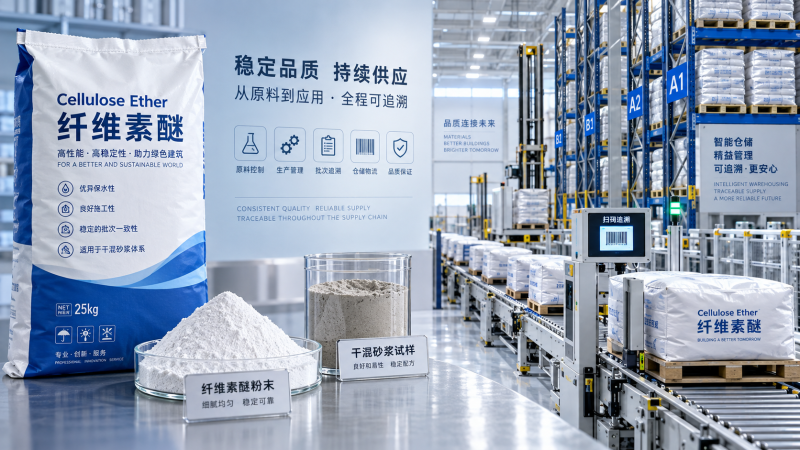
A dry-mix mortar formula can look stable on paper and still become difficult to sell when its Cellulose Ether supply changes from one shipment to the next. A distributor may receive questions after a tile adhesive begins to feel less workable, a wall putty needs more water adjustment, or a render mix shows a different open time under the same jobsite conditions. The immediate assumption is often that the formulation needs to be redesigned. In practice, the first issue to examine is whether the supplied grade is behaving consistently with the grade used during development.
The central supply trend is clear: formulators are no longer evaluating cellulose ether only by a nominal viscosity value or a quoted price. They are assessing supply reliability as part of formulation control. Capacity continuity, batch-to-batch consistency, traceable specifications, packaging condition, lead-time visibility, and technical response now influence whether a material partner can support a mortar product in the market. For channel partners, the opportunity lies in translating these supply-side changes into practical guidance for customers rather than treating the material as an interchangeable commodity.
Supply reliability is becoming a formulation variable
Dry-mix mortar manufacturers work with systems that are sensitive to relatively small changes in water retention, thickening behavior, air entrainment, dissolution rate, and setting profile. Cellulose ether is used at a limited dosage, but it has a strong influence on fresh mortar performance. That is why a supply disruption can create consequences beyond a delayed delivery. A substitute grade may allow production to continue, yet still alter the way a tile adhesive spreads, how a plaster resists sagging, or how a skim coat feels during finishing.
In earlier purchasing decisions, a buyer could often compare materials through a short specification sheet: viscosity, moisture, ash content, and a basic grade description. Those items remain important, but they do not answer every operational question. Two products with similar listed viscosity may show different behavior because of differences in substitution level, particle size, surface treatment, gel temperature, production control, or interaction with the rest of the mortar system.
For this reason, supply reliability now has two layers:
- Physical availability: Can the required grade be supplied in the required quantity and delivery window?
- Functional continuity: Will the supplied material perform close enough to the approved reference that the customer does not need repeated water, cement, polymer, or additive adjustments?
Physical availability prevents a production stop. Functional continuity protects the established formula, the application experience, and the manufacturer’s reputation with contractors. A reliable source needs to support both.
Why nominal viscosity alone is no longer enough
Viscosity remains a useful selection point because it influences mortar consistency, water retention, and anti-sag behavior. But it should be treated as a starting point rather than proof of equivalence. The test method, solution concentration, temperature, and measurement conditions all matter. A viscosity number without its method can lead to incorrect comparisons, especially when materials are sourced from different producers or regions.
A better comparison starts with the application. In cement-based tile adhesive, the formulator may prioritize water retention, open time, smooth spreading, and slip resistance. In wall putty, fine workability and smooth finishing may receive more attention. In gypsum-based products, setting interaction and mixing behavior can be particularly important. An external thermal insulation system adhesive or base coat may require a different balance of cohesion, water demand, and workable time.
When a buyer asks for “the same viscosity,” the useful follow-up questions are more specific:
- Which mortar type is being produced?
- Is the concern related to mixing, application, open time, slip, or final surface quality?
- What was the approved dosage range in the existing formula?
- Is the material added directly to a dry blend, and what mixing equipment is used?
- Does the existing grade have surface treatment or delayed dissolution behavior?
- Which laboratory test conditions define acceptance for the customer?
These questions prevent a common supply mistake: replacing a product solely because the label shows a similar viscosity range. That approach may work in a less demanding formulation, but it carries more risk when the mortar has already been optimized around a particular raw-material profile.
Capacity scale matters, but responsiveness matters too
Global availability is reshaping how material partners are evaluated. Large-scale production capacity can reduce the risk associated with limited output, but scale alone does not guarantee useful supply. A partner also needs a workable grade-management system, realistic order communication, and the ability to distinguish between construction applications rather than offering a single broad substitute.
Customers increasingly expect earlier visibility when production schedules, shipping routes, or packaging availability may affect deliveries. A vague assurance of supply has limited value when a mortar producer must plan batches, warehouse space, and commitments to building-material dealers. More useful communication includes expected lead times, available packaging formats, minimum order constraints, and confirmation of whether a requested grade is part of a routine production program or requires special scheduling.
For channel partners, the practical task is to avoid selling continuity that has not been confirmed. A safer approach is to keep a qualified primary grade and identify an alternative only after reviewing its application behavior. The alternative should not merely be “another cellulose ether.” It should have a documented trial route and clear limits on where it can be used.
When a backup grade is sensible
A backup source is most effective when it is prepared before a disruption occurs. It does not have to be identical in every physical parameter, but it must be evaluated against the performance requirements that matter to the mortar producer. A controlled comparison can include water demand, mixing time, wet density, consistency retention, open time, slip resistance, tensile adhesion where relevant, and appearance after application. The exact test set depends on the product category.
The key is to separate a laboratory indication from a production-ready decision. A small laboratory sample may disperse well under controlled mixing, while a full-scale dry-mix line can reveal differences in powder distribution, lump formation, or mixing time. Trial material should therefore be tested in the customer’s own process whenever the formulation is sensitive or the grade change is substantial.
Consistency is moving from a quality claim to a commercial requirement
Mortar formulators do not necessarily need every batch to be chemically identical. They need the supplied material to remain within a performance window that their formula can absorb. The narrower that window, the fewer production adjustments are needed and the more predictable the product remains in the field.
This changes the conversation between a supplier, a channel partner, and a formulator. Instead of asking only for a certificate of analysis, buyers are increasingly looking for a clear understanding of which variables are controlled, how grade changes are communicated, and whether retained samples or lot records can support an investigation when performance shifts.
Several signs indicate that a supply discussion is too superficial:
- The quotation lists only a viscosity number with no test method or application guidance.
- A replacement is proposed without confirming whether it is suited to cementitious, gypsum-based, or specialized mortar systems.
- There is no agreed process for notifying the customer about meaningful production or specification changes.
- Lot identification is unclear, making it difficult to trace a complaint back to a delivered batch.
- Samples are approved, but no one defines what will be monitored during the first production runs.
These gaps do not automatically mean the material is unsuitable. They do mean that the commercial risk is being transferred downstream, where it becomes harder and more expensive to diagnose.
The rise of application-specific supply conversations
One broad trend is the movement away from generic product requests toward application-specific grade selection. This does not require an overly complicated catalogue. It requires the supplier and sales channel to understand what the mortar is expected to do after water is added.
For instance, a high-viscosity grade may improve body and water retention, but excessive thickening can make a product feel heavy or increase water demand. A lower-viscosity grade may improve ease of mixing or finishing in some systems, but may not provide sufficient anti-sag or open-time support for others. Surface-treated grades can help control dissolution and mixing behavior, yet their suitability depends on the dry-mix process and the formulation design.
The same principle applies when cellulose ether is used alongside polymer modification. In flexible or adhesion-focused mortar systems, the interaction between the cellulose ether, cement, fillers, and polymer powder should be assessed as a system rather than as separate purchase items. During a formula review, a compatible Redispersible Polymer Powder may be part of the adjustment path, but it should not be used as a shortcut to compensate for an unqualified cellulose ether substitution. Each component has a different role, and changing several raw materials at once makes the source of performance variation harder to identify.
How to investigate a performance change after a supply shift
When a customer reports that a mortar no longer behaves as expected, it is tempting to focus immediately on the latest additive delivery. That may be correct, but a disciplined review avoids false conclusions. Cement lot changes, filler moisture, sand grading, pigment additions, mixing sequence, ambient humidity, and water measurement can also influence the result.
A useful investigation begins by preserving the comparison. Identify the reference batch that performed acceptably and the batch associated with the change. Confirm product codes, lot numbers, storage duration, bag integrity, and whether the material was exposed to moisture. Then compare the actual production formula and mixing conditions rather than relying only on the intended recipe.
- Define the visible symptom. Is the issue poor dispersion, higher water demand, reduced open time, reduced anti-sag, inconsistent workability, or a change in adhesion performance?
- Check the raw-material record. Review cellulose ether lot identity alongside cement, filler, polymer, and other additive lots used in both acceptable and affected batches.
- Repeat a controlled bench mix. Use the same water ratio, mixing sequence, standing time, and test conditions for both materials whenever retained samples are available.
- Change one variable at a time. Avoid adjusting dosage, water level, polymer content, and mixing time simultaneously. A single-variable approach makes the result interpretable.
- Escalate with useful information. Send the supplier the formulation category, dosage, symptom, test method, lot numbers, and comparison observations. A general complaint such as “viscosity is different” rarely supports a fast technical response.
This process is also valuable for distributors because it turns a complaint into a technical record. Even when the material is not the root cause, the review may reveal a process change that needs correction before more product is released.
Inventory strategy is changing as lead times become less predictable
Holding excessive stock is not an automatic answer to uncertain supply. Cellulose ether is moisture-sensitive in practical handling terms: damaged packaging, humid storage, and poor stock rotation can undermine material condition before it reaches the blend. The goal is not simply to buy more; it is to keep enough approved material to cover realistic replenishment uncertainty while maintaining controlled storage and lot discipline.
Channel partners can help customers plan around three separate time periods: confirmed manufacturing lead time, transport time, and the time needed for internal qualification of a new or alternate grade. The third period is often overlooked. A substitute may be physically available, but if the customer requires laboratory and production validation, it is not immediately available for commercial use.
Stock planning should therefore distinguish between routine supply and contingency supply. Routine supply supports normal production. Contingency supply is a qualified option that can be activated without starting the entire evaluation process from zero. This distinction is particularly useful for mortar producers serving seasonal construction demand, where a delayed material approval can be more disruptive than the delivery delay itself.
What a stronger supply partnership looks like
The most useful Cellulose Ether suppliers are not necessarily those offering the longest specification sheet. They are the ones that make it easier for downstream partners to maintain a stable mortar product. That usually involves consistent grade definitions, clear lot traceability, realistic delivery communication, and technical discussion centered on the end-use application.
For distributors and agents, the commercial value is increasingly tied to this translation work. Customers need help distinguishing an equivalent grade from a merely similar-looking one, preparing alternatives before shortages occur, and collecting the right information when application performance changes. A material supply relationship becomes more durable when it reduces uncertainty at the formulator’s production line rather than simply moving bags through the channel.
As dry-mix mortar systems become more specialized, supply decisions will continue to affect formulation decisions. The practical response is to qualify materials by performance window, keep substitution trials controlled, and treat communication about lots, changes, and lead times as part of technical service. That approach protects both continuity of supply and the consistency that contractors expect from the finished mortar.
Send Your Inquiry
We welcome your cooperation and we will develop with you.
