


How to Choose HPMC For Tile Adhesive for Large Tiles and High-Humidity Areas
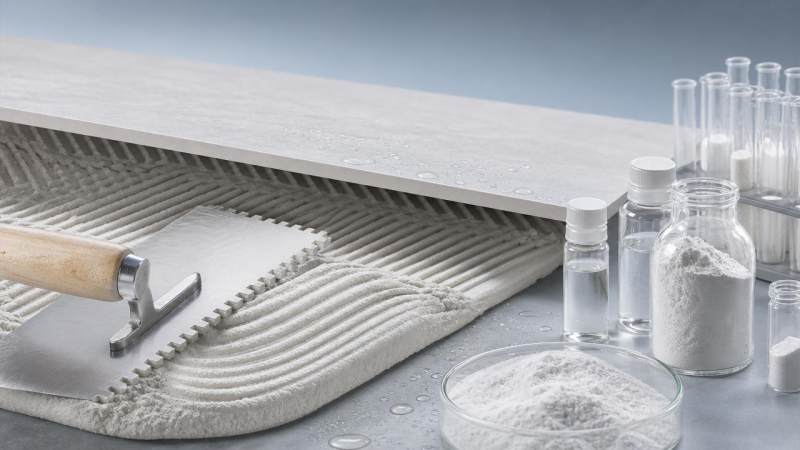
Selecting the right HPMC For Tile Adhesive becomes more demanding when the project involves large-format tiles or spaces exposed to constant moisture. In these cases, the additive is not just a thickener. It directly shapes slip resistance, open time, water retention, and application stability, all of which determine whether the adhesive performs reliably during installation and after curing.
Within the catalyst and chemical additives sector, HPMC plays a practical formulation role rather than a decorative one. For tile adhesive systems, especially cement-based grades, the right cellulose ether helps balance workability and bond development. That balance matters more as tiles grow heavier, substrates vary, and humidity slows drying or changes curing behavior.
This is also why supply capability and grade consistency matter. Jinan Ludong Chemical Co., Ltd. focuses on cellulose ethers and integrated construction solutions, with HPMC production capacities covering broad viscosity ranges from 400 to 200,000 CPS. For evaluation work, that kind of range makes it easier to match formulation targets to installation conditions instead of forcing one grade into every use case.
Why large tiles and humid areas change the selection logic
Standard wall or floor applications usually tolerate a wider formulation window. Large tiles and wet environments do not. The adhesive layer must support more weight, remain workable longer, and keep enough water for cement hydration.
Large tiles reduce margin for application error. Poor wetting, uneven bedding, or early skin formation can leave voids behind the tile. In humid areas, the challenge shifts slightly. Drying may slow, but water exposure and long-term dimensional stability become more critical.
That is why HPMC For Tile Adhesive should be assessed against the actual service condition, not only against a generic viscosity label. A grade that performs well in dry indoor settings may not deliver the same anti-sag control or open time consistency in bathrooms, kitchens, facades, or poolside installations.
What HPMC contributes inside a tile adhesive system
HPMC For Tile Adhesive mainly influences water management and rheology. These two effects shape several visible job-site properties at once.
- Water retention supports cement hydration and reduces premature moisture loss into porous substrates.
- Rheology control improves trowelability, spreadability, and anti-slip behavior on vertical surfaces.
- Open time management helps maintain adhesive transfer after spreading.
- Consistency control reduces segregation and helps stabilize on-site application quality.
In practical terms, these functions interact. A higher water retention grade may improve adhesion development, but if the mix becomes too creamy or too slow to set, handling may suffer. Selection therefore depends on balance, not on maximizing one parameter alone.
Key parameters worth comparing before approving a grade
A useful technical review starts with the parameters that most directly affect field performance. Viscosity is important, but it should never be the only screen.
Ludong Chemical’s HPMC portfolio, including construction grades such as type 75 and type 60, reflects this need for range. Broad viscosity control is valuable because tile adhesive formulas rarely serve a single substrate, climate profile, or tile size.
How humidity affects formulation decisions
High humidity does not always mean more forgiving installation. It often delays evaporation while increasing exposure to moisture during service. That changes how HPMC For Tile Adhesive should be judged.
Open time should stay usable, not simply longer
A longer open time can help tile placement. But if the adhesive surface becomes overly soft or unstable, bedding quality may become inconsistent. The better target is stable transfer within the expected laying window.
Water retention must support curing without weakening handling
In humid spaces, retained moisture helps hydration, but excessive retention combined with poor balance may slow strength build-up. This is especially relevant when early foot traffic or vertical holding strength matters.
Slip resistance becomes more sensitive with larger tile formats
Wall tiles in wet rooms create a double challenge. The adhesive must support tile weight while remaining workable. That is why anti-sag evaluation should be done with the intended tile dimension and surface texture.
Large-format tiles require a more complete compatibility check
When tile size increases, formulation sensitivity increases too. Large tiles often have lower tolerance for poor adhesive transfer and substrate irregularity. In this context, HPMC For Tile Adhesive should be assessed together with the full binder and filler system.
Polymer modification often becomes part of that discussion. In some formulations, adding Redispersible Polymer Powder improves flexibility, bonding, and deformation performance. The key point is not additive stacking, but compatibility. HPMC and polymer should support the same application target rather than compete for water demand or handling profile.
This is one reason integrated suppliers are often evaluated favorably. A producer with coordinated expertise in HPMC, RDP, and related construction additives can support more coherent formulation adjustments when tile type, substrate, or environmental exposure changes.
A practical screening method for HPMC For Tile Adhesive
A strong evaluation process usually starts from application risk, not from product brochure language. The following checkpoints help narrow the choice efficiently.
- Define tile size, weight, and installation orientation before comparing grades.
- Review substrate absorbency, because porous bases change water demand quickly.
- Check open time using real site intervals instead of only ideal lab timing.
- Measure anti-sag with the intended notch trowel and tile format.
- Compare handling after polymer addition if flexibility or wet-area durability is needed.
- Retest when cement source or filler grading changes, since performance can shift noticeably.
This method helps separate nominal viscosity from real formulation behavior. Two HPMC grades may appear similar on paper but respond differently once mixed with specific cement chemistry and aggregates.
What often causes selection mistakes
One common mistake is choosing HPMC For Tile Adhesive only by CPS level. Viscosity helps predict behavior, but it does not fully describe water retention efficiency, workability profile, or compatibility in a complete adhesive recipe.
Another issue is testing only under standard indoor conditions. A formulation may look acceptable on small ceramic tiles, then fail to keep sufficient grab on larger porcelain tiles in a humid installation area.
There is also a tendency to treat additives independently. In reality, cement type, filler gradation, HPMC grade, and polymer content form a system. Even a suitable cellulose ether can underperform if the surrounding formulation is not adjusted with the same objective.
From evaluation to the next decision
For demanding tile adhesive applications, the best choice is usually the grade that delivers predictable installation behavior under the target conditions, not the grade with the highest specification headline. That means looking at water retention, anti-sag control, open time, and compatibility as a package.
Where broader formulation tuning is needed, supporting materials such as Redispersible Polymer Powder may also become relevant, especially for bonding strength and flexibility in wet or demanding spaces. The more useful next step is to map tile size, humidity level, substrate type, and performance targets into a short screening matrix.
Once that matrix is clear, HPMC For Tile Adhesive can be selected with much greater precision. The outcome is not only better product matching. It also reduces reformulation cycles, supports stable job-site performance, and builds a more reliable basis for long-term construction durability.
Send Your Inquiry
We welcome your cooperation and we will develop with you.
