


How to Judge Redispersible Polymer Powder Quality Before Bulk Orders
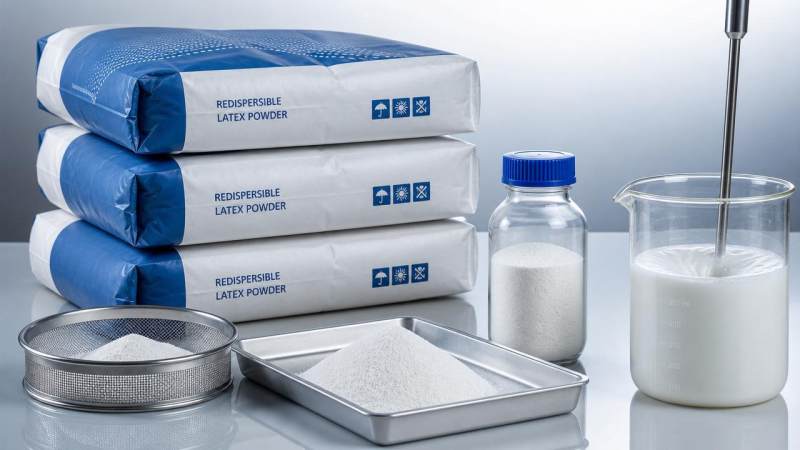
Before placing large-volume orders, buyers need a practical way to evaluate Redispersible Polymer Powder quality with confidence. From consistency and storage stability to application performance and supplier reliability, understanding the right checkpoints can reduce procurement risk, control project costs, and ensure stable end-use results. This guide explains how purchasing teams can assess Redispersible Polymer Powder efficiently before committing to bulk supply.
What Buyers Really Need to Verify Before a Bulk Purchase
When procurement teams search for how to judge Redispersible Polymer Powder quality, they usually are not looking for basic chemistry definitions. They want a reliable pre-order checklist.
The core intent is practical risk control. Buyers need to know whether a supplier can deliver stable powder quality, repeatable application performance, and low supply-chain uncertainty.
For most purchasing professionals, the biggest concerns are consistency between batches, suitability for the target mortar system, transportation and storage stability, and whether test data can be trusted.
That means an effective evaluation should go beyond a certificate. It should combine document review, sample testing, application validation, and supplier capability assessment before signing a bulk contract.
Start with the Quality Indicators That Matter Most
Not every technical index has the same procurement value. Buyers should focus first on the indicators that directly affect construction performance, storage safety, and batch-to-batch consistency.
Important checkpoints usually include appearance, moisture content, ash content, bulk density, particle size distribution, film-forming behavior, redispersion performance, and minimum film-forming temperature where relevant.
Appearance seems simple, but it often gives an early warning. A uniform free-flowing powder with stable color usually indicates better process control than material showing caking, large agglomerates, or obvious contamination.
Moisture content matters because excessive moisture can shorten storage life, increase caking risk, and reduce powder flowability. For bulk importers, this is especially important in humid transport environments.
Ash content can also help buyers understand formulation characteristics and product positioning. It should be checked against the intended application rather than judged in isolation.
Particle size distribution influences dispersion speed, blending behavior, and final mortar uniformity. If the particle range is unstable, downstream mixing consistency may become difficult to control.
For some buyers already sourcing additives like Hydroxypropyl Methyl Cellulose, it is also useful to evaluate compatibility between Redispersible Polymer Powder and the full dry-mix formulation.
Request Samples, but Test Them Like a Procurement Team
Many bulk purchasing mistakes happen because samples are tested informally. A good sample is useful only when the testing process reflects the real conditions of procurement and application.
Ask for samples from standard production, not specially prepared laboratory material. Confirm production date, batch number, packaging type, and recommended storage conditions before any internal review begins.
Then compare at least two or three batches if possible. One excellent sample does not prove long-term consistency. Procurement decisions should be based on repeatability, not on a single favorable result.
Check whether the powder disperses quickly in water without obvious floating lumps, hard particles, or delayed wetting. Good redispersion behavior is one of the most basic quality signals.
After redispersion, observe emulsion uniformity and stability over a reasonable standing period. Unexpected separation or coarse residue may indicate process or formulation limitations.
Buyers should also conduct a basic sieve residue check and flowability review. These simple tests can reveal transport sensitivity and packaging-related handling problems before scale-up.
Evaluate Performance in the End-Use Application, Not Only in the Lab
The real value of Redispersible Polymer Powder is not in the bag. It is in how it improves dry-mix mortar, tile adhesive, skim coat, repair mortar, self-leveling compound, or insulation systems.
That is why application testing should carry more weight than isolated numerical data. A product can meet several technical parameters and still underperform in a specific formulation.
For tile adhesives, buyers often need to verify adhesion strength, open time, slip resistance, workability, and flexibility. For repair mortars, crack resistance and bonding performance may be more critical.
For self-leveling or skim coat systems, flow, smoothness, anti-cracking behavior, and surface appearance may become decisive. The right testing method depends on the target market and customer expectations.
Procurement teams should ask their technical department or external laboratory to benchmark candidate powders in the actual formula, not in a simplified demonstration mix from the supplier.
Even a well-known product can behave differently depending on cement type, fillers, cellulose ether dosage, and local climate conditions. Compatibility is often as important as the powder itself.
In some formulation systems, interaction with additives such as Hydroxypropyl Methyl Cellulose can influence water retention, workability, and final application feel, so combination testing is worthwhile.
Check Batch Consistency Before You Check Price
Price matters, but unstable quality usually costs more than a higher unit rate. Rework, customer complaints, jobsite failure, and delayed delivery can quickly outweigh initial savings.
One of the smartest ways to judge Redispersible Polymer Powder quality before bulk orders is to verify whether the supplier can maintain the same standard every month, not only for one shipment.
Ask for batch test reports from multiple production dates. Compare key values instead of reviewing one report in isolation. Narrow variation bands often indicate stronger manufacturing discipline.
You can also request retained-sample practices, internal quality-control procedures, and traceability rules. Serious manufacturers are usually able to explain how they monitor raw materials and finished goods.
If possible, place a pilot order before a large annual contract. A commercial trial shipment reveals more about consistency, packaging integrity, and logistics performance than a free sample ever will.
Review Packaging, Storage Stability, and Logistics Risk
For buyers, product quality is not only what leaves the reactor. It is also what arrives at the warehouse after loading, shipping, customs clearance, and inland transport.
Redispersible Polymer Powder is sensitive to moisture and storage conditions. Poor packaging or weak pallet protection can turn a compliant product into a handling problem before it reaches production.
Check bag material, liner quality, sealing method, pallet wrapping, and labeling clarity. Confirm whether each bag shows product code, batch number, net weight, production date, and shelf-life information.
Also review recommended storage conditions and actual shipping routes. A supplier serving humid, hot, or long-distance export markets should already have practical packaging controls in place.
Ask how the supplier handles claims related to caking, damaged bags, or shelf-life concerns. Clear after-sales responsibility is part of quality assurance, not a separate issue.
Assess Supplier Capability, Not Just the Product Sheet
A technical data sheet can look impressive, but procurement risk depends heavily on the supplier’s actual manufacturing and service capability. Reliable supply is part of product quality.
Buyers should examine annual capacity, production-line stability, quality-management systems, export experience, and responsiveness to technical questions. These factors affect long-term partnership value.
A manufacturer with integrated production, quality control, and application support is often better positioned to solve issues quickly than a trader without process visibility.
It is also worth asking whether the supplier can customize grades, support formulation adjustment, or provide documentation for different market requirements. Flexibility can save time later.
If a supplier offers broad construction chemical experience across products such as HPMC, RDP, and HPS, that may indicate stronger understanding of how materials work together in practical applications.
For purchasing teams, this matters because technical alignment across additives can reduce troubleshooting time and improve formulation stability after scale-up.
Questions Procurement Teams Should Ask Before Signing
Before confirming a bulk order, buyers should prepare direct questions that expose hidden risk. Good suppliers usually answer clearly, specifically, and with evidence.
Ask whether the sample came from normal production. Ask what the typical variation range is for major indicators. Ask what the complaint rate has been for similar export orders.
Ask how often production batches are tested, what retention period applies to samples, and how non-conforming lots are handled. These answers reveal discipline more than marketing language does.
Also ask what happens if field performance differs from sample performance. A professional supplier should be willing to discuss joint troubleshooting, replacement policy, or technical support steps.
Finally, ask for a realistic lead time, not just an attractive one. Bulk orders depend on production scheduling, raw material availability, and logistics coordination.
A Practical Pre-Bulk Evaluation Checklist
For easy decision-making, procurement teams can use a simple sequence. First, confirm the application requirement and target performance indicators in the actual end-use product.
Second, collect documents including technical data sheet, COA, SDS, storage guidance, and batch information. Third, obtain standard production samples from more than one batch.
Fourth, perform basic physical checks such as appearance, flowability, caking tendency, and redispersion behavior. Fifth, run application tests in the real formulation under realistic conditions.
Sixth, compare consistency across batches rather than judging only one result. Seventh, review supplier capacity, packaging control, traceability, and after-sales response ability.
Eighth, place a pilot commercial order before full-scale annual procurement. This step can significantly reduce cost risk and quality disputes later in the relationship.
Conclusion
To judge Redispersible Polymer Powder quality before bulk orders, buyers should focus on one principle: performance consistency matters more than isolated claims or the lowest quoted price.
The best evaluation method combines technical indicators, real application testing, packaging and logistics review, and supplier capability assessment. This approach supports safer purchasing decisions.
For procurement teams, the goal is not just to buy powder. It is to secure stable product performance, lower complaint risk, and protect project margins across repeated deliveries.
If you evaluate samples systematically, compare batches carefully, and verify supplier reliability early, you will make stronger bulk purchasing decisions with far greater confidence.
Send Your Inquiry
We welcome your cooperation and we will develop with you.
