


Why Redispersible Polymer Powder Cracks in Dry Mix Mortar
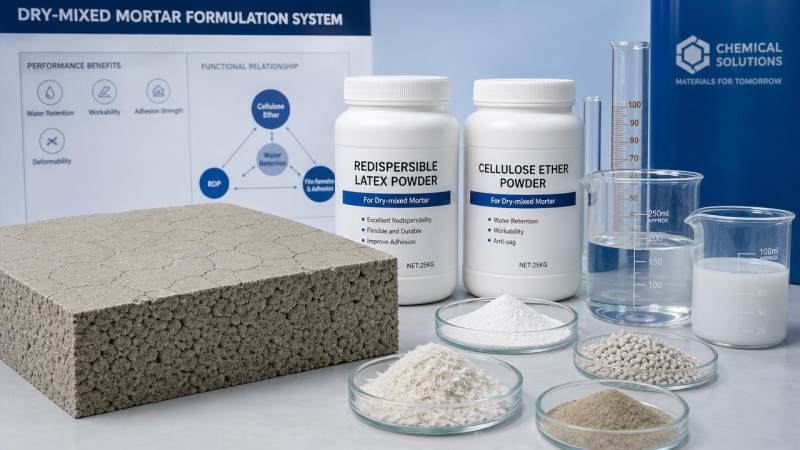
Cracking in dry mix mortar can compromise strength, appearance, and long-term durability, making it a critical issue for operators and end users. Redispersible Polymer Powder plays a vital role in flexibility, adhesion, and crack resistance, but improper formulation, dosage, or application conditions may lead to unexpected failures. Understanding why this happens is the first step toward improving mortar performance and achieving more reliable construction results.
Why does Redispersible Polymer Powder still lead to cracking in dry mix mortar?
Many operators assume that adding Redispersible Polymer Powder automatically improves crack resistance. In practice, cracking usually results from the interaction of formulation design, raw material balance, water demand, curing conditions, and field application control.
Redispersible Polymer Powder forms a polymer film after hydration and drying. This film improves flexibility, bonding, and deformation tolerance. However, if the mortar matrix shrinks too much, dries too fast, or lacks water retention, the polymer cannot fully compensate for stress.
For users and site operators, the key issue is not whether Redispersible Polymer Powder works, but whether the complete system is properly matched. Cement type, filler grading, cellulose ether choice, dosage level, and substrate absorption all affect final performance.
- Excessive drying shrinkage caused by high cement content, poor aggregate grading, or uncontrolled water addition.
- Insufficient polymer dosage for the target application, especially in tile adhesive, plaster, repair mortar, or EIFS-related systems.
- Poor compatibility between Redispersible Polymer Powder and other additives, leading to unstable workability or weak film formation.
- Incorrect site operation, such as overwatering, thick single-pass application, strong wind exposure, or high-temperature installation.
The most common misunderstanding on site
Operators often blame Redispersible Polymer Powder first, but visible cracks are frequently symptoms rather than root causes. A mortar that has poor water retention or a very rigid mineral skeleton can crack even when polymer addition is technically acceptable.
Which technical factors usually trigger cracking?
To troubleshoot effectively, it helps to separate cracking causes into material factors, process factors, and environmental factors. This approach allows operators to identify whether the issue starts in the production formula or during field use.
Material-related causes
If the cement hydration heat is high, aggregate size distribution is poor, or fillers are too fine, shrinkage stress can rise quickly. Redispersible Polymer Powder improves elasticity, but it cannot fully offset a severely imbalanced mineral system.
Water retention agents also matter. In many dry mix mortar systems, cellulose ethers stabilize open time and moisture movement. A properly matched grade such as Methyl Hydroxyethyl Cellulose (HEMC) may help reduce rapid water loss and lower the risk of plastic shrinkage cracking.
Application-related causes
On the construction side, adding too much mixing water is a major reason for cracks. Higher water demand increases porosity after drying. That weakens the matrix and raises shrinkage. Thick application in one pass can also build internal stress and cause surface fissures.
Environmental causes
High substrate suction, strong airflow, direct sunlight, and elevated ambient temperature can accelerate evaporation. In such cases, Redispersible Polymer Powder may not have enough time to form an effective film before stresses exceed the mortar’s tensile capacity.
The following table helps operators identify where cracking usually starts when Redispersible Polymer Powder is used in dry mix mortar systems.
This comparison shows that cracking is rarely caused by one single variable. When Redispersible Polymer Powder is evaluated together with the whole mortar system, troubleshooting becomes faster and more accurate.
How dosage and formulation balance affect Redispersible Polymer Powder performance
Dosage is one of the most sensitive issues in production and purchasing. Too little Redispersible Polymer Powder limits flexibility and adhesion. Too much can increase cost, alter consistency, and sometimes affect strength development if the entire formula is not rebalanced.
Operators should remember that polymer selection is application-specific. A dosage suitable for skim coat may be inadequate for tile adhesive or external insulation mortar. The right target depends on crack sensitivity, substrate movement, and expected mechanical stress.
Typical formulation balance points
- Polymer-to-cement balance should reflect flexibility needs, not only adhesive strength targets.
- Water retention should support cement hydration and polymer film formation under actual site conditions.
- Aggregate grading should reduce voids and unnecessary shrinkage.
- Additive compatibility should be checked through lab and application simulation, not by theoretical assumptions alone.
For buyers comparing dry mix mortar raw materials, the table below summarizes how formula choices can influence cracking risk when using Redispersible Polymer Powder.
This table highlights an important purchasing rule: material selection should be system-based. Optimizing only Redispersible Polymer Powder without adjusting water retention, filler structure, and water ratio often leaves the crack issue unresolved.
What should operators check during mixing and application?
Even a well-designed mortar can fail if site handling is inconsistent. For operators, the most valuable controls are simple, repeatable, and measurable. A short checklist often prevents expensive rework.
On-site control checklist
- Verify the recommended water addition range before mixing. Do not adjust only by feel.
- Mix long enough to disperse Redispersible Polymer Powder uniformly, but avoid uncontrolled remixing with extra water.
- Check substrate cleanliness, strength, and absorption. Highly absorbent surfaces may require pretreatment.
- Apply mortar within the designed thickness range. Thick one-coat application increases internal stress.
- Protect fresh mortar from strong wind, direct sun, or very dry conditions during the early curing phase.
When these controls are ignored, users may incorrectly conclude that Redispersible Polymer Powder quality is unstable. In many projects, the issue is actually process drift rather than raw material failure.
How to choose raw material partners for stable mortar performance
For purchasing teams and production managers, stable supply is as important as technical fit. Dry mix mortar performance depends on batch consistency, responsive technical support, and the ability to coordinate multiple additives in one solution package.
Jinan Ludong Chemical Co., Ltd. focuses on cellulose ethers, redispersible polymer powder, and integrated services for construction chemistry applications. Its production combines traditional process strengths with intelligent automated manufacturing, helping customers manage consistency, volume demand, and application-oriented adjustment.
With an annual production capacity of 45,000 tons and HPMC viscosity control from 400 to 200,000 CPS, Ludong Chemical is positioned to support different mortar systems, from standard dry mix products to more demanding construction and chemical grade applications.
What buyers should evaluate before ordering
- Whether the supplier can discuss Redispersible Polymer Powder performance in relation to the full mortar formula, not as a standalone commodity.
- Whether batch stability, viscosity control, and application adaptation can be supported for long-term production planning.
- Whether sample testing, parameter confirmation, and adjustment suggestions are available before large-volume procurement.
- Whether the supplier can align polymer powder with compatible cellulose ether solutions, including options such as Methyl Hydroxyethyl Cellulose (HEMC) where required by the application.
FAQ: practical questions about Redispersible Polymer Powder and mortar cracking
Does more Redispersible Polymer Powder always mean fewer cracks?
No. Higher dosage may improve flexibility, but it does not automatically solve cracking if the mortar has excessive water, poor aggregate structure, or bad curing conditions. Performance should be confirmed through formula testing and site simulation.
Why does cracking appear even when laboratory samples look acceptable?
Lab conditions are often more controlled than job sites. Field cracking can result from hotter temperatures, stronger substrate absorption, different mixing practice, or layer thickness variation. That is why pilot testing under real application conditions is important.
What is the first thing operators should check when cracks appear?
Start with water addition and substrate condition. These two factors are frequently responsible for unexpected shrinkage. Then review application thickness, weather exposure, and whether the Redispersible Polymer Powder dosage matches the target mortar type.
Is Redispersible Polymer Powder selection different for tile adhesive, plaster, and repair mortar?
Yes. Different applications require different balances of adhesion, flexibility, open time, and mechanical strength. A grade suitable for one system may not be sufficient for another, even if the crack problem looks similar on the surface.
Why choose us for dry mix mortar raw material support?
If you are dealing with cracking, unstable workability, or difficulty selecting Redispersible Polymer Powder for a specific mortar system, a formula-level discussion is more useful than a simple price comparison. Jinan Ludong Chemical Co., Ltd. can support customers with product matching across RDP, HPMC, and related construction chemistry needs.
You can contact us to discuss practical items such as parameter confirmation, product selection, viscosity range, dosage suggestions, sample support, delivery schedule, and customized solutions for different dry mix mortar applications. This helps operators, purchasing teams, and manufacturers reduce trial-and-error costs and improve application reliability.
Send Your Inquiry
We welcome your cooperation and we will develop with you.
