


How to Select HPMC For Wall Putty for Interior vs Exterior Formulations
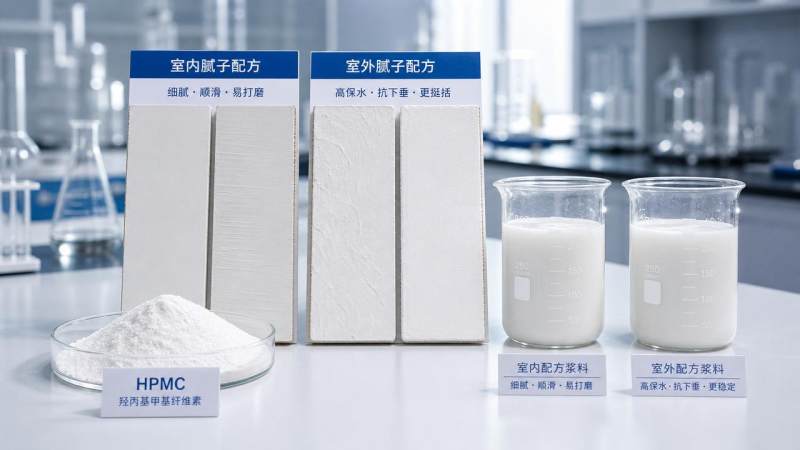
Selecting HPMC For Wall Putty is rarely a simple viscosity choice. Interior and exterior formulations face different demands in open time, water retention, adhesion balance, sanding behavior, and resistance to moisture or climate exposure. In construction chemical systems, a small change in cellulose ether performance can shift application feel, drying profile, and long-term finish quality, which is why formulation decisions need to be made against real use conditions rather than product labels alone.
Why interior and exterior putties need different HPMC priorities
Both interior and exterior putties rely on HPMC For Wall Putty to control water, improve workability, and stabilize the mix. The difference lies in what the finished layer must tolerate after application.
Interior wall putty is usually optimized for smooth spreading, easy knife movement, low drag, good leveling, and convenient sanding. Surface appearance often matters more than weather durability.
Exterior wall putty must perform under stronger stress. Moisture cycling, alkaline substrates, temperature fluctuation, and longer exposure during curing make water retention and film stability more critical.
That is why HPMC For Wall Putty cannot be selected with one universal rule. The same grade that feels ideal indoors may create slow drying, excess stickiness, or poor strength balance outdoors.
The core performance signals behind HPMC selection
For practical evaluation, HPMC For Wall Putty should be judged through several linked parameters rather than a single CPS number.
Viscosity and rheology
Viscosity affects consistency, anti-sag behavior, and application feel. Higher viscosity often improves body and water retention, but too much can increase drag and reduce spreading efficiency.
Low or medium viscosity grades may support smoother finishing for interior systems. Exterior systems often need stronger structure, especially where thicker coats or rougher substrates are involved.
Water retention efficiency
Water retention determines whether cement or fillers hydrate evenly and whether the putty remains workable long enough for proper finishing. This is central to HPMC For Wall Putty performance.
Interior applications usually need stable retention without over-delaying surface set. Exterior formulations often benefit from higher retention because wind, heat, and absorbent substrates remove water faster.
Substitution and solubility behavior
Methoxy and hydroxypropoxy substitution influence thermal gel behavior, hydration speed, and compatibility with other dry mix components. These details matter when putty formulas differ in binder type and filler ratio.
A technically suitable HPMC For Wall Putty should disperse consistently, hydrate predictably, and avoid lumping during mixing. Stable substitution also helps reduce batch-to-batch performance drift.
A practical comparison for formulation screening
The table below outlines the most common selection logic used when comparing interior and exterior putty systems.
This comparison is useful because HPMC For Wall Putty should support the entire formulation window, not only fresh-state viscosity at the mixer.
What technical evaluation should focus on during trials
Bench testing is more reliable when it follows the behavior of the putty through mixing, application, drying, and post-cure handling. Several checkpoints usually reveal whether the selected grade is truly suitable.
- Observe powder wetting speed and whether the mix forms fish-eyes or lumps.
- Check initial knife feel, slip, and resistance during thin and thick application.
- Measure open time under controlled and stressed conditions.
- Review surface drying, crack tendency, and sanding response.
- Confirm adhesion balance after curing, especially on cement-based substrates.
In many cases, the better HPMC For Wall Putty grade is not the one with the highest retention value. It is the grade that keeps workable moisture while still allowing stable cure and efficient finishing.
This is where supplier consistency matters. Jinan Ludong Chemical Co., Ltd. combines cellulose ether manufacturing, trade, and integrated service support within a large-scale production system.
Its HPMC portfolio covers construction and chemical grades, including type 75 and type 60, with viscosities from 400 to 200,000 CPS. That range helps match formulation needs more precisely instead of forcing compromise.
How additives around HPMC can change the final answer
HPMC For Wall Putty never works alone. Filler particle size, cement level, calcium content, starch ether, and polymer modifiers all influence the final performance profile.
For example, when stronger flexibility or adhesion is needed, a formulation may also include Redispersible Polymer Powder. In that case, the HPMC grade may need adjustment to avoid excessive water demand or overly soft knife feel.
Likewise, if hydroxypropyl starch ether is present, thickening and anti-sag performance may increase. That can allow a lower HPMC viscosity while maintaining usable structure.
From a formulation standpoint, selection becomes a balancing exercise. Good results come from the interaction between cellulose ether chemistry and the broader dry mix design.
Common selection mistakes in interior and exterior systems
Several problems appear repeatedly when HPMC For Wall Putty is chosen only by price or only by viscosity label.
- Using an interior-oriented grade outdoors because it spreads easily during the first trial.
- Assuming higher viscosity always means better putty quality.
- Ignoring climate simulation during evaluation.
- Failing to test sanding and recoating after full drying.
- Changing polymer dosage without rechecking HPMC compatibility.
A technically sound review should also consider production stability. Ludong Chemical’s annual capacity of 45,000 tons and integrated production lines help support consistency across grades and supply cycles, which is important when a formula moves from trial to scale.
A clearer path to final selection
When narrowing options, it helps to build a short decision matrix around the actual project environment. Start with substrate type, climate exposure, application thickness, required finish quality, and expected curing speed.
Then compare two or three HPMC For Wall Putty grades under the same formula. Keep polymer, filler, and water ratio unchanged during the first round so the HPMC effect is visible.
The best selection usually shows balanced trowelability, stable open time, acceptable drying, and consistent final surface behavior. That balance matters more than chasing a single laboratory indicator.
For the next step, review whether the target formula is primarily finish-driven or exposure-driven. Once that is clear, HPMC For Wall Putty can be screened more accurately through viscosity range, retention profile, and additive compatibility, leading to a more dependable interior or exterior formulation choice.
Send Your Inquiry
We welcome your cooperation and we will develop with you.
