


Why Wall Putty Foams or Dries Too Fast: Troubleshooting HPMC Selection Issues
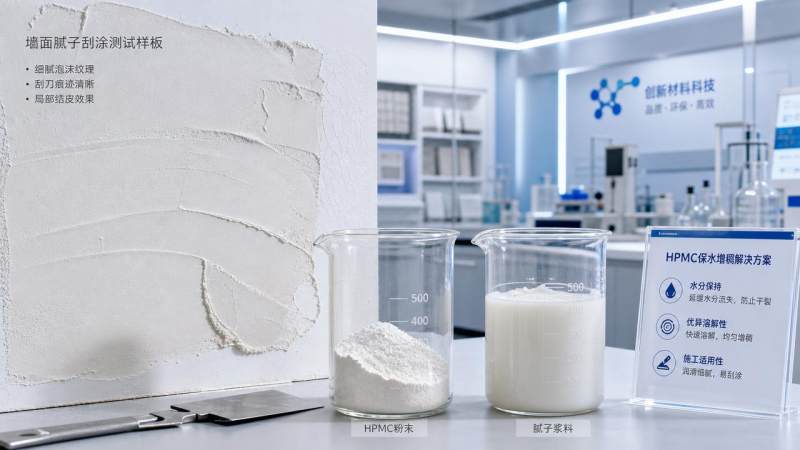
Why does wall putty foam or dry too fast after application?
When wall putty suddenly foams, skins over, or loses spreadability, the complaint often starts at the jobsite but the cause begins in material matching.
In many cases, the formula is not entirely wrong. The bigger issue is that HPMC For Wall Putty was selected without enough attention to water retention, dissolution behavior, and open time.
That is why troubleshooting should move beyond surface symptoms. A putty that dries too fast may not simply need more water. It may need a different cellulose ether profile.
In practical construction systems, HPMC controls moisture migration, application feel, anti-sag performance, and part of the air entrainment behavior. If those properties do not fit the formula, defects appear quickly.
For producers working with broad viscosity ranges and different construction grades, the key is performance matching rather than choosing the highest number on a data sheet.
Is the problem really caused by HPMC For Wall Putty, or by something else?
It is rarely one factor alone. Foaming and fast drying usually come from interaction between HPMC, fillers, mixing method, ambient temperature, and alkaline components.
Still, HPMC For Wall Putty is often the best starting point for diagnosis because it directly influences water retention and workable time.
A quick field judgment can help separate likely causes before deeper lab checks.
This kind of comparison avoids random changes. It also reduces the risk of blaming cement, calcium, or weather when the root issue is grade selection.
What HPMC properties matter most when troubleshooting wall putty?
Three properties usually matter first: water retention, viscosity behavior, and workability stability over time.
Water retention is more than a lab value
A high result on paper does not always guarantee enough open time on a porous wall. Substrate suction, season, and layer thickness change the outcome.
If the putty flashes dry within minutes, check whether the selected HPMC For Wall Putty keeps water in the system under real site conditions.
Viscosity must fit the whole formula
Higher viscosity does not automatically solve everything. It can improve hang resistance, but it may also increase drag, trap air, or slow leveling.
More useful than asking for “higher viscosity” is asking how the putty behaves during mixing, resting, and final scraping.
Dissolution and application feel are often overlooked
Some grades hydrate faster and build viscosity quickly. That can be good for efficiency, but it may shorten the comfortable application window.
A better choice may be a balanced grade that gives smooth knife feel without early stiffening. One example often reviewed in formulation matching is Hydroxypropyl Methyl Cellulose.
How can you tell whether foaming comes from the grade or from the mixing process?
This is a common confusion. Foaming may appear after switching HPMC, yet the real trigger may be mixing intensity or powder feeding sequence.
A practical way to judge it is to compare the same formula under controlled mixing conditions. If foam changes sharply with mixing speed, process is heavily involved.
If foam remains high across repeated tests, the cellulose ether grade may be entraining too much air for that system.
- Check whether powder is dumped too fast into water.
- Review if the defoamer was reduced after changing HPMC.
- Observe whether foam is fine and stable or large and easy to break.
- Compare fresh density before and after the grade change.
Fine, persistent foam usually points to formulation compatibility. Large bubbles can more often be linked to mechanical entrainment.
This distinction matters because changing HPMC For Wall Putty without adjusting the mixing routine can create a second round of complaints.
What selection mistakes make wall putty dry too fast even when dosage seems correct?
The most common mistake is relying on dosage alone. A correct addition level cannot compensate for the wrong performance profile.
Another mistake is choosing based only on viscosity range. Two grades with similar CPS can behave very differently in putty because substitution pattern and particle design also matter.
In actual complaint handling, these errors appear again and again:
- Using a general construction grade without checking putty-specific open time.
- Ignoring seasonal differences between summer and winter application.
- Switching filler sources but keeping the same HPMC grade unchanged.
- Assuming water addition can solve poor water retention.
For suppliers with broad production capability, such as viscosity control from 400 to 200,000 CPS, the advantage is not just range. It is the ability to narrow the selection to the actual wall putty behavior needed.
That is where manufacturers like Jinan Ludong Chemical, with integrated cellulose ether production and construction-grade experience, fit into troubleshooting discussions in a practical way.
If you need to adjust HPMC For Wall Putty, what should be checked before changing the formula?
Before changing multiple raw materials, confirm a few basic facts. This saves time and makes the trial result easier to read.
Only after those checks should the HPMC grade be adjusted. Otherwise, the team may solve one symptom while keeping the real instability in place.
When a grade change is necessary, compare small trial batches with one variable at a time. That approach gives clearer evidence than full reformulation.
So, what is the most reliable way to prevent repeat complaints?
The most reliable approach is to build a simple matching standard for HPMC For Wall Putty instead of reacting case by case.
That standard should connect three things: target jobsite behavior, formula composition, and grade performance under actual application conditions.
A practical internal checklist can include open time, water retention on absorbent substrate, foam tendency, scraping feel, and rework tolerance after resting.
Where supply consistency matters, it also helps to work with producers that combine large-scale output with controlled grade differentiation. This reduces variation between batches and complaint cycles.
In that context, reviewing a stable cellulose ether source, including Hydroxypropyl Methyl Cellulose, can support a more structured troubleshooting process rather than a one-time fix.
If wall putty keeps foaming or drying too fast, the next step is not guesswork. Check the symptom pattern, confirm site variables, then match the HPMC grade to the formula’s real working demands.
That usually leads to faster complaint resolution, fewer repeat adjustments, and more predictable wall putty performance from batch to batch.
Send Your Inquiry
We welcome your cooperation and we will develop with you.
