


How to Select Methyl Hydroxyethyl Cellulose (MHEC) for Cement-Based Putty
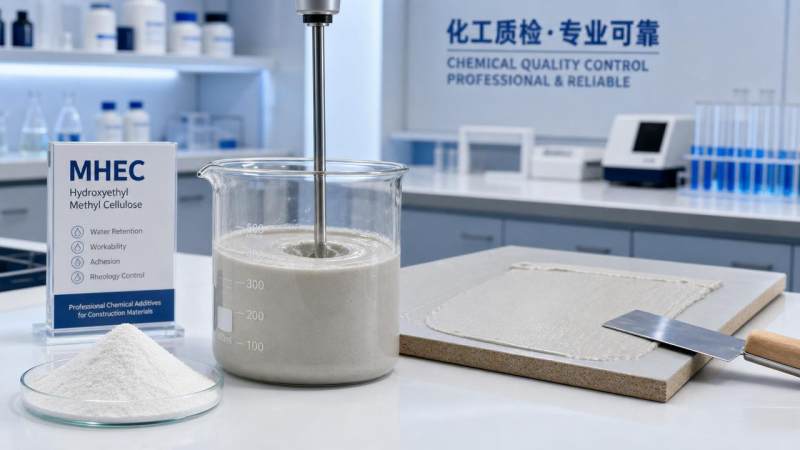
Selecting the right Methyl Hydroxyethyl Cellulose (MHEC) for cement-based putty is not a minor formulation detail. It shapes mixing behavior, open time, water retention, troweling feel, adhesion, and the final smoothness of the cured surface.
In the construction chemicals field, Methyl Hydroxyethyl Cellulose (MHEC) is valued because it helps stabilize cementitious systems that must perform consistently under changing temperatures, water ratios, and substrate conditions.
That is why selection should go beyond a simple viscosity comparison. A reliable evaluation looks at rheology, compatibility, worksite behavior, and the supplier’s production control at the same time.
Why MHEC selection matters in cement-based putty
Cement-based putty needs a careful balance. It must spread easily, resist sagging, retain enough water for cement hydration, and still allow efficient sanding or finishing after curing.
Methyl Hydroxyethyl Cellulose (MHEC) acts as a key functional additive in that balance. It influences water management and application feel more directly than many minor formulation components.
When the grade is too thin, the putty may lose body and dry too quickly. When the grade is too heavy, mixing load rises, leveling may suffer, and the formula can become unnecessarily expensive.
In practice, the best grade is the one that supports stable jobsite performance, not the one with the highest nominal specification.
Core performance points behind Methyl Hydroxyethyl Cellulose (MHEC)
Methyl Hydroxyethyl Cellulose (MHEC) is used in cementitious dry-mix systems for several linked reasons. Each one affects application quality and production efficiency.
- Water retention helps preserve moisture for cement hydration and reduces premature drying on absorbent substrates.
- Thickening and rheology control improve consistency, making the putty easier to spread and shape.
- Lubricity supports smooth knife or trowel movement, which improves application comfort and appearance.
- Anti-sag behavior matters on vertical surfaces or when a thicker pass is required.
- Stability during mixing affects powder wet-out, lump resistance, and batch-to-batch reproducibility.
These functions are interdependent. A grade that improves one property may weaken another, so selection should always be tied to the target putty design.
Viscosity is important, but not enough
Viscosity is usually the first filter when screening Methyl Hydroxyethyl Cellulose (MHEC). It is useful, but it should never be treated as the only decision factor.
A medium-viscosity grade may deliver better workability than a higher-viscosity product if the dissolution profile, particle design, and substitution pattern are more suitable for cement-based putty.
How to read viscosity in context
Low to medium ranges often support easy mixing and good spreadability. Higher ranges may be chosen when stronger anti-sag performance or richer body is needed.
Still, the same stated viscosity can behave differently in a real formula. Cement type, fillers, polymer powder, starch ether, and water demand all influence the final result.
Compatibility with the full formulation
A strong Methyl Hydroxyethyl Cellulose (MHEC) choice performs well inside the complete putty system, not only in water. This is where technical evaluation becomes more meaningful.
Cement composition can change hydration speed and alkali environment. Calcium carbonate fineness affects water demand and texture. Redispersible polymer powder changes flexibility and adhesion.
Starch ether, defoamer, and retarders may also alter the apparent behavior of Methyl Hydroxyethyl Cellulose (MHEC). A grade that feels excellent in one formula may become less balanced in another.
This is one reason integrated suppliers often bring value beyond material supply. Companies such as Jinan Ludong Chemical, with cellulose ether manufacturing and broader construction additive experience, can support more realistic formulation matching.
Its production system combines conventional process control with intelligent automation, and its viscosity coverage from 400 to 200,000 CPS reflects the flexibility needed for diverse dry-mix applications.
What to test before approving a grade
Lab screening should focus on practical behavior, not only certificate values. Several short tests usually reveal whether a candidate grade fits the target putty.
Fresh-state checks
- Mixing time and lump tendency after water addition.
- Application smoothness, knife drag, and edge feathering.
- Slump or sag under thicker application conditions.
- Open time retention during the expected working window.
Cured-state checks
- Surface appearance after drying, including pinholes and shrinkage marks.
- Adhesion to the intended substrate system.
- Sanding behavior, powdering tendency, and finish uniformity.
- Crack resistance under different thicknesses and drying conditions.
If the formula also includes Hydroxypropyl Methyl Cellulose, side-by-side comparison can clarify whether MHEC or another cellulose ether chemistry offers the better fit for the targeted finish and processing style.
Selection signals that often predict stable performance
Some supplier and product signals are easy to overlook, yet they strongly affect long-term consistency.
- Batch consistency across repeated trials, especially at the same water ratio.
- Clear technical data covering viscosity method, moisture, ash, and recommended application range.
- Stable supply capacity for scale-up, seasonal demand, and export logistics.
- Ability to discuss formula interactions rather than only product specifications.
This matters in construction chemicals because a putty formula is rarely static. Changes in cement source, filler particle size, or climate can expose weaknesses in a narrowly selected additive.
Cost should be measured against formulation efficiency
The lowest unit price does not always produce the lowest system cost. A cheaper Methyl Hydroxyethyl Cellulose (MHEC) grade may require higher dosage, more rework, or tighter process correction.
A slightly more suitable grade can improve spread area, reduce waste, and keep surface quality more stable. In many cases, that creates better total value than chasing a lower raw material number.
This is especially relevant when production runs at scale. Suppliers with large output and broad cellulose ether portfolios can often support more efficient grade selection and adjustment over time.
For example, broad product families that include cellulose ethers, RDP, and HPS make it easier to fine-tune a formula when one additive change affects the entire rheology package.
A practical path to the final decision
A useful approval process begins with the required putty profile. Define substrate type, target viscosity feel, open time, anti-sag need, finishing standard, and climate conditions.
Then compare two or three Methyl Hydroxyethyl Cellulose (MHEC) grades under the same formula and water ratio. Record both fresh and cured behavior, not just one preferred trait.
If performance is close, review supply stability and technical support depth. In some projects, that practical reliability matters more than a small difference in lab feel.
Where broader benchmarking is needed, comparing MHEC with Hydroxypropyl Methyl Cellulose options can also sharpen the selection standard and reveal the most economical route to the required finish.
The next step is simple: translate field expectations into measurable test items, validate them against the full cement-based putty formula, and keep the final choice tied to repeatable performance rather than isolated data points.
Send Your Inquiry
We welcome your cooperation and we will develop with you.
