


MHEC Application Mistakes That Lead to Lumps, Slow Dissolution, or Uneven Mixing
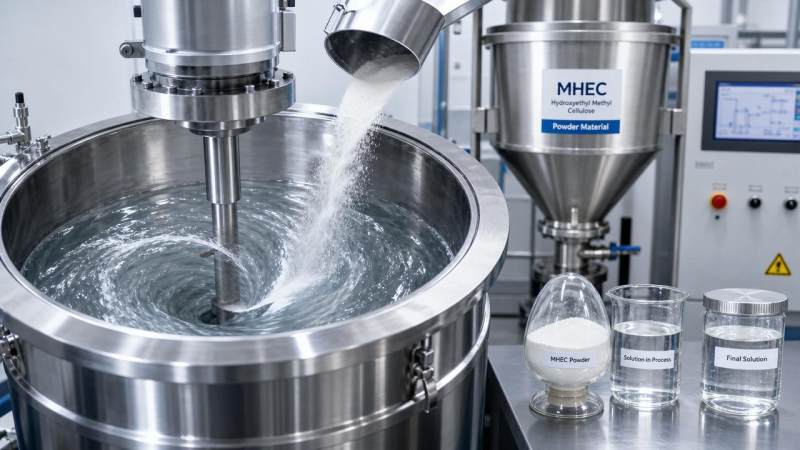
MHEC Application Mistakes That Lead to Lumps, Slow Dissolution, or Uneven Mixing
When Methyl Hydroxyethyl Cellulose (MHEC) forms lumps, dissolves too slowly, or mixes unevenly, site performance can drop very quickly.
That usually means unstable viscosity, poor workability, reduced water retention, and avoidable rework during application.
In practice, these issues rarely come from one single cause.
More often, they result from small handling mistakes during feeding, wetting, mixing, temperature control, or raw material coordination.
This guide explains the most common Methyl Hydroxyethyl Cellulose (MHEC) application mistakes and how to correct them with practical steps.
The goal is simple: smoother mixing, faster dissolution, better consistency, and more predictable final construction results.
Why MHEC Mixing Problems Happen So Often
MHEC is designed to build viscosity, stabilize water, and improve application behavior in drymix and wet systems.
Those same properties also make it sensitive during the first seconds of contact with water.
If powder meets water too aggressively, the outer layer hydrates first and traps dry material inside.
That creates fish-eyes, soft lumps, or stubborn gel particles that refuse to break apart.
From there, slow dissolution and uneven mixing are almost guaranteed.
Understanding this hydration behavior is the first step toward better MHEC application control.
Mistake 1: Adding MHEC Directly Into Still Water
This is one of the fastest ways to create lumps.
When MHEC is dumped into still or weakly moving water, local concentration rises immediately.
The powder surface hydrates, swells, and seals before the inside can disperse.
Even long mixing later may not fully recover the batch.
How to avoid it
- Start agitation before powder addition.
- Feed MHEC slowly and evenly, not in one large dump.
- Use a vortex that pulls powder in without splashing.
- Keep feed rate matched to mixer speed and batch size.
Mistake 2: Using the Wrong Feeding Sequence
Sequence matters more than many operators expect.
If MHEC is added after rapid thickening has already started, dispersion becomes harder and hydration becomes less uniform.
In drymix systems, poor premixing before water addition can create local pockets of high cellulose ether concentration.
Those pockets turn into visible lumps during wet mixing.
Better sequence options
- Premix MHEC with other dry powders for more even distribution.
- Add the dry blend into water under steady agitation.
- Allow full wetting before increasing shear too aggressively.
This approach usually improves MHEC dissolution speed and reduces visible agglomerates.
Mistake 3: Mixer Speed Is Too Low or Too High
Low mixer speed often means poor wetting and dead zones inside the vessel.
High mixer speed can also create problems, especially if it causes splashing, foam, or powder sticking to vessel walls.
The best result usually comes from controlled, staged agitation rather than maximum speed from the beginning.
What good control looks like
- Use moderate speed during powder feeding.
- Increase speed after initial wetting is complete.
- Check tank geometry, impeller type, and circulation pattern.
- Watch for unmixed corners or powder floating on the surface.
If uneven mixing continues, the issue may be equipment design, not only material behavior.
Mistake 4: Ignoring Water Temperature
Water temperature has a direct effect on MHEC wetting and dissolution behavior.
If temperature shifts too far from the expected processing window, hydration can become harder to control.
In many plants, seasonal temperature changes are a hidden reason for unstable batch performance.
From recent operating trends, this has become a more common signal than many teams realize.
Practical temperature tips
- Keep water temperature stable from batch to batch.
- Record seasonal changes and compare viscosity development.
- Do not troubleshoot only the formula before checking temperature.
A stable process usually starts with stable water conditions.
Mistake 5: Not Allowing Enough Hydration Time
Some batches look smooth early, but the MHEC has not fully developed yet.
That can lead to false conclusions about low viscosity, poor flow, or weak consistency.
In actual production, rushing the maturation period often causes more correction work later.
This also means the right mixing result is not only about dispersion, but also about timing.
What to do
- Set a standard hydration time for each formulation.
- Measure viscosity only after that window is complete.
- Train teams not to judge batch quality too early.
Consistent timing improves consistent MHEC performance.
Mistake 6: Overlooking Formula Compatibility
Sometimes the real problem is not the MHEC itself.
Other powders, salts, fillers, binders, or additives may affect wetting speed and dispersion behavior.
For example, auxiliary materials that change surface wetting or film behavior can shift the mixing profile.
In some systems, complementary materials such as Polyvinyl Alcohol may be considered when optimizing adhesion or formulation balance.
The key is not adding materials blindly, but testing compatibility under real mixing conditions.
Compatibility check points
- Review each additive’s impact on wetting and thickening.
- Run small-batch comparisons before scaling changes.
- Track whether lumps appear after any raw material substitution.
This helps separate a process mistake from a formula mismatch.
Mistake 7: Choosing the Wrong MHEC Grade for the Job
Not every MHEC grade behaves the same during application.
Viscosity range, particle characteristics, and application design all influence mixing and dissolution performance.
A grade that works well in one mortar system may not perform the same in another process.
That is why supplier support and application matching matter.
Jinan Ludong Chemical Co., Ltd. focuses on cellulose ethers and integrated construction solutions with flexible production and viscosity control.
Its annual capacity reaches 45,000 tons, including HPMC series products from 400 to 200,000 CPS.
That kind of manufacturing range reflects why grade selection should be based on process needs, not habit alone.
A Simple On-Site Checklist for Better MHEC Application
If MHEC lumps, dissolves slowly, or mixes unevenly, check these points in order.
- Was agitation running before powder addition?
- Was the powder added slowly and evenly?
- Was the dry blend uniform before wet mixing?
- Was mixer speed appropriate for the batch stage?
- Was water temperature within the normal operating range?
- Was enough hydration time allowed?
- Did any new additive or supplier change enter the formula?
- Is the selected MHEC grade suitable for the actual application?
This checklist often identifies the root cause faster than repeated blind adjustments.
How to Reduce Rework and Stabilize Results
The most reliable MHEC application results come from standardizing the process, not reacting after defects appear.
Set clear rules for feeding order, agitation level, water temperature, hydration time, and batch verification.
Document what works, especially after seasonal shifts or raw material changes.
If formulation tuning is needed, test one factor at a time.
In some application upgrades, materials such as Polyvinyl Alcohol may also be reviewed as part of a wider formulation strategy.
Still, the first priority should always be correct MHEC handling and process discipline.
Once the basics are stable, batch consistency improves, troubleshooting becomes faster, and construction performance becomes more predictable.
If lumps, slow dissolution, or uneven mixing keep appearing, revisit the process step by step and correct the cause at its source.
Send Your Inquiry
We welcome your cooperation and we will develop with you.
