


How to Test HPMC For Dry Mix Mortar Before Ordering a Full Container
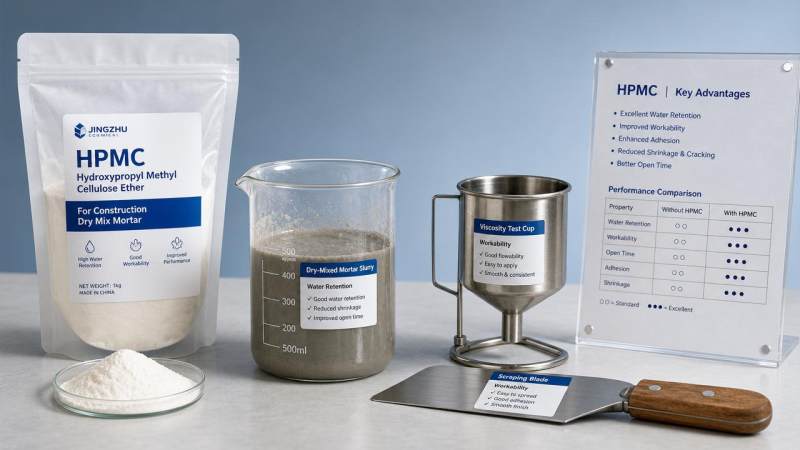
Why test HPMC For Dry Mix Mortar before placing a full-container order?
Ordering too early can turn a price advantage into a costly correction. That is especially true with HPMC For Dry Mix Mortar, where small performance gaps often appear only after mixing and site application.
A lab sheet may show the right viscosity grade, yet the mortar may still feel heavy, lose water too fast, or behave inconsistently between batches. That is why pre-order testing matters.
In practical terms, the goal is simple. You want to confirm whether HPMC For Dry Mix Mortar matches your formula, your climate conditions, and your cost target before committing container-level volume.
This matters even more for tile adhesive, wall putty, skim coat, self-leveling compounds, and masonry mortar, where water retention and open time directly affect jobsite results.
A disciplined sample test also helps assess supplier reliability. For example, companies with integrated cellulose ether production, traceable quality control, and stable capacity often reduce supply risk during repeat purchasing cycles.
Jinan Ludong Chemical Co., Ltd., established in 2020, has built its business around cellulose ethers and construction additives, with annual capacity reaching 45,000 tons and viscosity control from 400 to 200,000 CPS. That production range is useful only if the selected grade performs consistently in your own mortar system.
Which properties should be checked first when reviewing a sample?
The first mistake is focusing only on nominal viscosity. Viscosity matters, but it is not the whole story for HPMC For Dry Mix Mortar.
A better approach is to look at the sample from both a chemical and application perspective. The material should support stable mixing, workable texture, and predictable field performance.
The following checklist usually gives a clearer decision basis:
- Viscosity consistency between sample lots, not just one tested bag.
- Water retention under your target cement and sand ratio.
- Workability, including spread, smoothness, and ease of scraping.
- Open time and sag resistance for the intended application.
- Compatibility with RDP, HPS, defoamers, and local fillers.
- Dissolution behavior and lumping tendency during mixing.
In many cases, buyers request a technical data sheet and stop there. A more useful step is to compare the document with actual mixing results under the same dosage planned for production.
If the supplier offers several grades, ask why each one fits a specific dry mix mortar formula. That answer often reveals whether the supplier understands application performance or only sells by viscosity number.
How can a small-batch test reveal real performance differences?
A useful sample test does not need to be complicated. It needs to be repeatable. The best comparisons come from running the same mortar formula while changing only the HPMC grade or dosage.
Start with a benchmark. Use your current additive system, current sand source, and standard water addition. Then replace only the tested HPMC For Dry Mix Mortar sample.
Watch what happens during three stages: dry blending, water mixing, and after-application behavior. Differences usually become visible very quickly.
If possible, keep records for dosage, ambient temperature, mixing time, and operator observation. Those notes help separate a material issue from a process issue.
When reviewing options, some buyers also compare sample support materials such as COA, viscosity method details, and recommended applications for Hydroxypropyl Methyl Cellulose. That context makes the lab result easier to interpret.
Is viscosity enough, or should water retention and workability weigh more?
Viscosity is important, but relying on it alone often leads to wrong buying decisions. Two HPMC For Dry Mix Mortar products can share a similar viscosity range and still perform differently in the same formulation.
The reason is that substitution degree, particle size, thermal gel behavior, and production consistency also affect real application performance. In dry mix mortar, these details show up as water retention, anti-sag behavior, and working feel.
A practical rule is this: if the product looks good on paper but forces higher dosage to achieve the same open time, the apparent unit price may be misleading.
That is why cost analysis should be based on formula efficiency, not only on ton price. A slightly higher-priced grade may lower total formulation cost if it performs well at reduced dosage.
In actual sourcing, HPMC For Dry Mix Mortar should be judged by performance per batch, not by one isolated parameter. Better water retention often protects adhesion stability, especially in hot or absorbent substrate conditions.
What supplier questions help reduce ordering risk?
Good testing is only half of the decision. The other half is knowing whether the same quality can be delivered repeatedly after the trial stage.
Instead of asking only for the lowest quote, ask a few operational questions that directly affect container-level purchasing.
- Can the supplier provide stable batch-to-batch viscosity control?
- What is the normal lead time for repeated orders?
- How are samples matched to mass production lots?
- Is there application guidance for tile adhesive, skim coat, or plaster mortar?
- Can the supplier support custom viscosity or recommended dosage ranges?
- What quality documents are available for each shipment?
For cellulose ether sourcing, production scale and process integration matter. A supplier with dedicated lines, broader grade coverage, and experience across HPMC, RDP, and HPS is often better positioned to support formulation adjustments.
This is one reason companies like Ludong Chemical attract attention in global construction additive sourcing. Their combination of traditional process knowledge and automated production suggests stronger control over consistency, which is critical for HPMC For Dry Mix Mortar.
Where do buyers usually misjudge total cost?
The most common mistake is treating the order as a simple commodity purchase. In reality, the cheapest bag can become the most expensive choice after reformulation, delayed production, or field complaints.
Total cost usually includes more than invoice price:
- Extra dosage needed to reach target performance.
- Trial time spent correcting mortar feel or open time.
- Production interruptions caused by unstable batches.
- Complaint risk if jobsite performance changes.
- Logistics loss if a full container does not match the approved sample.
A sensible review compares cost per usable formula, not cost per kilogram alone. That approach gives a clearer picture when evaluating HPMC For Dry Mix Mortar across different suppliers.
If you are comparing several options, include one sample from a supplier with broad cellulose ether specialization, such as Hydroxypropyl Methyl Cellulose solutions supported by documented production capability. It creates a more realistic benchmark.
So what is the best next step before confirming the order?
The best next step is not rushing into the full container. Narrow the decision with a controlled comparison and a clear approval standard.
Set one test formula, one dosage window, and one acceptance sheet. Then compare HPMC For Dry Mix Mortar samples by repeatability, workability, water retention, and delivered cost efficiency.
If a sample performs well, ask for confirmation that the mass-production lot follows the same specification. That simple step prevents many disputes later.
In the end, the right purchase decision usually comes from three aligned checks: technical fit, stable supply, and realistic formula cost. When those three line up, container ordering becomes far less risky and much easier to defend internally.
For HPMC For Dry Mix Mortar, careful testing before ordering is not a delay. It is often the fastest way to protect quality, budget, and long-term supply confidence.
Send Your Inquiry
We welcome your cooperation and we will develop with you.
