


How to Test HPMC High Viscosity Performance
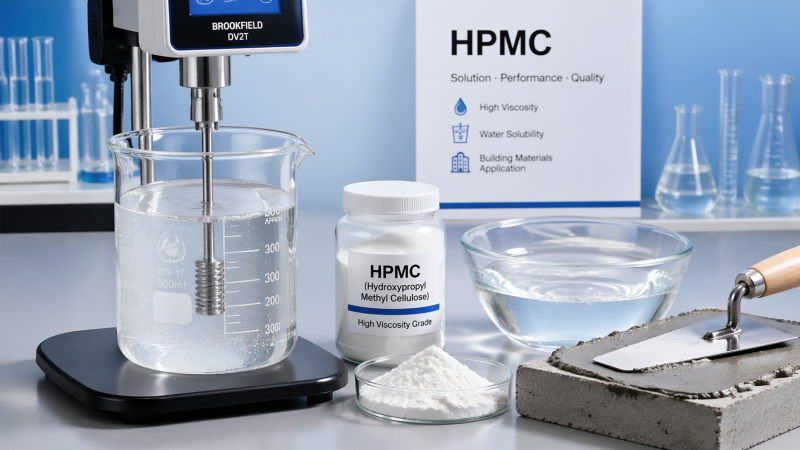
Testing HYDROXYPROPYL METHYL CELLULOSE high viscosity is essential for technical evaluators, buyers, and quality teams seeking stable performance in construction formulations. As a global HYDROXYPROPYL METHYL CELLULOSE supplier, Jinan Ludong Chemical helps customers assess viscosity consistency, water retention, and HYDROXYPROPYL METHYL CELLULOSE water-soluble behavior to ensure reliable product selection and better application results.
For B2B buyers and formulation engineers, high viscosity is not just a catalog number. It affects sag resistance, open time, anti-slip behavior, water demand, and mixing stability in products such as tile adhesive, wall putty, EIFS, and gypsum-based systems. A material labeled 100,000 CPS or 200,000 CPS may still behave differently in production if its particle size distribution, dissolution profile, and batch consistency are not controlled well.
Jinan Ludong Chemical Co., Ltd., established in 2020, operates large-scale cellulose ether production and integrated supply services with annual capacity reaching 45,000 tons. Its HPMC viscosity range spans from 400 to 200,000 CPS, covering construction and chemical grades such as type 60 and type 75. This article explains how to test HPMC high viscosity performance in a practical, procurement-oriented way, helping technical teams compare samples, reduce trial costs, and make more reliable sourcing decisions.
Why High Viscosity HPMC Testing Matters in Construction Formulations
High viscosity HPMC is widely selected when a formulation needs stronger water retention, thicker consistency, better anti-sag performance, or improved workability over 20 to 60 minutes of application time. However, a viscosity label alone does not guarantee field performance. In cement-based systems, the same nominal viscosity can produce different flow curves after 5 minutes, 30 minutes, and 2 hours because hydration, pH, and mixing energy all change the polymer response.
Technical evaluators usually focus on four questions: whether the viscosity is stable from batch to batch, whether the powder dissolves smoothly without fisheyes, whether the product holds water under hot and dry conditions, and whether it creates the right rheology for application. Procurement teams add two more concerns: supply consistency and the supplier’s ability to control production in the 400 to 200,000 CPS range without large deviations.
For quality and safety personnel, testing is also a risk control process. If a batch shows delayed hydration or abnormal lumping, plant operators may increase water addition or extend mixing time by 10 to 20 minutes, which can disturb downstream quality control. Early laboratory testing helps avoid complaints linked to poor spreadability, weak adhesion development, or unstable storage performance in finished dry-mix products.
In practice, high viscosity evaluation should combine at least 3 layers: basic viscosity measurement, formulation performance testing, and consistency checks across multiple batches. A single Brookfield value is useful, but it should be read together with application data. This is especially important for buyers comparing suppliers in large-volume contracts above 10 tons, where small performance differences can lead to significant adjustment costs.
Key Performance Areas to Verify
- Viscosity stability at standard test concentration, typically 1% to 2% solution depending on grade.
- Water retention behavior in mortar or putty under ambient conditions such as 23°C to 25°C.
- Dissolution speed and lump resistance during 3 to 10 minutes of mixing.
- Workability retention, including open time and ease of troweling during 20 to 40 minutes.
- Batch consistency over at least 3 sample lots before final supplier approval.
Common Risks When Testing Is Too Narrow
A frequent mistake is to compare only one laboratory viscosity number. Another is to test with non-standard water temperature, for example 10°C in winter or above 30°C in summer, without recording the condition. These differences can distort decision-making. In high viscosity grades, even small changes in test method can shift the apparent value enough to misjudge a supplier or approve an unsuitable material.
Core Laboratory Methods for Measuring HPMC High Viscosity
A reliable testing process starts with a standard solution preparation method. In many laboratories, HPMC is dispersed in room-temperature water and then fully dissolved under controlled stirring. The solution concentration, spindle selection, rotation speed, and temperature must be fixed. For high viscosity grades, 2% aqueous solution at 20°C or 25°C is commonly used, but the exact method should remain consistent when comparing suppliers or batches.
Brookfield viscosity testing is the most common entry point. Yet high viscosity behavior should also be checked through solution appearance, undissolved particles, and the time required to reach a stable reading. A sample that reaches target viscosity only after excessive swelling or long resting may create practical issues in customer mixing operations, even if the final number looks acceptable on paper.
For construction applications, the lab should move beyond liquid testing and verify mortar-level performance. Prepare a benchmark formula, keep cement and sand ratio constant, and compare water demand, anti-sag, and open time. If two HPMC grades both read 100,000 CPS but one improves water retention by 3% to 5% and reduces slip by 1 to 2 mm, that difference may be more valuable than the viscosity number itself.
Jinan Ludong Chemical’s large-scale production setup and integrated lines are relevant here because repeatability matters. When annual capacity reaches 45,000 tons, process control, raw material handling, and automated production support more dependable batch-to-batch behavior, which is a major concern for enterprise buyers managing long-term formulation stability across regions and seasons.
Recommended Basic Test Items
The table below summarizes a practical laboratory framework for initial HPMC high viscosity evaluation. It is useful for technical reviewers, purchasing teams, and QC staff who want a uniform checklist before scale-up or trial production.
The key conclusion is that viscosity measurement should never stand alone. Buyers who combine solution testing with formulation-level checks are more likely to avoid rework, customer complaints, and hidden production costs caused by unstable cellulose ether behavior.
Step-by-Step Internal Validation
- Prepare 3 retained samples from different lots and store them under the same conditions for 24 hours.
- Test viscosity at a fixed concentration and temperature using the same spindle and speed.
- Run a mortar or putty formula with unchanged cement, filler, and water ratio.
- Record open time, anti-sag, spreadability, and any visible agglomeration.
- Compare results against internal acceptance windows before commercial approval.
How to Interpret Results for Technical, Purchasing, and QC Decisions
A strong test report should support different decision makers at the same time. For technical evaluators, the main question is whether a high viscosity HPMC grade matches the target formula. For procurement teams, the issue is whether the product can be sourced reliably at the right consistency level. For plant QC, the concern is whether the material stays within a manageable operating window over multiple deliveries.
Interpretation should focus on tolerance, not isolated best-case values. For example, if internal standards allow a ±10% viscosity variation, but the application properties remain stable within that window, the grade may still be acceptable. By contrast, if a 5% shift in viscosity leads to visible anti-sag loss or shortens open time by 8 to 10 minutes, the formula may require a tighter approval range.
Another practical point is compatibility. HPMC is often used together with redispersible polymer powder, starch ether, retarders, and mineral fillers. In some systems, adding a small amount of Hydroxypropyl Starch Ether can fine-tune anti-sag and application feel. This does not replace HPMC high viscosity testing, but it shows why evaluation should consider full-system rheology rather than one ingredient in isolation.
Enterprise decision makers should also look at supplier manufacturing capability. A supplier with integrated production, broader viscosity control from 400 to 200,000 CPS, and the ability to support both construction and chemical grades is often better positioned to provide continuity during demand changes, specification updates, or region-specific formulation adjustments.
Decision Matrix for Supplier Comparison
The following matrix can help procurement and technical teams score HPMC high viscosity suppliers using measurable criteria rather than general impressions.
The most useful insight from this matrix is that a competitive supplier is not defined by one low price or one high viscosity point. Reliable sourcing depends on a combination of process stability, formulation support, and the ability to keep application performance consistent over time.
Acceptance Criteria Suggestions
- Set a viscosity tolerance window aligned with your actual formula sensitivity.
- Approve materials only after both lab solution testing and application simulation are completed.
- Track at least 2 seasonal conditions if your products are used in hot or cold climates.
- Review packaging, storage stability, and lead-time reliability before annual contracts.
Common Mistakes, Practical Optimization, and FAQ
One common mistake is using different water quality or different stirring intensity in separate trials. Hard water, warmer water, or faster mixing can all change dissolution behavior. Another mistake is overvaluing one application property. A sample that gives very high initial thickness may still perform poorly if it reduces workable time too quickly or requires excessive water addition during production.
A second issue is failing to connect testing with procurement planning. If a company consumes 20 tons or 50 tons per month, supplier selection must include lead time, substitution strategy, and technical communication speed. Fast troubleshooting can save far more value than minor price differences when a production line is under pressure to deliver on schedule.
Formulators should also remember that HPMC performance can be adjusted within a system. In some mortar applications, combining HPMC with additives such as Hydroxypropyl Starch Ether may help balance anti-sag and smoothness. The best approach is comparative testing in the exact formula rather than assuming one additive will solve all rheology issues by itself.
For companies seeking dependable HPMC sourcing, Jinan Ludong Chemical offers a broad production range, integrated services, and scalable supply suited to technical reviews, procurement comparisons, and long-term industrial cooperation. Careful testing of high viscosity performance helps buyers move from sample evaluation to confident purchasing with fewer formulation surprises.
FAQ: How should buyers test high viscosity HPMC before bulk purchasing?
Run at least 3 stages: solution viscosity check, dissolution observation, and formula application test. Use at least 2 to 3 lots if possible. This approach gives a more realistic basis for contracts than a single retained sample.
FAQ: Which indicators matter most besides viscosity?
Water retention, workability retention, anti-sag, dissolution speed, and compatibility with other additives are usually the most important. In many construction systems, these factors influence field results more directly than one nominal CPS value.
FAQ: How many batches should QC review?
A practical minimum is 3 batches, especially for annual or large-volume sourcing. If your application is highly sensitive, testing over 4 to 6 batches provides a clearer view of process consistency.
FAQ: What is the next step after successful testing?
Move to pilot-scale verification, define acceptance limits, and align supply planning with the supplier. If you need a more targeted evaluation path for construction-grade HPMC, procurement comparison support, or formulation guidance, contact Jinan Ludong Chemical to get product details, technical recommendations, and a customized solution for your application.
Send Your Inquiry
We welcome your cooperation and we will develop with you.
