


Why Water-Soluble HPMC Fails in Some Mixes
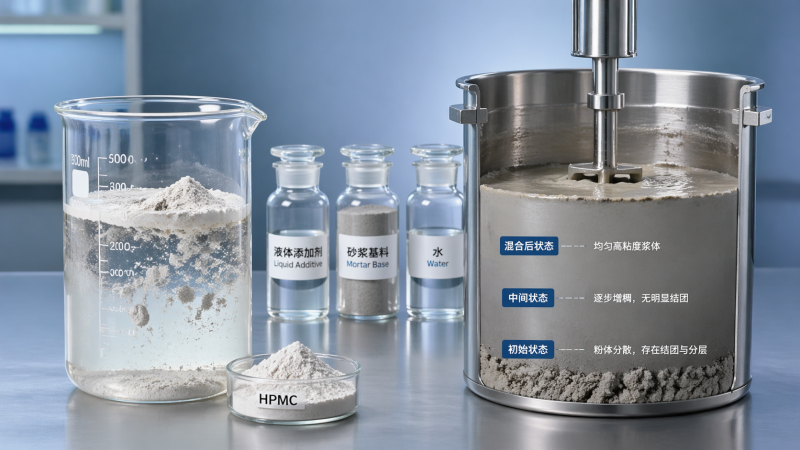
Water-soluble HPMC can still “fail” in real production because solubility alone does not guarantee compatibility, stable viscosity build, or predictable application performance. In practice, issues such as lumping, delayed thickening, poor water retention, phase separation, weak workability, or inconsistent batch behavior are more often linked to formulation design, mixing sequence, raw material interactions, temperature, pH, and grade selection than to a simple defect in the cellulose ether itself. For technical evaluators, procurement teams, quality managers, and business decision-makers, the key question is not whether HYDROXYPROPYL METHYL CELLULOSE is water-soluble, but whether the selected grade matches the full process and end-use environment.
That distinction matters in construction chemicals, dry-mix mortars, tile adhesives, putties, self-leveling systems, gypsum-based products, coatings, and related applications. A HYDROXYPROPYL METHYL CELLULOSE supplier may offer products with similar descriptions, yet differences in substitution degree, particle size, thermal gel behavior, viscosity range, surface treatment, and production consistency can lead to very different field results. This is also why HYDROXYPROPYL METHYL CELLULOSE water-soluble grades and HYDROXYPROPYL METHYL CELLULOSE high viscosity products should be evaluated in the context of the full formulation rather than as isolated raw materials.
Why does water-soluble HPMC sometimes underperform in actual mixes?
The short answer is that “water-soluble” describes only one part of HPMC behavior. In a finished formulation, HPMC must do more than dissolve. It may need to disperse quickly, avoid agglomeration, build viscosity at the right rate, retain water, improve open time, support anti-sag behavior, stabilize fillers, and remain compatible with cement, gypsum, starch ether, polymer powder, defoamers, retarders, and other additives.
When failure occurs, it usually shows up in one of these forms:
- Fish-eyes or lump formation during wetting
- Slow or uneven viscosity development
- Poor water retention in cementitious systems
- Excessive thickening or poor flow balance
- Loss of open time or reduced workability
- Segregation, settlement, or unstable suspension
- Unexpected interaction with salts, surfactants, or binders
- Batch-to-batch variation during plant production
For quality and technical teams, this means the root cause should be analyzed as a system issue. For buyers and decision-makers, it means supplier evaluation should go beyond viscosity specification alone.
What are the most common root causes behind HPMC failure?
Most performance problems can be traced to five practical factors.
1. Grade selection does not match the application
Not every HPMC grade is suitable for every formulation. A grade optimized for tile adhesive may not perform well in skim coat, self-leveling mortar, detergent, or latex-based systems. Even if two products share similar nominal viscosity, they may behave differently in water retention, enzymatic stability, slip resistance, or hydration rate.
Technical evaluators should confirm:
- Target application and substrate conditions
- Required viscosity range under actual shear conditions
- Desired open time, sag resistance, and water retention
- Cement- or gypsum-based compatibility
- Need for surface-treated or fast-dispersing grades
2. Dispersion and mixing sequence are incorrect
A frequent complaint is that the product “does not dissolve” or “forms gel lumps.” In many cases, the issue is not true insolubility but poor dispersion. HPMC particles can hydrate rapidly on contact with water, forming a swollen outer layer that traps dry powder inside. This creates agglomerates that are difficult to break during mixing.
Typical process mistakes include:
- Adding HPMC too quickly into water without sufficient shear
- Using the wrong temperature profile during wet mixing
- Adding HPMC after other components have already changed the water chemistry
- Insufficient premixing with dry fillers before water addition in dry-mix systems
In production environments, adjusting addition order often solves more problems than changing suppliers.
3. Incompatibility with other additives
HPMC performance depends heavily on the surrounding formulation matrix. Cement ions, gypsum chemistry, redispersible polymer powder, starch ether, defoamers, surfactants, preservatives, and pH modifiers can all influence hydration and rheology.
For example:
- Some defoamers can negatively affect thickening efficiency
- High electrolyte systems may alter solution behavior
- Starch ether and HPMC may compete or overbuild viscosity if not balanced properly
- Polymer powders may change water demand and workability profile
This is where formulation testing matters more than brochure claims. In some systems, a related cellulose ether such as Methyl Hydroxyethyl Cellulose (MHEC) may be considered during comparative development, especially when balancing workability, water retention, and specific environmental conditions.
4. Dosage is either too low or too high
Low dosage can result in poor cohesion, low water retention, and weak anti-sag performance. High dosage can create excessive viscosity, poor leveling, difficult pumping, entrained air issues, and slower hydration or curing behavior in some mixes.
What matters is not only absolute dosage, but dosage relative to:
- Total binder content
- Particle size distribution of fillers
- Water-to-binder ratio
- Presence of other rheology modifiers
- Required application thickness and method
5. Supplier consistency and process control are insufficient
For procurement teams and business leaders, one of the biggest hidden risks is assuming that all HPMC with the same listed viscosity behaves the same in production. It does not. Real consistency depends on manufacturing control, substitution uniformity, moisture management, particle distribution, and stable quality assurance procedures.
A supplier with scalable production, controlled viscosity range, and application-specific technical support is generally better positioned to reduce formulation risk than a supplier competing only on price.
How can you tell whether the issue is the HPMC itself or the formula around it?
A structured diagnostic process is the fastest way to avoid wrong conclusions.
Check the symptom pattern
- If lumping appears immediately during water contact, suspect dispersion method or surface treatment mismatch.
- If flow changes after several minutes, suspect hydration rate or additive interaction.
- If water retention is weak despite normal viscosity, suspect grade mismatch rather than simple viscosity shortage.
- If only one plant or one season shows instability, review water quality, temperature, and mixing energy.
Run controlled comparison tests
Use the same formula and compare:
- Different HPMC grades at equal dosage
- Different dosages of the same grade
- Different mixing orders
- Different water temperatures
- With and without specific additives such as RDP, HPS, or defoamer
This approach quickly reveals whether the root problem is material selection, interaction, or processing.
Evaluate performance by end-use criteria, not one lab number
A Brookfield viscosity value alone is not enough. Practical evaluation should also include:
- Water retention
- Open time
- Slip resistance
- Workability and hand feel
- Anti-sag behavior
- Pumpability
- Film or set development under real site conditions
What do buyers and decision-makers need to verify before choosing a supplier?
For procurement and management teams, the cost of a poor HPMC decision is rarely limited to raw material price. It can affect application quality, complaints, rework, formulation redesign, production downtime, and customer trust.
Before approving a supplier, verify these points:
- Can the supplier provide stable viscosity ranges across batches?
- Is the product portfolio broad enough to match different applications?
- Can the supplier support both construction and chemical grade requirements?
- Is annual production capacity sufficient for long-term supply security?
- Does the supplier offer technical guidance for dosage and compatibility?
- Are pilot test samples representative of mass production quality?
In industrial sourcing, consistent large-scale capability matters. Manufacturers with integrated cellulose ether production and controlled product ranges are usually better equipped to support qualification, scale-up, and global supply continuity.
How can technical and quality teams reduce failure risk in future formulations?
The most effective strategy is to combine material selection with process discipline.
Build a practical evaluation matrix
Instead of screening only by price and nominal viscosity, create a checklist covering:
- Application type
- Target rheology
- Water retention requirements
- Compatibility with cement, gypsum, and polymers
- Mixing method
- Climate and storage conditions
- Scale-up sensitivity
Standardize testing conditions
Many “inconsistencies” come from inconsistent internal testing. Standardize:
- Water quality
- Mixing speed and time
- Temperature
- Aging time before measurement
- Sample preparation sequence
Use formulation-oriented supplier communication
Do not only ask for TDS and price. Share end-use requirements, binder system, dosage window, and processing conditions. The better the supplier understands the real mix environment, the more accurately it can recommend a suitable grade. In some comparative projects, teams may also benchmark against alternatives such as Methyl Hydroxyethyl Cellulose (MHEC) when optimizing application-specific rheology behavior.
A practical perspective on supplier capability
For companies sourcing cellulose ethers at scale, capability is not just about producing HPMC; it is about delivering reproducible performance across applications. Jinan Ludong Chemical Co., Ltd. operates as a large-scale global manufacturing enterprise focused on cellulose ethers, with integrated production, trading, and service capabilities. Its product portfolio covers HPMC, RDP, and HPS, supporting broader construction formulation needs rather than isolated raw material supply.
With annual capacity reaching 45,000 tons and HPMC viscosity control from 400 to 200,000 CPS across type 75 and type 60 construction and chemical grades, such manufacturing depth can be relevant for customers seeking long-term consistency, formulation flexibility, and supply reliability. For technical and purchasing teams, this kind of production range can simplify grade selection when different projects require different hydration speeds, rheology profiles, or viscosity levels.
Conclusion: Water-soluble does not mean universally trouble-free
When water-soluble HPMC fails in a mix, the most likely explanation is not that the material is inherently ineffective, but that the selected grade, dosage, compatibility profile, or processing method does not fit the real formulation conditions. That is the core insight technical evaluators, buyers, quality teams, and business decision-makers should keep in mind.
The best results come from looking at HPMC as part of a full system: raw materials, process, end-use requirement, and supplier consistency. If you evaluate beyond basic solubility and nominal viscosity—focusing instead on application match, interaction control, test standardization, and supply stability—you can reduce formulation risk, improve final performance, and make more confident sourcing decisions.
Send Your Inquiry
We welcome your cooperation and we will develop with you.
