


How to Use Water-Soluble HPMC Correctly
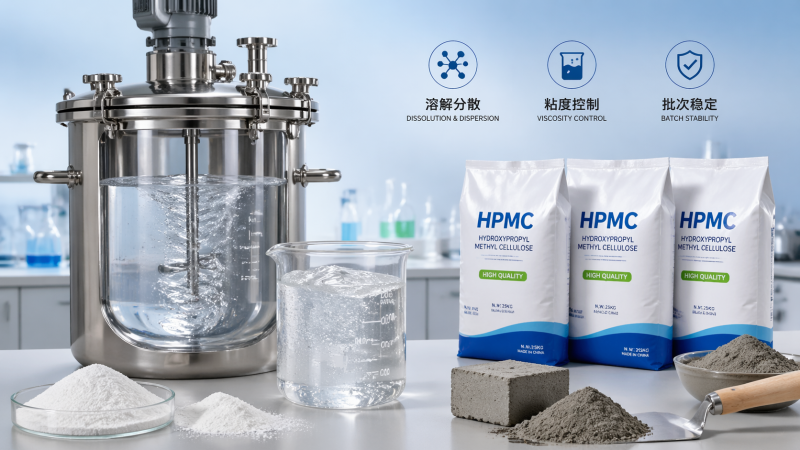
Using HYDROXYPROPYL METHYL CELLULOSE water-soluble grades correctly is essential for stable performance, safe handling, and cost control in chemical and construction applications. For technical evaluators, buyers, and quality teams, choosing a reliable HYDROXYPROPYL METHYL CELLULOSE supplier matters as much as understanding dosage, dispersion, viscosity, and compatibility. This guide explains the right way to use water-soluble HPMC to improve efficiency, consistency, and procurement decisions.
What Users Really Need to Know Before Using Water-Soluble HPMC
When people search for how to use water-soluble HPMC correctly, they usually want a practical answer, not a textbook definition. The real concerns are straightforward: how to dissolve it without lumping, how to choose the right viscosity, how to control dosage, how to keep batch performance stable, and how to avoid waste or quality complaints.
For technical evaluators, the key issue is whether a grade can match the target formulation and process conditions. For procurement teams, the question is whether the supplier can provide stable quality, scalable output, and consistent viscosity control. For quality and safety personnel, the focus is on handling, storage, traceability, and risk prevention. For decision-makers, the bigger picture is simple: correct HPMC use reduces rework, improves product consistency, and lowers total operating cost.
In short, using water-soluble HPMC correctly means matching the product grade to the application, following the right dispersion procedure, verifying compatibility with the full formula, and controlling quality from receiving to final use.
Start with the Right HPMC Grade, Not Just the Lowest Price
One of the most common mistakes is treating all HPMC grades as interchangeable. They are not. Water-soluble HPMC performance depends on several technical parameters, including viscosity range, substitution level, particle characteristics, moisture control, and application-specific behavior.
If your application is in dry-mix mortar, tile adhesive, skim coat, self-leveling systems, detergents, or other chemical formulations, the “correct use” of HPMC begins with selecting a grade designed for that system. A product that dissolves well in one formulation may perform poorly in another due to differences in water demand, pH, fillers, cement content, additives, or mixing intensity.
When evaluating a grade, focus on these practical criteria:
- Viscosity: Determines thickening behavior, workability, sag resistance, and water retention.
- Water retention performance: Critical in cement- and gypsum-based systems.
- Dispersion speed: Affects mixing time and lump prevention.
- Compatibility: Must work well with other additives such as starch ether, defoamers, retarders, and polymer modifiers.
- Batch consistency: Essential for quality control and large-scale production stability.
For buyers and enterprise managers, this is where supplier capability matters. A manufacturer with broad viscosity control, mature production systems, and stable annual output is better positioned to support repeatability and long-term procurement planning.
How to Dissolve Water-Soluble HPMC Without Lumping
Lumping is one of the most frequent processing problems. It usually happens when HPMC particles contact water too quickly and form a gel layer on the surface before the inside is fully wetted. Once that outer layer develops, dispersion becomes difficult, and the result can be fisheyes, uneven viscosity, or longer mixing times.
To use water-soluble HPMC correctly, follow these good practices:
- Prepare clean water first. Use water quality appropriate for your process. Excessive impurities may affect hydration and final performance.
- Add HPMC slowly under agitation. Do not dump the full quantity in one place. Gradual feeding helps each particle disperse more evenly.
- Maintain sufficient mixing speed. Agitation should be strong enough to create circulation, but not so aggressive that it introduces unnecessary air.
- Allow enough hydration time. Full dissolution is not always immediate. Give the material time to hydrate and reach stable viscosity.
- Follow the recommended sequence. In multi-component systems, adding HPMC at the wrong stage can reduce its efficiency or increase lumping risk.
In dry-mix applications, HPMC is typically premixed with powders and only hydrates when water is introduced on site or in production. In liquid systems, pre-dispersion technique becomes even more important. Trial verification is strongly recommended before scale-up.
How Much HPMC Should You Use?
The correct dosage depends on the application, formula balance, and target performance. There is no universal percentage that works for all systems. Overdosing can increase cost, affect flow, or create an overly thick system. Underdosing may cause poor water retention, weak workability, settling, or reduced stability.
Instead of asking for a generic dosage, technical teams should define the performance target first:
- Do you need stronger thickening or mainly water retention?
- Is open time more important than flowability?
- Are you optimizing anti-sag performance in vertical application?
- Do you need better construction feel, pumpability, or anti-segregation behavior?
The practical approach is to run small-scale comparative tests with different viscosities and dosage windows. This gives a more reliable answer than relying only on supplier brochures. Procurement teams should also compare not only unit price, but performance per ton of finished product. A lower-priced material that requires higher dosage may not be the most economical option.
Compatibility Matters More Than Many Buyers Expect
Even if HPMC performs well by itself, final results depend on how it interacts with the rest of the formula. In many construction and chemical systems, HPMC works alongside powders, mineral fillers, cement, gypsum, surfactants, polymer modifiers, and specialty additives. If compatibility is poor, problems may appear as unstable viscosity, reduced workability, foam issues, phase separation, or inconsistent application behavior.
For example, some formulations may benefit from combining HPMC with materials such as Redispersible Polymer Powder to improve adhesion, flexibility, or overall application performance, depending on the end-use system. However, such combinations should always be validated through real formulation testing rather than assumed from isolated product data.
This is especially important for quality teams. Incoming inspection should not stop at checking appearance or certificate values. It should also include application-relevant verification where possible, such as viscosity retention, working time, and formulation response under actual processing conditions.
Key Quality Control Points from Receiving to Use
Correct usage is not only about mixing. It also depends on how the material is received, stored, tracked, and released for production. Even a high-quality HPMC grade can underperform if storage and handling are not controlled.
Quality and safety teams should monitor the following points:
- Packaging integrity: Check for moisture ingress, damage, or contamination.
- Batch identification: Maintain lot traceability for complaint handling and process review.
- Storage conditions: Keep in a dry, clean environment away from humidity and incompatible materials.
- Shelf-life control: Use first-in, first-out inventory management when appropriate.
- Verification testing: Confirm key indicators such as viscosity and application behavior before large-scale use.
For companies serving export markets or multiple production sites, standardizing these controls can significantly reduce formulation drift and complaint risk.
How to Evaluate a Reliable Water-Soluble HPMC Supplier
Correct use of HPMC is easier when the supplier can provide not only material, but also technical consistency and service support. This is why technical evaluators and enterprise buyers often assess more than product data sheets.
Look for these supplier capabilities:
- Stable production capacity: Important for long-term supply security.
- Broad and controllable viscosity range: Helps match different applications more precisely.
- Application support: Useful when optimizing dosage, process sequence, and formulation compatibility.
- Consistent batch quality: Reduces production adjustments and end-user complaints.
- Integrated product offering: Can simplify sourcing for complementary additives and system solutions.
Jinan Ludong Chemical Co., Ltd., established in 2020, operates as a large-scale global manufacturing enterprise focused on cellulose ethers production, trading, and integrated services. Its product portfolio includes HPMC, RDP, and HPS, serving construction and chemical applications. With advanced production lines, integrated solutions, and annual capacity reaching 45,000 tons, the company offers HPMC series products with viscosities controllable from 400 to 200,000 CPS. For procurement and technical teams, this kind of manufacturing capability can be highly relevant when supply continuity and performance consistency are key evaluation factors.
Common Mistakes That Lead to Poor HPMC Performance
Many usage problems are not caused by the material itself, but by process errors or incomplete evaluation. The most common mistakes include:
- Choosing grade by price only, without testing application fit
- Adding HPMC too quickly and causing lumping
- Using the wrong mixing sequence
- Skipping compatibility tests with other additives
- Assuming one grade can cover all product lines
- Ignoring storage humidity and packaging condition
- Failing to compare cost-in-use instead of purchase price alone
For business decision-makers, these mistakes translate into hidden costs: lower line efficiency, unstable quality, more complaints, and weaker customer confidence. Correct use therefore has both technical and commercial value.
Conclusion
Using water-soluble HPMC correctly is ultimately about making better technical and purchasing decisions. The right approach starts with selecting the correct grade for the application, then controlling dispersion, dosage, compatibility, and quality checks throughout the process. For technical teams, this improves formulation reliability. For procurement teams, it supports better supplier comparison and lower total cost. For quality and safety personnel, it reduces risk and strengthens consistency.
If you want dependable results, do not evaluate HPMC only by specification sheets or initial price. Evaluate how it performs in your actual system, how consistently it can be supplied, and how well the supplier can support long-term application needs. That is the practical way to use water-soluble HPMC correctly and create measurable value from every batch.
Send Your Inquiry
We welcome your cooperation and we will develop with you.
