


Hydroxypropyl Starch Ether Market Price Trends and Cost Signals
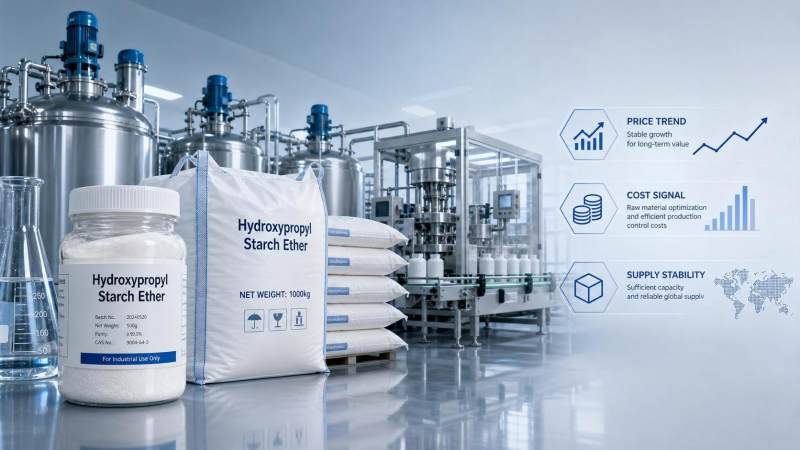
Why is the hydroxypropyl starch ether market getting so much attention?
Price movement in the hydroxypropyl starch ether market is no longer a background issue.
It directly affects budget control, supply continuity, and the real cost of formulation performance.
In construction and chemical additive applications, HPS is often purchased in large volume.
That means even a small price change can shift project margins.
The more useful question is not whether prices rise or fall.
It is what those changes are signaling about raw materials, plant utilization, and supplier discipline.
In practice, the hydroxypropyl starch ether market reacts to starch feedstock costs, propylene oxide trends, energy pricing, freight pressure, and regional demand recovery.
When several of these move together, quoted prices usually follow.
Another point matters.
Low offers in the hydroxypropyl starch ether market do not always mean lower total cost.
Unstable viscosity, delayed shipment, or inconsistent substitution level can create higher use rates and more claims later.
What usually drives price trends in the hydroxypropyl starch ether market?
Most price trends begin upstream, not at the quotation stage.
Native starch availability is one major input.
If crop supply tightens or processing costs rise, HPS costs rarely stay flat.
Chemical modification costs are another factor.
Changes in etherification agents, utilities, and environmental compliance can move production cost faster than buyers expect.
Capacity utilization also sends a clear signal.
When factories run below efficient rates, fixed costs are spread across fewer tons.
When demand rebounds sharply, lead times can stretch before prices fully adjust.
That gap often creates the first warning sign in the hydroxypropyl starch ether market.
A practical way to read the market is to track four indicators together:
- Feedstock cost direction over the last one to three months
- Average supplier lead time by shipment region
- Operating rate changes at major producers
- Complaint frequency related to gelation, workability, or consistency
When all four are tightening, the hydroxypropyl starch ether market is usually moving toward firmer pricing.
How can you tell whether a quotation is competitive or simply risky?
This is where many cost reviews go wrong.
The lowest quotation may reflect lower solids consistency, weaker batch control, or limited after-sales support.
A more reliable comparison uses landed cost plus use performance.
That means checking not only price per ton, but also dosage stability, application results, and delivery certainty.
In mortar and related systems, HPS is often evaluated alongside cellulose ethers.
For formulation benchmarking, some buyers compare HPS behavior with Hydroxypropyl Methyl Cellulose to understand water retention, open time, and handling balance.
That comparison is useful because the hydroxypropyl starch ether market is rarely assessed in isolation.
It is usually part of a full additive cost structure.
Using a table like this keeps hydroxypropyl starch ether market comparisons grounded in usable evidence.
Do production scale and automation really affect HPS cost signals?
Yes, and often more than list price suggests.
A supplier with modern production lines can usually manage tighter process control and lower fluctuation risk.
That does not guarantee the lowest quote.
It often improves cost predictability, which matters more for repeated purchases.
Jinan Ludong Chemical Co., Ltd., established in 2020, operates at global manufacturing scale in cellulose ethers.
Its business combines production, trading, and integrated service capability.
That mix matters because the hydroxypropyl starch ether market often rewards suppliers that can balance plant output with customer-specific response.
Ludong Chemical reports advanced production lines, integrated solutions, and a blend of traditional processing with intelligent automation.
Its annual capacity reaches 45,000 tons across cellulose ether categories.
That scale can support steadier delivery planning when demand shifts quickly.
The same production background is relevant when reviewing associated materials such as HPMC, including Hydroxypropyl Methyl Cellulose, especially where formulation compatibility and replacement planning are under review.
Where do buyers misread the hydroxypropyl starch ether market most often?
One common mistake is treating all HPS grades as interchangeable.
In reality, substitution level, process route, and particle behavior can change final application results.
Another mistake is waiting for a price drop without checking supply timing.
A slightly lower market price can be offset by delayed production or vessel rollover.
There is also a documentation gap in many sourcing decisions.
Some teams approve a trial sample, then place bulk orders without locking the same specification window.
That creates hidden variation inside the hydroxypropyl starch ether market review process.
The safer approach is to confirm these points before final approval:
- Sample and production batch must follow the same test method
- Quoted price should state incoterm, packaging, and validity period
- Lead time should be tied to actual capacity booking
- Claims handling should be defined before shipment
These details are routine, but they separate an attractive quote from a dependable supply decision.
What signals are worth watching over the next buying cycle?
The hydroxypropyl starch ether market usually gives early warnings before major price resets.
Feedstock cost movement is one signal, but not the only one.
Watch whether suppliers shorten quotation validity periods.
That often means cost confidence is weakening.
Also track whether minimum order quantities change.
A sudden increase can suggest tighter scheduling or margin protection.
In actual purchasing cycles, these signals deserve attention:
- Freight and port volatility in destination regions
- Construction season demand in core export markets
- Changes in energy and environmental compliance costs
- Supplier willingness to hold price for contracted volume
If several indicators tighten at once, waiting for a better number may not reduce total purchasing cost.
It may simply compress the delivery window.
So what is the practical way to source against hydroxypropyl starch ether market volatility?
Start with a clearer internal benchmark.
Define acceptable viscosity range, application target, packaging format, and shipment timing before requesting final offers.
Then compare suppliers on total delivered value, not only unit price.
The hydroxypropyl starch ether market rewards buyers that combine price tracking with technical validation.
A short checklist is usually enough to improve decisions:
- Review monthly raw material and freight direction
- Validate batch consistency before bulk confirmation
- Keep an alternate source for timing risk
- Use trial data to calculate effective dosage cost
- Check whether supplier capacity supports repeat orders
In simple terms, the best reading of the hydroxypropyl starch ether market is not a single price chart.
It is the combination of cost trend, quality stability, and supply reliability.
That is the basis for better timing, fewer surprises, and more defensible purchasing decisions in the next sourcing round.
Send Your Inquiry
We welcome your cooperation and we will develop with you.
