


MHEC Water Retention: What to Check First
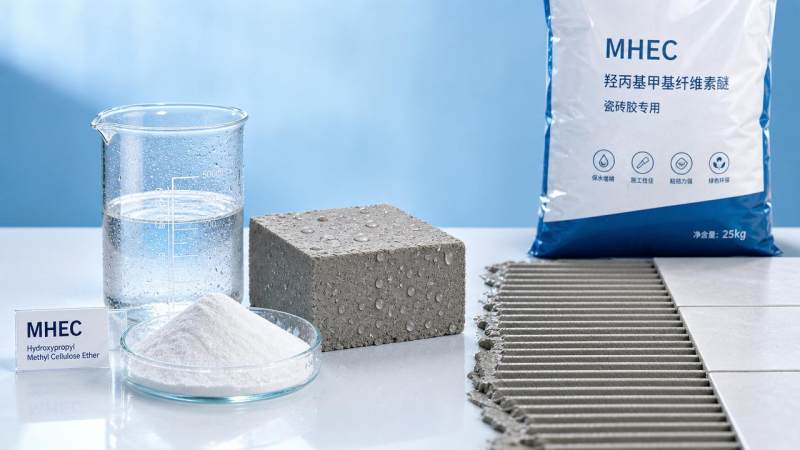
MHEC Water Retention: What to Check First
When water retention in mortar, tile adhesive, or plaster starts to drift, root cause checks must begin before losses escalate.
Methyl Hydroxyethyl Cellulose (MHEC) supports workability, open time, and curing consistency across dry-mix construction chemicals.
Its performance can shift with viscosity, substitution uniformity, dosage, powder compatibility, process water, and storage conditions.
This guide outlines practical first checks for evaluating Methyl Hydroxyethyl Cellulose (MHEC) water retention and reducing formulation risk.
Basic Function of Methyl Hydroxyethyl Cellulose (MHEC)
Methyl Hydroxyethyl Cellulose (MHEC) is a non-ionic cellulose ether used in cement, gypsum, and lime-based systems.
It dissolves in water and builds a hydrated polymer network within the wet mortar matrix.
This network slows water migration into porous substrates and reduces rapid evaporation during early curing.
For construction chemicals, Methyl Hydroxyethyl Cellulose (MHEC) is usually selected by viscosity grade, modification level, and application target.
High water retention helps cement hydration, improves adhesion development, and limits cracking caused by premature water loss.
However, excessive retention can delay setting, reduce early strength, or make finishing less predictable.
The right balance depends on substrate absorption, climate, binder type, filler grading, and total formulation design.
Industry Signals That Require Immediate Review
Water retention problems often appear as field complaints before laboratory data shows a clear deviation.
Early signals should be documented and compared with batch records, raw material lots, and weather conditions.
In many cases, Methyl Hydroxyethyl Cellulose (MHEC) is blamed too quickly.
A disciplined review prevents unnecessary reformulation and supports stable production decisions.
First Check: Viscosity Grade and Test Consistency
Viscosity is usually the first measurable indicator for Methyl Hydroxyethyl Cellulose (MHEC) water retention behavior.
A higher viscosity grade often increases thickening and moisture holding capacity in mortar systems.
Still, viscosity alone cannot fully predict field performance.
Test method, solution concentration, temperature, hydration time, and spindle settings must remain consistent.
- Confirm the declared viscosity range against the incoming inspection record.
- Use the same water temperature during each laboratory comparison.
- Allow complete hydration before reading viscosity results.
- Compare fresh samples with retained reference samples from approved lots.
A sudden viscosity drop may indicate grade mismatch, moisture damage, thermal exposure, or supplier variation.
If viscosity is within range, continue to substitution, particle size, and formulation compatibility checks.
Second Check: Substitution Uniformity and Hydration Behavior
Methyl Hydroxyethyl Cellulose (MHEC) contains methyl and hydroxyethyl groups that influence solubility, gel behavior, and water binding.
Uniform substitution helps the polymer hydrate predictably and disperse evenly in dry-mix systems.
Poor uniformity can cause fisheyes, slow dissolution, inconsistent thickening, or unstable water retention.
Laboratories should observe dispersion quality in clean water and in the actual mortar environment.
- Check whether powder wets uniformly during mixing.
- Record lump formation, delayed thickening, or floating particles.
- Compare mortar consistency after five, ten, and twenty minutes.
- Assess final workability after standard resting time.
These checks connect laboratory observations with site handling behavior.
They also reveal whether Methyl Hydroxyethyl Cellulose (MHEC) is compatible with the selected binder and fillers.
Third Check: Dosage Accuracy and Mixing Sequence
Small dosage changes can strongly affect Methyl Hydroxyethyl Cellulose (MHEC) water retention in cementitious formulations.
Batching errors may occur through scale drift, feeder bridging, poor premixing, or operator adjustments.
A formulation review should compare theoretical dosage, actual weighing data, and finished product performance.
Mixing sequence is equally important because cellulose ether must disperse before rapid hydration begins.
- Verify scale calibration and feeder stability.
- Inspect premix uniformity before adding larger mineral fractions.
- Check whether the cellulose ether is added too late.
- Confirm dry blending time and mixer loading ratio.
When dosage is stable, inconsistent retention often points to raw material interaction rather than weighing error.
Fourth Check: Compatibility With Cement, Gypsum, Fillers, and Polymers
Methyl Hydroxyethyl Cellulose (MHEC) does not work alone in a dry-mix formulation.
Cement alkali level, gypsum purity, limestone grading, sand absorption, and admixture chemistry can change retention behavior.
Fine fillers increase surface area and may demand more water for the same workability target.
Coarser aggregates may reduce cohesion, causing water separation or uneven film formation.
Polymer additives also matter in tile adhesives, skim coats, repair mortars, and insulation systems.
For adhesion and flexibility targets, Redispersible Polymer Powder is often evaluated beside cellulose ether performance.
The combined system should be tested for open time, slip resistance, strength, and curing balance.
Changing one additive without checking the full system can move the failure point elsewhere.
Fifth Check: Storage Conditions and Moisture Exposure
Storage conditions can quietly reduce Methyl Hydroxyethyl Cellulose (MHEC) performance before production begins.
Cellulose ether powder should be protected from humidity, direct heat, broken packaging, and contamination.
Moisture uptake may cause caking, reduced flowability, poor dosing accuracy, and slower dispersion.
Warehouse checks should include pallet position, bag integrity, lot age, and first-in-first-out discipline.
- Keep bags sealed until use.
- Avoid storing cellulose ether against exterior walls.
- Separate damaged bags for inspection.
- Record warehouse temperature and humidity.
- Use retained samples for comparison after complaints.
If storage is uncontrolled, laboratory retesting should precede any large production release.
Application Value in Construction Chemical Control
Reliable Methyl Hydroxyethyl Cellulose (MHEC) water retention improves more than laboratory numbers.
It supports predictable jobsite handling, balanced hydration, bond strength development, and surface quality.
For tile adhesive, good retention helps maintain open time and wetting against ceramic surfaces.
For plaster, it reduces rapid suction on porous substrates and supports smoother finishing.
For masonry mortar, it contributes to cohesion, board life, and consistent placement.
Practical Laboratory and Production Recommendations
A useful review combines chemical data, mortar testing, and process evidence.
Do not rely on a single viscosity number when evaluating Methyl Hydroxyethyl Cellulose (MHEC).
Use a short checklist that can be repeated during incoming inspection and complaint investigation.
- Retest viscosity using the approved internal method.
- Measure mortar water retention under fixed temperature and humidity.
- Compare workability loss at defined time intervals.
- Run a blank formulation without recent raw material changes.
- Check binder and filler lots for absorption differences.
- Confirm packaging, storage, and lot traceability.
Safety and quality teams should also review dust control during handling.
Although cellulose ethers are widely used, fine powders require proper ventilation and personal protection.
Stable handling protects personnel and reduces cross-contamination between additive batches.
Supplier Evaluation and Long-Term Stability
Consistent Methyl Hydroxyethyl Cellulose (MHEC) quality depends on controlled raw materials and stable production technology.
Jinan Ludong Chemical Co., Ltd. focuses on cellulose ether production, trading, and integrated construction chemical services.
Its product portfolio includes HPMC, RDP, HPS, and related solutions for global dry-mix applications.
With automated production lines and annual capacity reaching 45,000 tons, controlled viscosity ranges support diverse formulation needs.
For long-term stability, supplier review should cover certificates, retained samples, batch traceability, and technical response speed.
A qualified supplier should help connect Methyl Hydroxyethyl Cellulose (MHEC) data with real mortar performance.
Action Guide for the Next Investigation
When water retention changes, begin with the simplest evidence.
Check Methyl Hydroxyethyl Cellulose (MHEC) viscosity, dosage, dispersion, storage, and formulation compatibility before changing the recipe.
Then confirm the finding through controlled mortar tests and retained sample comparisons.
This sequence reduces speculation and protects production continuity.
For formulation review, prepare current recipe data, test records, raw material lots, and observed site conditions.
A structured evaluation of Methyl Hydroxyethyl Cellulose (MHEC) helps identify root causes faster and supports safer construction chemical performance.
Send Your Inquiry
We welcome your cooperation and we will develop with you.
