


Using MHEC in Wall Putty Without Sagging
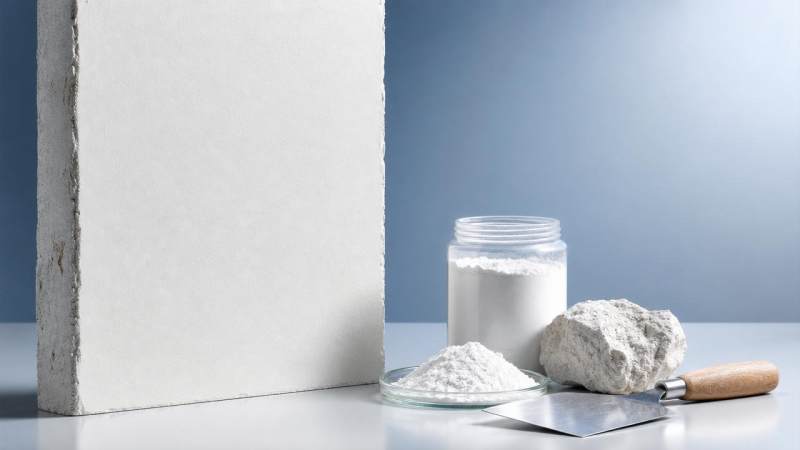
Sagging wall putty can slow application, waste material, and reduce final surface quality on vertical substrates.
Choosing the right cellulose ether is essential for balancing workability, adhesion, open time, and anti-sag stability.
Methyl Hydroxyethyl Cellulose (MHEC) improves water retention and consistency, helping wall putty remain stable during spreading and leveling.
Using Methyl Hydroxyethyl Cellulose (MHEC) in Wall Putty Without Sagging
Wall putty must stay where it is applied, even before cement hydration or binder film formation becomes effective.
If the paste slips downward, applicators need extra correction, and the surface may show waves, thickness marks, or poor sanding behavior.
Methyl Hydroxyethyl Cellulose (MHEC) helps control this risk by building a stable wet structure in the putty matrix.
It increases viscosity, reduces water loss, and supports better particle suspension in cement-based and gypsum-based formulations.
Basic Function of MHEC in Wall Putty
Methyl Hydroxyethyl Cellulose (MHEC) is a non-ionic cellulose ether widely used in dry-mix construction chemicals.
In wall putty, it dissolves after water addition and forms a hydrated polymer network around mineral particles.
This network improves cohesion, delays water evaporation, and makes the fresh mortar easier to apply in thin layers.
The main functions include thickening, water retention, lubrication, open time extension, and improved wet adhesion.
For anti-sag performance, the most important point is the balance between workable flow and standing stability.
A suitable Methyl Hydroxyethyl Cellulose (MHEC) grade allows putty to spread smoothly but resist downward movement after application.
Why Sagging Happens
Sagging usually appears when the wet paste lacks yield value, internal cohesion, or early structural recovery.
High water dosage, low binder content, coarse filler distribution, or unsuitable cellulose ether can increase this problem.
A formulation may feel easy during mixing but become unstable after being placed on a vertical wall.
Methyl Hydroxyethyl Cellulose (MHEC) reduces this gap by improving the paste structure after shear from troweling.
Industry Background and Current Formulation Concerns
Modern wall putty is expected to be smooth, economical, durable, and easy to sand after curing.
At the same time, jobsite conditions vary widely, including temperature, substrate absorption, mixing water, and application thickness.
These variables make the selection of Methyl Hydroxyethyl Cellulose (MHEC) a practical performance decision, not only a cost item.
In many markets, thin-layer finishing has become more demanding because decorative coatings require flatter backgrounds.
This increases attention on additives that stabilize wet mortar without making it sticky or hard to polish.
Application Value in Anti-Sag Wall Putty
The value of Methyl Hydroxyethyl Cellulose (MHEC) is visible during mixing, application, correction, and final surface formation.
During mixing, it helps water distribute uniformly and reduces dry powder lumps when dispersion is properly controlled.
During application, it improves blade glide, allowing the paste to move smoothly under pressure.
After the trowel passes, Methyl Hydroxyethyl Cellulose (MHEC) helps the material rebuild enough structure to prevent sliding.
This recovery behavior is especially important for thicker passes, corners, repair areas, and uneven base walls.
Water Retention and Hydration Support
Wall putty often contains cement, lime, gypsum, calcium carbonate, and other mineral fillers.
If water leaves too quickly, the binder cannot hydrate or form strength under balanced conditions.
Methyl Hydroxyethyl Cellulose (MHEC) slows this water migration, especially on absorbent concrete, plaster, or block substrates.
Better water retention also reduces powdering, weak edges, and premature drying during surface correction.
Consistency and Workability Control
A good anti-sag putty is not simply very thick.
It should spread under shear and then regain stability when the shear force stops.
Methyl Hydroxyethyl Cellulose (MHEC) supports this balance by modifying the rheology of the fresh mix.
The result is cleaner trowel movement, fewer ridges, and less downward flow after placement.
Typical Formulation Scenarios and Material Selection
Different wall putty systems require different viscosity levels, substitution patterns, and dosage ranges.
Selection should consider binder chemistry, filler grading, desired open time, and expected application thickness.
For flexible or adhesion-focused systems, polymer binders may also be used with cellulose ether.
In some powder formulas, Polyvinyl Alcohol can support bonding strength and film-related performance when matched carefully.
The combined system should be tested for spreadability, drying behavior, sanding, and compatibility with Methyl Hydroxyethyl Cellulose (MHEC).
Practical Dosage and Testing Considerations
The dosage of Methyl Hydroxyethyl Cellulose (MHEC) depends on viscosity grade, formulation design, and performance targets.
Typical dry-mix use levels are often low, but small changes can strongly affect application behavior.
Increasing dosage may improve water retention and anti-sag resistance, but excessive addition can create stickiness.
Too much viscosity can also reduce leveling, increase trowel marks, and make sanding less efficient.
- Start with a laboratory benchmark formulation before changing dosage.
- Measure water demand, wet density, pot life, and open time.
- Apply putty on vertical panels at different thicknesses.
- Check sag distance after fixed intervals, such as 5, 15, and 30 minutes.
- Evaluate surface smoothness, adhesion, sanding, and final powder resistance.
Testing should include local raw materials because filler shape and particle size affect the thickening response.
Fine calcium carbonate may require different Methyl Hydroxyethyl Cellulose (MHEC) behavior than a coarser filler blend.
Mixing Method Matters
Even a well-selected additive can perform poorly if dispersion is uneven during dry blending or water mixing.
MHEC should be distributed uniformly with cement, filler, and other powder components before packaging.
During site mixing, water should be added consistently, followed by proper stirring and short standing time.
This allows Methyl Hydroxyethyl Cellulose (MHEC) to hydrate sufficiently and develop stable viscosity.
Common Mistakes That Reduce Anti-Sag Performance
Sagging is often blamed only on cellulose ether, but the full formulation must be reviewed.
Water addition is one of the most frequent causes of inconsistent site performance.
Excess water makes the paste easier to spread at first, but it weakens wet stability.
- Using low-viscosity MHEC where thicker vertical build is required.
- Ignoring substrate absorption and ambient temperature.
- Selecting fillers only by cost, not grading or shape.
- Reducing binder content without adjusting the rheology system.
- Testing only flow on a table, without vertical panel evaluation.
A reliable anti-sag wall putty requires balanced viscosity, sufficient cohesion, and controlled water release.
Methyl Hydroxyethyl Cellulose (MHEC) is central, but it works best inside a complete formulation approach.
Supply Quality and Technical Consistency
Consistent cellulose ether quality is important because viscosity drift can change putty performance from batch to batch.
Key quality factors include viscosity control, moisture level, particle size, purity, and dissolution behavior.
Jinan Ludong Chemical Co., Ltd. focuses on cellulose ether production, trading, and integrated construction chemical services.
Its production capacity supports large-scale supply for HPMC, RDP, HPS, and related dry-mix formulation needs.
With controlled viscosities from 400 to 200,000 CPS, product selection can be aligned with different construction applications.
For wall putty optimization, stable raw material parameters help reduce trial errors and improve production repeatability.
Practical Guidance for Better Wall Putty Results
To use Methyl Hydroxyethyl Cellulose (MHEC) effectively, define the target application thickness before selecting the grade.
For thin finishing coats, smooth trowel feel and surface leveling may be the priority.
For thicker leveling coats, anti-sag resistance and structural recovery become more important.
The best grade is not always the highest viscosity product.
A balanced MHEC grade should maintain workable consistency without excessive stickiness or delayed drying.
- Confirm the substrate type and expected water absorption.
- Select a starting MHEC viscosity based on coat thickness.
- Adjust water dosage through controlled laboratory mixing.
- Run vertical anti-sag testing before field validation.
- Check final sanding and coating compatibility after curing.
When these steps are followed, wall putty can achieve better wet stability, smoother operation, and more uniform finishing quality.
Conclusion and Next Step
Methyl Hydroxyethyl Cellulose (MHEC) is a practical additive for reducing sagging in wall putty systems.
It improves water retention, consistency, open time, and wet structural stability on vertical surfaces.
The most reliable results come from matching the correct grade with binder type, filler design, and application thickness.
For formulation development, compare several MHEC grades under the same water ratio and vertical panel conditions.
A structured trial can quickly identify the best balance between anti-sag performance, workability, adhesion, and final surface quality.
Send Your Inquiry
We welcome your cooperation and we will develop with you.
